
Thoracic Outlet Syndrome: A Comprehensive Review of Diagnosis and Management
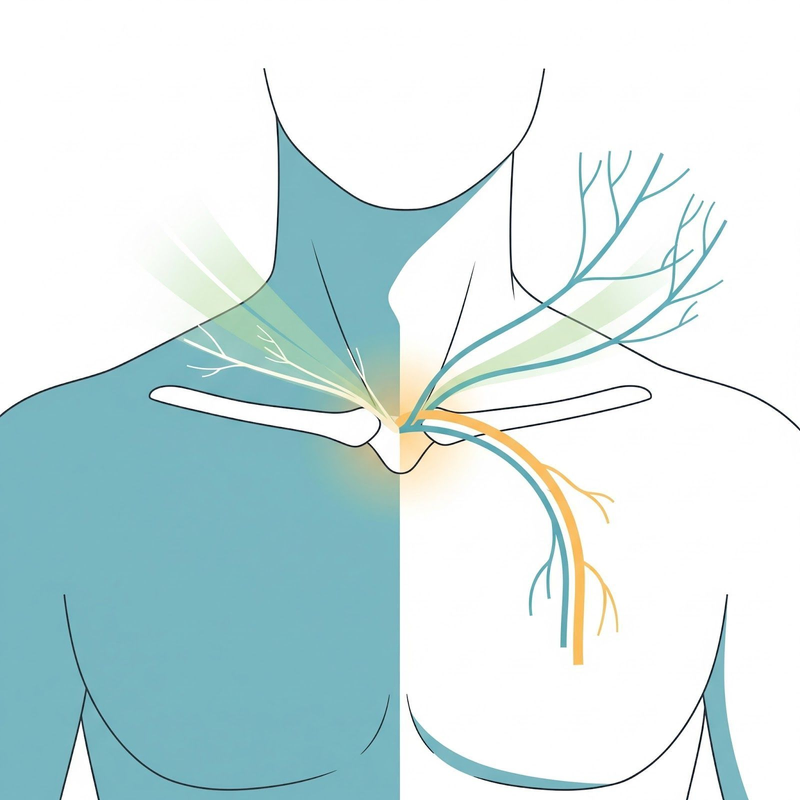
Thoracic outlet syndrome (TOS) is a complex condition involving the compression of nerves, arteries, or veins in the space between the collarbone and first rib, known as the thoracic outlet 1. This compression can lead to a variety of symptoms, including pain, numbness, tingling, and weakness in the neck, shoulder, arm, and hand 1. TOS is classified into three main types: neurogenic (nTOS), venous (vTOS), and arterial (aTOS), depending on the structure compressed 2. nTOS, caused by brachial plexus compression, is the most common type, accounting for approximately 95% of cases 2. vTOS involves compression of the subclavian vein, while aTOS, the rarest type, affects the subclavian artery 2. The diagnosis and management of TOS often require a multidisciplinary approach, involving specialists such as thoracic surgeons, vascular surgeons, neurologists, and rehabilitation specialists 3.
Diagnosis of Thoracic Outlet Syndrome
Diagnosing TOS can be challenging due to the variability of symptoms and the presence of other conditions with similar presentations 4. A thorough evaluation is crucial to accurately diagnose TOS and differentiate it from other conditions like carpal tunnel syndrome, cubital tunnel syndrome, and cervical spine disease 5.
Causes and Risk Factors
TOS can be caused by various factors, including anatomical abnormalities, trauma, repetitive injuries, and certain lifestyle factors 3.
-
Bony factors:
-
Cervical ribs (extra ribs) 3
- Abnormal first ribs 3
-
Soft tissue factors:
-
Anomalous fibrous bands near the brachial plexus 3
- Muscle hypertrophy, often seen in athletes and weightlifters 3
-
Trauma: Trauma and mechanical stress to the neck, shoulders, or upper extremities, especially in combination with an anatomical predisposition like a cervical rib, are major contributors to TOS 3. This can include injuries from car accidents, sports, or work-related activities 4.
-
Repetitive use: Repetitive arm movements, common in certain sports like swimming, baseball, and tennis, can also lead to TOS 3.
-
Other risk factors:
-
Anatomical defects (e.g., cervical rib) 4
- Poor posture 4
- Tumors that press on nerves 4
- Pregnancy 4
- Obesity 4
Anatomy of the Thoracic Outlet
The thoracic outlet is a complex anatomical space where the neurovascular bundle (brachial plexus, subclavian artery, and subclavian vein) passes from the neck to the arm. This bundle can be compressed in three main spaces 3:
- Interscalene triangle: Bordered by the anterior scalene muscle, middle scalene muscle, and first rib.
- Costoclavicular space: Located between the clavicle (collarbone) and first rib.
- Retropectoralis minor space: Situated behind the pectoralis minor muscle.
Compression in any of these spaces can lead to the various symptoms of TOS.
Diagnostic Tests
The diagnostic process for TOS typically involves a combination of the following:
-
Medical History and Physical Examination: A detailed medical history, including symptom onset, characteristics, and aggravating factors, is essential 6. Physical examination focuses on evaluating posture, range of motion, and any signs of TOS, such as tenderness in the neck and shoulder or swelling in the arm 6. Provocative tests, like the upper limb tension test and elevated arm stress test, may be performed to elicit symptoms 2.
-
Imaging Studies:
-
X-ray: Can reveal cervical ribs (extra ribs) or other bony abnormalities 6.
- Ultrasound: Often the first imaging test used to assess blood flow in arteries and veins, aiding in the diagnosis of vTOS and aTOS 6.
- CT scan: Provides detailed cross-sectional images to identify the location and cause of compression 6.
- MRI: Offers a comprehensive view of the thoracic outlet, including soft tissues, and can reveal anatomical variations like fibrous bands 6.
- Arteriography and Venography: Involve injecting a contrast dye into blood vessels to visualize and assess blood flow, particularly helpful in identifying compressed or clotted veins and arteries 6.
-
Electrodiagnostic Studies:
-
Electromyography (EMG): Measures the electrical activity of muscles to determine if muscle weakness is caused by nerve damage 1.
- Nerve Conduction Studies: Evaluate the speed of nerve impulse conduction, helping identify nerve compression or damage 1.
-
Other Tests:
-
Anterior Scalene and Pectoralis Minor Muscle Block: Involves injecting a local anesthetic into these muscles to determine if they are the source of compression 1.
Management of Thoracic Outlet Syndrome
The management of TOS depends on the type, severity of symptoms, and underlying cause. Treatment options range from conservative measures to surgical intervention.
Conservative Treatment Options
Conservative treatment is often the first line of management, especially for nTOS 6. These treatments focus on relieving symptoms, improving posture, and strengthening muscles. They include:
-
Physical Therapy: A cornerstone of conservative treatment, physical therapy focuses on exercises and stretches to strengthen shoulder and neck muscles, improve posture, and increase range of motion 1. Specific exercises may include:
-
Shoulder rolls 9
- Neck tilts 9
- Scapular squeezes 9
- Nerve gliding techniques 9
-
Medications: Various medications can help manage symptoms:
-
NSAIDs: Reduce pain and inflammation 1.
- Muscle Relaxants: Alleviate muscle spasms and pain 1.
- Antidepressants and Anticonvulsants: May be used for pain management 1.
- Blood Thinners: Prescribed for vTOS and aTOS to prevent blood clots 1.
-
Lifestyle Modifications: Certain lifestyle changes can help reduce symptoms:
-
Maintaining good posture: Reduces strain on the thoracic outlet 6.
- Avoiding activities that worsen symptoms: Limits repetitive overhead movements or heavy lifting 2.
- Ergonomic adjustments: Optimizing workspace to promote good posture and reduce strain 6. This may involve adjusting chair height, keyboard position, and monitor placement.
- Weight management: Reduces pressure on the thoracic outlet 6.
-
Injections: Injections of local anesthetics, steroids, or botulinum toxin (Botox) into the affected muscles can provide temporary pain relief and help diagnose TOS 1.
-
Alternative Therapies:
-
Chiropractic care: May help restore normal spinal alignment and function 10.
- Occupational therapy: Assists patients in adapting to their condition and performing daily activities 10.
- Acupuncture: Can provide pain relief 10.
- Massage therapy: May help relax muscles and improve blood flow 10.
-
Orthotic Devices and Ergonomics: Orthotic devices, such as braces or splints, can help support and stabilize the shoulder and improve posture 10. Ergonomics plays a crucial role in managing TOS by optimizing workspace and activity patterns to minimize strain on the thoracic outlet 10.
-
Anti-inflammatory Diet: Some evidence suggests that an anti-inflammatory diet, rich in omega-3 fatty acids and fresh fruits and vegetables, may help reduce chronic pain associated with TOS 10.
Surgical Decompression
Surgical intervention is considered when conservative treatments fail to provide adequate relief or in cases of vTOS and aTOS where there is a risk of vascular complications 6. Thoracic outlet decompression surgery aims to relieve pressure on the nerves and blood vessels by removing or modifying structures that cause compression 11. Surgical approaches vary depending on the type of TOS and the specific anatomical abnormality. Common procedures include:
- First Rib Resection: Removal of the first rib, either partially or completely, to create more space in the thoracic outlet 1. This is often a key component of surgical decompression for TOS.
- Cervical Rib Removal: Excision of an extra rib (cervical rib) if present 1.
- Scalenectomy: Removal of the scalene muscles, which can contribute to compression 1.
- Pectoralis Minor Tenotomy: Release of the pectoralis minor tendon to reduce compression 1.
- Vascular Repair: In vTOS and aTOS, surgical repair of the affected vein or artery may be necessary, including thrombolysis (clot removal), angioplasty (widening of narrowed vessels), or bypass surgery 5.
Surgical Approaches:
- Transaxillary Approach: This approach involves an incision in the armpit. It is often preferred due to better visualization of the first rib and the ability to address the pectoralis minor muscle 14. A unique procedure championed by a UC Davis vascular surgeon utilizes this approach to remove the anterior scalene muscle and first rib 13.
- Supraclavicular Approach: This approach involves an incision above the collarbone 14. It provides good access to the scalene muscles and first rib but requires careful attention to protect the phrenic nerve, long thoracic nerve, and supraclavicular nerves 15.
- Paraclavicular Approach: This approach involves an incision below the clavicle 14. It is less commonly used but may be suitable for certain cases of vTOS.
- Infraclavicular Approach: This approach involves an incision below the clavicle 14. It is also less commonly used.
The choice of surgical approach depends on factors such as the type of TOS, surgeon experience, and patient-specific considerations 14.
Conservative Treatment vs. Surgical Decompression
The decision between conservative treatment and surgery is made based on individual patient needs and the response to initial conservative measures 8. Conservative treatment is generally preferred as the first line of management, especially for nTOS 8. However, surgery may be necessary for patients with persistent symptoms, vascular complications, or those who fail to respond to conservative therapies 6. Surgical treatment for nTOS is generally considered when conservative options fail and the patient experiences significant disability that affects their ability to work or perform daily activities 16.
| Treatment | Advantages | Disadvantages |
|---|---|---|
| Conservative Treatment | Less invasive, lower risk, often effective for nTOS | May not provide complete relief for all patients, may require prolonged therapy |
| Surgical Decompression | Can provide definitive treatment, addresses structural abnormalities | More invasive, longer recovery time, potential surgical complications |
Reviews and Meta-analyses of TOS Treatment
Reviews and meta-analyses of TOS treatment have attempted to evaluate the effectiveness of different approaches. However, there is a lack of consensus on the best conservative treatment protocols, and the indications for surgical treatment are often debated 17. A review by Peek et al. found low-quality evidence comparing transaxillary first rib resection to supraclavicular neuroplasty and no significant benefit of botulinum toxin injections over placebo 18. This highlights the need for further research with higher-quality studies to provide more definitive guidance on TOS treatment.
Long-Term Outcomes of TOS Treatment
Long-term outcomes of TOS treatment vary depending on the type of TOS, the chosen treatment, and individual patient factors. Studies have shown that surgical intervention, particularly first rib resection, can lead to significant improvement in symptoms and quality of life for most patients 19. A study analyzing long-term functional outcomes after first rib resection found that 90% of patients reported improvement in symptoms, with a mean QuickDASH score of 22 (range, 0–86) 19. The QuickDASH score is a validated questionnaire used to assess upper extremity disability and function. However, it's important to note that surgery doesn't guarantee a complete cure, and some patients may experience residual symptoms or recurrence of TOS 18.
Factors that may influence long-term outcomes include:
- Type of TOS: nTOS generally has a better prognosis than vTOS and aTOS 22.
- Severity of symptoms: Patients with more severe symptoms may have less favorable outcomes 22.
- Presence of anatomical abnormalities: Cervical ribs or other anatomical variations can increase the risk of recurrence 22.
- Patient compliance with treatment: Adherence to physical therapy and postoperative instructions is crucial for optimal outcomes 20.
- Overall health and comorbidities: Patients with underlying health conditions may have a higher risk of complications 22.
Long-term follow-up is essential to monitor for recurrence and manage any residual symptoms. Patients should be educated about lifestyle modifications and exercises to maintain good posture and prevent recurrence 18.
Conclusion
Thoracic outlet syndrome is a challenging condition that requires a comprehensive approach to diagnosis and management. Accurate diagnosis involves a thorough medical history, physical examination, and appropriate imaging and electrodiagnostic studies. Treatment options range from conservative measures like physical therapy and medication to surgical decompression. The choice of treatment depends on the type of TOS, severity of symptoms, and individual patient factors. While conservative treatment, particularly physical therapy, is often effective for nTOS, surgery may be necessary for those with persistent symptoms, vascular complications (vTOS and aTOS), or those who fail to respond to conservative therapies.
Early diagnosis and appropriate management are crucial to minimize long-term complications and improve quality of life for individuals with TOS. While long-term outcomes are generally favorable, especially with first rib resection, some patients may experience residual symptoms or recurrence. Factors influencing long-term outcomes include the type of TOS, severity of symptoms, anatomical abnormalities, patient compliance with treatment, and overall health.
Further research is needed to better understand the optimal management strategies for TOS, including the development of standardized conservative treatment protocols, refinement of surgical techniques, and identification of factors that predict treatment success and long-term outcomes. Continued research and advancements in the field will ultimately lead to improved care and outcomes for patients with this complex condition.
Works cited
1. Thoracic Outlet Syndrome - Yale Medicine, accessed February 17, 2025, https://www.yalemedicine.org/conditions/thoracic-outlet-syndrome
2. Thoracic Outlet Syndrome (TOS): Symptoms and Treatment - Cleveland Clinic, accessed February 17, 2025, https://my.clevelandclinic.org/health/diseases/17553-thoracic-outlet-syndrome-tos
3. Thoracic Outlet Syndrome: Practice Essentials, Etiology, Epidemiology, accessed February 17, 2025, https://emedicine.medscape.com/article/96412-overview
4. Thoracic Outlet Syndrome (TOS) - Brigham and Women's Hospital, accessed February 17, 2025, https://www.brighamandwomens.org/lung-center/diseases-and-conditions/thoracic-outlet-syndrome
5. Thoracic Outlet Syndrome | Johns Hopkins Medicine, accessed February 17, 2025, https://www.hopkinsmedicine.org/health/conditions-and-diseases/thoracic-outlet-syndrome
6. Thoracic outlet syndrome - Diagnosis and treatment - Mayo Clinic, accessed February 17, 2025, https://www.mayoclinic.org/diseases-conditions/thoracic-outlet-syndrome/diagnosis-treatment/drc-20353994
7. Diagnosing Thoracic Outlet Syndrome - NYU Langone Health, accessed February 17, 2025, https://nyulangone.org/conditions/thoracic-outlet-syndrome/diagnosis
8. Thoracic Outlet Syndrome Clinic - Johns Hopkins Medicine, accessed February 17, 2025, https://www.hopkinsmedicine.org/heart-vascular-institute/vascular-surgery/thoracic-outlet-syndrome
9. Thoracic Outlet Syndrome Exercises-Tips from TOS Experts, accessed February 17, 2025, https://www.tosmri.com/treatment-of-thoracic-outlet-syndrome/treatment-of-neurogenic-thoracic-outlet-syndrome/conservative-treatment-of-neurogenic-thoracic-outlet-syndrome/thoracic-outlet-syndrome-exercises/
10. Treatment of Neurogenic TOS - NeoVista® MRI for Thoracic Outlet Syndrome, accessed February 17, 2025, https://www.tosmri.com/treatment-of-thoracic-outlet-syndrome/treatment-of-neurogenic-thoracic-outlet-syndrome/
11. Thoracic Outlet Decompression - Tampa General Hospital, accessed February 17, 2025, https://www.tgh.org/institutes-and-services/treatments/thoracic-outlet-decompression
12. Thoracic Outlet Decompression: Types, What to Expect, and More - Healthline, accessed February 17, 2025, https://www.healthline.com/health/thoracic-outlet-decompression
13. Thoracic Outlet Syndrome | Vascular Center - UC Davis Health, accessed February 17, 2025, https://health.ucdavis.edu/vascular/diseases/TOS.html
14. Surgical approaches for thoracic outlet decompression in the treatment of thoracic outlet syndrome - PMC - PubMed Central, accessed February 17, 2025, https://pmc.ncbi.nlm.nih.gov/articles/PMC10797336/
15. Thoracic Outlet Decompression | Surgical Education / Learn Surgery | Washington University in St. Louis, accessed February 17, 2025, https://surgicaleducation.wustl.edu/thoracic-outlet-decompression/
16. Surgery for Thoracic Outlet Syndrome (Obstruction) Treatment & Management, accessed February 17, 2025, https://emedicine.medscape.com/article/462166-treatment
17. Thoracic outlet syndrome: which surgical approach? - Davoli, accessed February 17, 2025, https://ccts.amegroups.org/article/view/38997/html
18. Thoracic Outlet Syndrome Treatment & Management - Medscape Reference, accessed February 17, 2025, https://emedicine.medscape.com/article/96412-treatment
19. Long-Term Functional Outcome of Surgical Treatment for Thoracic Outlet Syndrome - PMC, accessed February 17, 2025, https://pmc.ncbi.nlm.nih.gov/articles/PMC5871990/
20. All about thoracic outlet syndrome (TOS): Recovery and long-term outlook - Mayo Clinic, accessed February 17, 2025, https://www.mayoclinic.org/vid-20567967
21. Long-term outcome of surgery for thoracic outlet syndrome - PubMed, accessed February 17, 2025, https://pubmed.ncbi.nlm.nih.gov/7879844/
22. 17 years' experience of surgical management of thoracic outlet syndrome at a district general hospital - RCSEng, accessed February 17, 2025, https://publishing.rcseng.ac.uk/doi/10.1308/rcsann.2023.0002
