
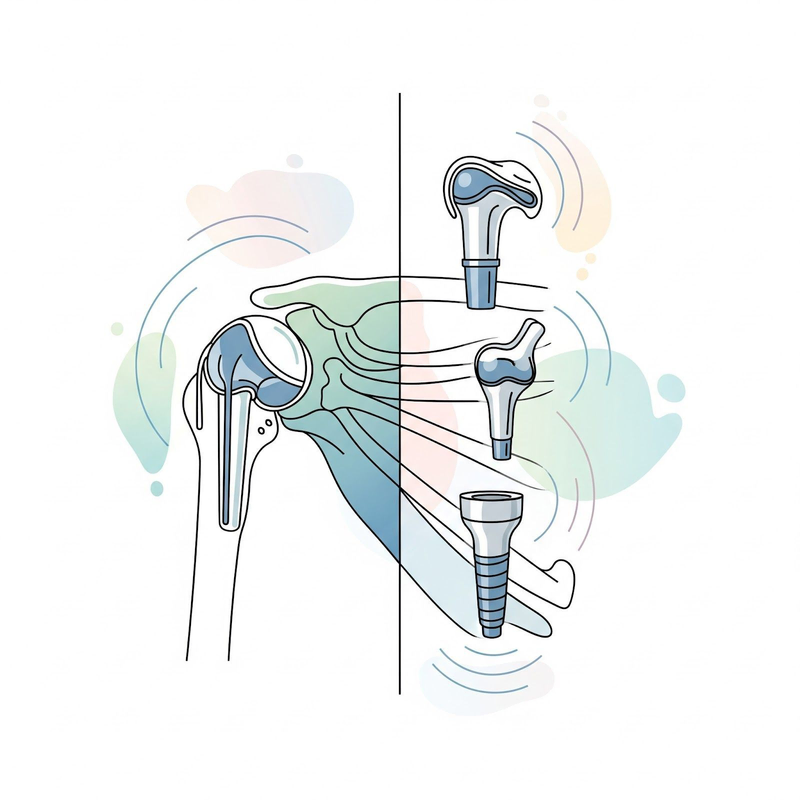
Shoulder Arthroplasty Implants: An Analysis of Types, Indications, and Selection Factors
Shoulder arthroplasty, commonly known as shoulder replacement, is a surgical procedure that involves replacing the damaged parts of the shoulder joint with artificial components called implants. This procedure aims to alleviate pain, restore mobility, and improve the overall quality of life for individuals with severe shoulder conditions.
Historically, shoulder arthroplasty has undergone various stages of development, starting with Dr. Jules Emile Péan's ivory total shoulder in 18931. Since then, significant advancements in materials, designs, and geometries have led to the modern implants used today. This article provides a comprehensive analysis of the different types of shoulder arthroplasty implants available, including anatomical, reverse, and partial replacements. It discusses the indications for each type and explores the factors that influence implant selection, such as patient age, activity level, and glenoid bone quality.
Types of Shoulder Arthroplasty Implants
Shoulder implants are available in a few different shapes and a range of sizes. Replacement options include partial and total using either anatomic or reverse implants2. Conditions that can damage the shoulder joint include:
- Osteoarthritis
- Rotator cuff injuries
- Fractures
- Rheumatoid arthritis and other inflammatory disorders
- Osteonecrosis 2
Depending on the type of joint damage, the following shoulder replacement options may be recommended:
Anatomic Total Shoulder Arthroplasty
Anatomic total shoulder arthroplasty (aTSA) involves replacing both the ball (humeral head) and the socket (glenoid) of the shoulder joint with implants that closely resemble the natural anatomy of the joint2. The aTSA implant typically consists of a metal ball that is attached to the upper arm bone (humerus) and a plastic socket that is fitted into the shoulder blade (scapula). The head of the implant is made of an alloy of cobalt chrome and smaller amounts of other metals or titanium, and the socket is made of high molecular weight polyethylene, which is a type of plastic3.
Currently, surgeons utilize stemless humeral implants if at all possible because they minimize the trauma to the humerus by not entering the humeral canal3. If the quality of the proximal humeral bone is insufficient to allow a stemless implant, then a traditional stemmed humeral component will be utilized3.
Surgeons from the Hospital for Special Surgery designed a special implant called the Comprehensive Primary Shoulder System, with a cobalt-chrome or titanium ball and a titanium stem. The system's specialized ball component creates a new humeral head that conforms to the patient's exact anatomy4.
Reverse Total Shoulder Arthroplasty
Reverse total shoulder arthroplasty (rTSA) is an alternative to aTSA that involves "reversing" the ball-and-socket configuration of the shoulder joint. In rTSA, the artificial ball is attached to the shoulder blade, and the artificial socket is attached to the upper arm bone2. This design allows the deltoid muscle to take over the function of the rotator cuff. The Reverse Shoulder Prosthesis (RSP) was the first reverse shoulder design to successfully incorporate a center of rotation (COR) lateral to the glenoid5. The design of the RSP baseplate provides 2000N of compression between the prosthesis-bone interface, providing stable initial fixation as well as ideal conditions for bony ingrowth for long-term fixation5.
Partial Shoulder Arthroplasty
Partial shoulder arthroplasty, also known as hemiarthroplasty, involves replacing only the ball of the shoulder joint while leaving the socket intact2. This procedure is typically recommended for patients with a severe fracture or arthritic conditions of the shoulder in which only the humeral head or ball of the joint is damaged and the glenoid socket is normal or intact6. This surgery is often chosen in cases of avascular necrosis, a problem of bone death and cartilage collapse seen mainly on the ball side, often in younger patients with healthy glenoid cartilage7.
Indications and Contraindications for Each Type of Implant
The choice of shoulder arthroplasty implant depends on several factors, including the underlying shoulder condition, the extent of joint damage, the patient's age and activity level, and the quality of the glenoid bone. The most common indications for shoulder arthroplasty are osteoarthritis, inflammatory arthritis, proximal humerus fractures, irreparable rotator cuff tears, rotator cuff arthropathy, and avascular necrosis of the humeral head8.
Anatomic Total Shoulder Arthroplasty
aTSA is indicated for patients with end-stage glenohumeral arthritis who have an intact and functional rotator cuff3. This type of implant is designed to restore the normal biomechanics of the shoulder joint and provide pain relief, improved range of motion, and increased strength3.
Contraindications:
- Insufficient glenoid bone stock
- Rotator cuff arthropathy
- Deltoid dysfunction
- Active infection
- Brachial plexus palsy 10
Reverse Total Shoulder Arthroplasty
rTSA is indicated for patients with rotator cuff tear arthropathy, irreparable rotator cuff tears, or failed previous shoulder replacements with rotator cuff deficiency11. This type of implant is designed to provide pain relief and improve shoulder function in patients with compromised rotator cuff muscles11.
Contraindications:
- Good rotator cuff function
- Active infection
- Severe osteoporosis
- Poor general health
- Unrealistic expectations 12
Partial Shoulder Arthroplasty
Partial shoulder arthroplasty is indicated for patients with isolated damage to the humeral head, such as a severe fracture or arthritis, when the glenoid socket is still in good condition6. This procedure is less invasive than total shoulder arthroplasty and may be suitable for younger patients or those with lower functional demands6.
Contraindications:
- Coracoacromial ligament deficiency 14
- Infection
- Neuropathic joint
- Unmotivated patient 14
Factors Influencing Implant Selection
Patient Age
Patient age is an important factor to consider when selecting a shoulder arthroplasty implant. Younger patients tend to be more active and have higher functional demands, which may influence the choice of implant and the surgical approach15. Older patients may have decreased bone density and muscle strength, which may affect the stability and longevity of the implant17. Patient age and baseline platelet count are also considerable influences18.
Activity Level
The patient's activity level is another crucial factor in implant selection. Patients who engage in high-impact activities or have physically demanding jobs may require a more durable implant that can withstand greater stress and wear19. Conversely, patients with lower activity levels may be suitable candidates for less invasive procedures or implants that preserve more bone stock19. The member's deltoid must be intact, and the member must have at least 90 degrees of passive shoulder range of motion (elevation/flexion)21.
Glenoid Bone Quality
The quality of the glenoid bone is essential for the success of shoulder arthroplasty. Adequate bone stock is necessary to ensure secure fixation of the glenoid component22. Patients with significant glenoid bone loss may require specialized implants, such as augmented glenoid components or bone grafting, to achieve stability and prevent implant loosening24. Glenoid deformity has an important effect on outcomes and complication rates after shoulder arthroplasty for primary glenohumeral arthritis. The B2/B3 glenoid has particularly been associated with a poorer outcome with shoulder arthroplasty compared with other glenoid types25. One of the primary challenges is striking a balance between deformity correction and joint line preservation25.
Different types of glenoid components are available, including keeled, pegged, and metal-backed components26. The choice of glenoid component depends on factors such as the amount of bone loss, the desired level of stability, and the surgeon's preference.
Clinical Trials and Studies
Several clinical trials and studies have compared the outcomes of different types of shoulder arthroplasty implants. These studies have provided valuable insights into the effectiveness, longevity, and complications associated with each type of implant.
| Study |
Works cited
1. Common Factors in Shoulder and Hip Arthroplasty Implant Failures: A Historical Review, accessed February 17, 2025, https://www.mdpi.com/2077-0383/13/8/2370
2. Shoulder replacement surgery - Mayo Clinic, accessed February 17, 2025, https://www.mayoclinic.org/tests-procedures/shoulder-replacement/about/pac-20519121
3. Anatomic and Reverse Total Shoulder Replacement - Robert Tashjian, MD, accessed February 17, 2025, https://www.roberttashjianmd.com/anatomic-and-reverse-total-shoulder-replacement-orthopaedics-surgeon-salt-lake-city-ut.html
4. Shoulder Replacement Surgery | HSS Orthopedics, accessed February 17, 2025, https://www.hss.edu/condition-list_shoulder-replacement.asp
5. Reverse Shoulder Prosthesis® (RSP®) - Enovis, accessed February 17, 2025, https://enovis.com/products/surgical/reverse-shoulder-prosthesis-rsp
6. Partial Shoulder Replacement | Advanced Orthopaedics & Sports Medicine, Orthopaedic Specialists, Cypress, Houston, TX, accessed February 17, 2025, https://www.advancedosm.com/partial-shoulder-replacement-orthopaedic-sports-medicine-specialist-cypress-houston-tx/
7. Partial and Total Shoulder Replacement | Summit Health, accessed February 17, 2025, https://www.summithealth.com/partial-and-total-shoulder-replacement
8. Shoulder Arthroplasty, from Indications to Complications: What the Radiologist Needs to Know | RadioGraphics - RSNA Journals, accessed February 17, 2025, https://pubs.rsna.org/doi/abs/10.1148/rg.2016150055
9. Standard (Anatomic) Total Shoulder Replacement | Dr. Gordon Groh, accessed February 17, 2025, https://www.drgordongroh.com/orthopaedic-injuries-treatment/shoulder/standard-total-shoulder-replacement/
10. Total Shoulder Arthroplasty - Shoulder & Elbow - Orthobullets, accessed February 17, 2025, https://www.orthobullets.com/shoulder-and-elbow/3075/total-shoulder-arthroplasty
11. Reverse Total Shoulder Replacement | Johns Hopkins Medicine, accessed February 17, 2025, https://www.hopkinsmedicine.org/health/treatment-tests-and-therapies/reverse-total-shoulder-replacement
12. Reverse Shoulder Replacement | HSS Sports Medicine, accessed February 17, 2025, https://www.hss.edu/conditions_reverse-shoulder-replacement.asp
13. Shoulder hemiarthroplasty (partial replacement) - OrthoVirginia, accessed February 17, 2025, https://www.orthovirginia.com/shoulder-hemiarthroplasty-partial-replacement/
14. Shoulder Hemiarthroplasty - Shoulder & Elbow - Orthobullets, accessed February 17, 2025, https://www.orthobullets.com/shoulder-and-elbow/3074/shoulder-hemiarthroplasty
15. Effect of Age on Outcomes of Shoulder Arthroplasty - PMC, accessed February 17, 2025, https://pmc.ncbi.nlm.nih.gov/articles/PMC5499606/
16. Evaluating the effects of age on the long-term functional outcomes following anatomic total shoulder arthroplasty, accessed February 17, 2025, https://pmc.ncbi.nlm.nih.gov/articles/PMC10497918/
17. The Impact of Age on Reverse Shoulder Joint Replacement Outcomes, accessed February 17, 2025, https://www.jointinstitutefl.com/2024/05/17/the-impact-of-age-on-reverse-shoulder-joint-replacement-outcomes/
18. Identifying the Patient, Disease, Surgical and Implant Positional Factors that Predict Outcomes Following Total Shoulder Arthroplasty - Consult QD, accessed February 17, 2025, https://consultqd.clevelandclinic.org/identifying-the-patient-disease-surgical-and-implant-positional-factors-that-predict-outcomes-following-total-shoulder-arthroplasty
19. A Medical Professional's Resource: Shoulder Replacement for Treatment of Glenohumeral Arthritis in Younger Patients - Brown University Health, accessed February 17, 2025, https://www.brownhealth.org/centers-services/total-joint-replacement/surgical-specialties/medical-resource
20. Return to sports after shoulder arthroplasty - PMC, accessed February 17, 2025, https://pmc.ncbi.nlm.nih.gov/articles/PMC5027006/
21. Shoulder Arthroplasty and Arthrodesis - Medical Clinical Policy Bulletins | Aetna, accessed February 17, 2025, https://www.aetna.com/cpb/medical/data/800_899/0837.html
22. Glenoid bone loss in shoulder arthroplasty: a narrative review - PMC - PubMed Central, accessed February 17, 2025, https://pmc.ncbi.nlm.nih.gov/articles/PMC10929280/
23. Glenoid Component Failure in Total Shoulder Arthroplasty - UW Orthopaedic Surgery and Sports Medicine, accessed February 17, 2025, https://orthop.washington.edu/sites/default/files/Portals/21/www/Research/Publications/The%20Journal%20of%20Bone%20and%20Joint%20Surgery%20%28JBJS%29/Glenoid%20Component%20Failure%20in%20Total%20Shoulder%20Arthroplasty%20%28Frederick%20Matsen%29.pdf
24. The glenoid in shoulder arthroplasty - Dr. Eric Strauss, accessed February 17, 2025, https://www.sportssurgerynewyork.com/articles/the-glenoid-shoulder-arthroplasty.pdf
25. Considerations for Shoulder Arthroplasty Implant Selection in Primary Glenohumeral Arthritis With Posterior Glenoid Deformity - PubMed, accessed February 17, 2025, https://pubmed.ncbi.nlm.nih.gov/36027046/
26. Implant selection for successful reverse total shoulder arthroplasty - PMC - PubMed Central, accessed February 17, 2025, https://pmc.ncbi.nlm.nih.gov/articles/PMC10030993/
