
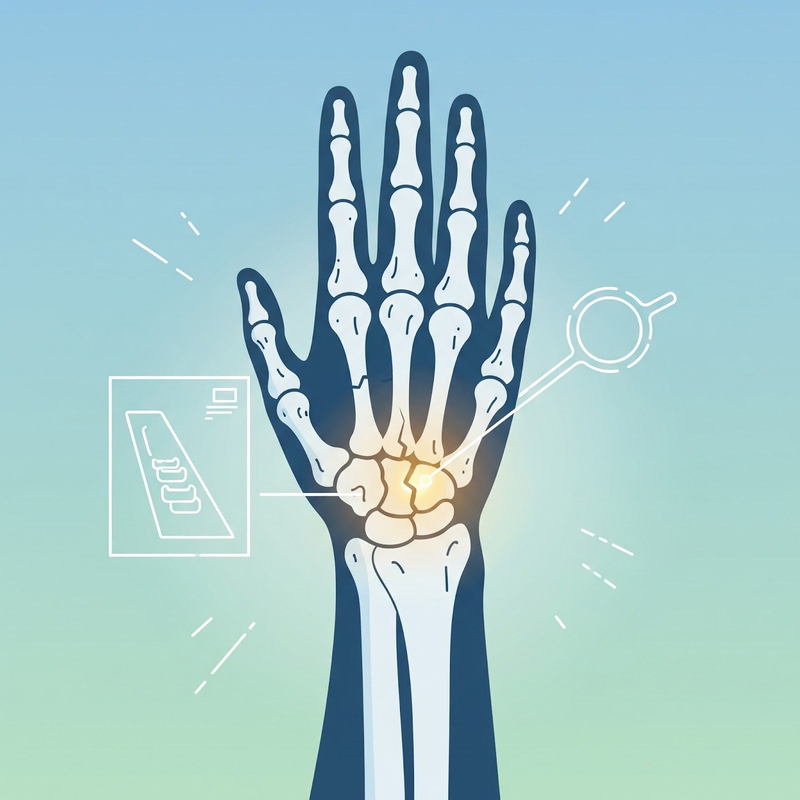
Scaphoid Fracture: Diagnosis, Management, and the Importance of Prompt Treatment
Scaphoid fractures are the most common carpal bone fractures, representing 60-70% of all carpal bone fractures and 2-7% of all fractures1. In the United States, the incidence rate is 1.47 per 100,000 person-years2. They typically occur in young, active individuals, with a higher incidence in males1. These fractures are often missed during initial clinical and radiographic examinations, potentially leading to misdiagnosis as a simple wrist sprain1. This misdiagnosis can have significant consequences, as the risk of nonunion is high, ranging from 14% to 50% in displaced fractures1. If left untreated, nonunion can lead to complications such as arthritis, deformity, and instability, which invariably develop within five years, resulting in significant disability and long-term morbidity1. This article provides a comprehensive analysis of the diagnosis and management of scaphoid fractures, emphasizing the risk of nonunion and the importance of prompt treatment.
Anatomy and Mechanism of Injury
The scaphoid is the largest of the eight carpal bones, located on the thumb side of the wrist1. It plays a crucial role in wrist stability and motion. The blood supply to the scaphoid predominantly originates from the dorsal carpal branch of the radial artery, entering the bone distally and flowing retrograde towards the proximal pole1. This unique blood supply pattern makes the proximal pole particularly vulnerable to avascular necrosis (AVN) when a fracture occurs.
The most common mechanism of injury is a fall onto an outstretched hand (FOOSH), with the wrist in hyperextension and radial deviation1. This forceful impact causes the scaphoid to compress against the dorsal rim of the radius, leading to a fracture. Other causes include contact sports and road traffic accidents1.
Types of Scaphoid Fractures
Scaphoid fractures are classified based on various factors, including location, stability, and fracture pattern. The following table summarizes the three main classification systems:
| Classification System | Fracture Type | Description |
|---|---|---|
| Mayo Classification 3 | Middle third fractures (70%) | Occur at the waist of the scaphoid |
| Distal third fractures (20%) | Involve the distal pole, including the tubercle and articular surface. Distal pole fractures are further classified by the Prosser classification into: Type I (tuberosity fractures), Type II (distal intra-articular fractures), and Type III (osteochondral fractures)4. | |
| Proximal third fractures (10%) | Affect the proximal pole, which has a limited blood supply and is prone to AVN | |
| Herbert Classification 5 | Type A: Stable, acute fractures | Include tubercle fractures (A1) and incomplete waist fractures (A2) |
| Type B: Unstable, acute fractures | Include distal oblique fractures (B1), complete waist fractures (B2), proximal pole fractures (B3), transscaphoid perilunate dislocation fractures (B4), and comminuted fractures (B5) | |
| Type C: Delayed union | ||
| Type D: Established nonunions | Can be further classified as fibrous (D1) or sclerotic (D2) | |
| Russe Classification 6 | Type I | Horizontal oblique fracture line |
| Type II | Transverse fracture line | |
| Type III | Vertical oblique fracture line |
It's important to note the relationship between fracture location and the risk of AVN and nonunion. Proximal pole fractures, due to their precarious blood supply, are particularly susceptible to these complications4.
Diagnosis
Early and accurate diagnosis of scaphoid fractures is crucial for preventing nonunion and long-term complications. Misdiagnosis or delayed treatment can significantly increase the risk of nonunion and associated problems1. However, diagnosis can be challenging due to the often subtle nature of these fractures.
Clinical Presentation
Patients with scaphoid fractures typically present with wrist pain following a fall onto an outstretched hand1. The pain is often localized to the radial side of the wrist and exacerbated by movement1. Symptoms often include: 1
- Pain
- Swelling
- Limited range of motion
Tenderness is usually present in specific locations depending on the fracture location: 1
- Anatomical snuffbox for waist fractures
- Volar prominence at the distal wrist for distal pole fractures
- Distal to Lister's tubercle for proximal pole fractures
Imaging Techniques
Several imaging techniques are used in the diagnosis of scaphoid fractures:
- X-rays: The initial radiographic evaluation includes a dedicated scaphoid series with four projections: posteroanterior (PA), lateral, semi-pronated oblique, and scaphoid views8. However, X-rays may miss up to 20% of fractures in the acute setting8. If initial X-rays are negative but clinical suspicion remains high, repeat X-rays after 7-10 days or advanced imaging is recommended8. It's important to note that a scaphoid fracture may not show up on initial X-rays, and follow-up X-rays after 2-3 weeks may be necessary9.
- CT scan: CT scans are useful when plain films are normal or inconclusive8. They provide detailed images of the bone and can detect some fractures with minimal displacement1. CT is also helpful for staging fractures, assessing bone union, and evaluating carpal instability8. CT scans have a reported sensitivity of 89-90% and a specificity of 85-100%10.
- MRI: MRI is considered the most sensitive imaging modality for detecting scaphoid fractures, especially occult fractures not visible on X-rays11. It can also assess the vascularity of the proximal pole, which is crucial for determining treatment and prognosis11. The American College of Radiology (ACR) recommends MRI as the best second-line investigation for scaphoid fractures11. Early MRI has been shown to have advantages, including reduced immobilization time and a faster return to work11.
- Bone scan: Bone scans are highly sensitive but less specific than MRI8. They are usually reserved for patients with persistent pain despite normal serial plain films8.
- Sonography: While not as commonly used, sonography can also be used in the diagnosis of scaphoid fractures. It can detect cortical disruptions, providing evidence of a fracture8.
Management
The management of scaphoid fractures depends on various factors, including fracture location, displacement, stability, and patient factors. Treatment options can be broadly categorized as non-surgical and surgical.
Non-surgical Treatment
Non-surgical treatment is typically reserved for stable, non-displaced fractures13. This involves immobilization with a cast or splint for a period of 4 to 12 weeks, depending on the fracture location13. Cast immobilization promotes natural healing by stabilizing the fractured bone and restricting movement14. Different types of casts are used, including: 13
- Forearm cast with thumb spica
- Above-elbow cast
The type of cast and duration of immobilization vary depending on the fracture location and individual patient needs13. One study showed that a supportive bandage, compared to a below-elbow cast, decreased immobilization time and absence from work without negatively impacting fracture healing15.
Surgical Treatment
Surgical treatment 1 is often recommended for:
- Unstable fractures
- Displaced fractures
- Proximal pole fractures
- Fractures with associated carpal instability
The goal of surgery is to achieve anatomical reduction and stable fixation of the fracture, promoting healing and preventing nonunion16. Surgical options include:
- Percutaneous screw fixation: This minimally invasive technique involves inserting a screw across the fracture site through a small incision4. It is often preferred for less displaced fractures.
- Open reduction and internal fixation (ORIF): This involves making an incision to directly visualize and reduce the fracture, followed by fixation with screws or plates4. It is typically used for more complex or displaced fractures.
- Bone grafting: Bone grafting may be necessary for nonunions or fractures with AVN16. It involves transplanting healthy bone tissue to the fracture site to stimulate healing.
Risk of Nonunion
Nonunion is a significant complication of scaphoid fractures, occurring when the fractured bone fails to heal4. Several factors contribute to the risk of nonunion, including:
- Fracture location: Proximal pole fractures have the highest risk of nonunion due to their limited blood supply4.
- Fracture displacement: Displaced fractures are more likely to disrupt blood flow and have a higher risk of nonunion1.
- Delayed diagnosis and treatment: Delays in diagnosis and treatment can significantly increase the risk of nonunion1.
- Smoking: Smoking impairs bone healing and increases the risk of nonunion17.
- Patient factors: Age, overall health, and compliance with treatment can also influence the risk of nonunion.
- Degree of fracture displacement: The greater the displacement, the higher the risk of nonunion18.
- Presence of scaphoid AVN: AVN further compromises the blood supply and increases the risk of nonunion18.
Spontaneous union of scaphoid fractures, while rare, has been reported, typically occurring in children17.
Complications of Nonunion
Scaphoid nonunion can lead to several complications, including:
- Avascular necrosis (AVN): AVN occurs when the blood supply to the proximal pole is disrupted, leading to bone death4. It can cause pain, weakness, and eventual collapse of the bone.
- Scaphoid nonunion advanced collapse (SNAC): SNAC is a progressive degenerative condition that develops in untreated scaphoid nonunions17. It leads to wrist instability, deformity, and arthritis. The most common carpal instability pattern is scapholunate dissociation10.
- Osteoarthritis: Nonunion can disrupt the normal mechanics of the wrist, leading to abnormal wear and tear and eventually osteoarthritis19. This can cause pain, stiffness, and decreased range of motion.
Importance of Prompt Treatment
Prompt diagnosis and treatment of scaphoid fractures are essential to minimize the risk of nonunion and long-term complications. Early intervention, whether surgical or non-surgical, aims to stabilize the fracture, promote healing, and restore wrist function20. Delays in treatment can lead to increased healing time, higher nonunion rates, and a greater likelihood of developing AVN and osteoarthritis21. Recovery time for scaphoid fractures can vary depending on factors such as the severity of the fracture, the individual's age, and whether they smoke20.
Guidelines for Management
Several medical societies and organizations provide guidelines for the management of scaphoid fractures. These guidelines emphasize the importance of early diagnosis, appropriate imaging, and individualized treatment based on fracture characteristics and patient factors22. Some key recommendations include:
- In cases of suspected scaphoid fracture where initial radiographs are negative, a supplementary MRI or CT should be carried out within 3-5 days22.
- Fracture classification, assessment of dislocation, and evaluation of fracture healing are best done on CT with reconstructions in the coronal and sagittal planes, following the longitudinal axis of the scaphoid22.
Synthesis
Scaphoid fractures are common wrist injuries that require prompt and accurate diagnosis and management to prevent long-term complications. These fractures often occur due to falls onto an outstretched hand and can be challenging to diagnose due to their subtle presentation on initial X-rays. Advanced imaging techniques like CT scans and MRI play a crucial role in confirming the diagnosis and assessing fracture characteristics. Treatment strategies range from non-surgical immobilization with casts or splints for stable fractures to surgical interventions like percutaneous screw fixation, ORIF, and bone grafting for unstable or displaced fractures.
A significant concern in scaphoid fracture management is the risk of nonunion, which can lead to complications such as avascular necrosis, scaphoid nonunion advanced collapse (SNAC), and osteoarthritis. These complications can cause chronic pain, wrist instability, and decreased range of motion, ultimately affecting an individual's quality of life. Therefore, early diagnosis and prompt treatment are paramount in ensuring optimal outcomes and minimizing the long-term consequences of scaphoid fractures. Adherence to established guidelines and individualized treatment plans based on fracture characteristics and patient factors are essential for successful management.
Works cited
1. Scaphoid Wrist Fracture - StatPearls - NCBI Bookshelf, accessed February 17, 2025, https://www.ncbi.nlm.nih.gov/books/NBK536907/
2. Bilateral Scaphoid Fractures: A Systematic Literature Review - PMC, accessed February 17, 2025, https://pmc.ncbi.nlm.nih.gov/articles/PMC11051215/
3. Mayo classification of scaphoid fractures | Radiology Reference Article | Radiopaedia.org, accessed February 17, 2025, https://radiopaedia.org/articles/mayo-classification-of-scaphoid-fractures?lang=us
4. Treatment of Scaphoid Fractures and Nonunions - PMC, accessed February 17, 2025, https://pmc.ncbi.nlm.nih.gov/articles/PMC4405116/
5. Classifications for fractures of carpal bones - AO Surgery Reference, accessed February 17, 2025, https://surgeryreference.aofoundation.org/orthopedic-trauma/adult-trauma/carpal-bones/further-reading/classifications-for-fractures-of-carpal-bones
6. Scaphoid Fracture - Hand - Orthobullets, accessed February 17, 2025, https://www.orthobullets.com/hand/6034/scaphoid-fracture
7. Scaphoid Fracture Nonunion - Hand - Orthobullets, accessed February 17, 2025, https://www.orthobullets.com/hand/422868/scaphoid-fracture-nonunion
8. Scaphoid fracture | Radiology Reference Article | Radiopaedia.org, accessed February 17, 2025, https://radiopaedia.org/articles/scaphoid-fracture?lang=us
9. Scaphoid Fracture of the Wrist - OrthoInfo - AAOS, accessed February 17, 2025, https://orthoinfo.aaos.org/en/diseases--conditions/scaphoid-fracture-of-the-wrist/
10. Scaphoid Fracture Imaging: Practice Essentials, Radiography, Computed Tomography, accessed February 17, 2025, https://emedicine.medscape.com/article/397230-overview
11. The role of magnetic resonance imaging in the evaluation of scaphoid fractures - PMC, accessed February 17, 2025, https://pmc.ncbi.nlm.nih.gov/articles/PMC6399182/
12. Utilising magnetic resonance imaging as the gold standard in management of suspected scaphoid fractures in the emergency department setting - Irish Medical Journal, accessed February 17, 2025, https://imj.ie/utilising-magnetic-resonance-imaging-as-the-gold-standard-in-management-of-suspected-scaphoid-fractures-in-the-emergency-department-setting/
13. Conservative interventions for treating scaphoid fractures in adults ..., accessed February 17, 2025, https://pmc.ncbi.nlm.nih.gov/articles/PMC6513536/
14. Treatments for Scaphoid Fracture Nonunion - The Institute for Advanced Reconstruction, accessed February 17, 2025, https://www.advancedreconstruction.com/hand-upper-extremity/what-we-treat/scaphoid-fracture-nonunion/
15. Clinically SUspected ScaPhoid fracturE: treatment with supportive bandage or CasT? 'Study protocol of a multicenter randomized controlled trial' (SUSPECT study) | BMJ Open, accessed February 17, 2025, https://bmjopen.bmj.com/content/10/9/e036998
16. Scaphoid Fracture Treatment Louisville | Avascular Necrosis Treatment KY, accessed February 17, 2025, https://www.orthopedicandsportsspecialists.com/scaphoid-fracture-andrew-louis-degruccio-md.html
17. Spontaneous union of neglected proximal pole scaphoid fracture: A case report - Journal of Musculoskeletal Surgery and Research, accessed February 17, 2025, https://journalmsr.com/spontaneous-union-of-neglected-proximal-pole-scaphoid-fracture-a-case-report/
18. Treatment of failed scaphoid nonunion fixation using free medial femoral condyle vascularized bone grafting | SICOT-J, accessed February 17, 2025, https://www.sicot-j.org/articles/sicotj/full_html/2023/01/sicotj230008/sicotj230008.html
19. Scaphoid Injuries and Conditions (Wrist Injuries) - HSS, accessed February 17, 2025, https://www.hss.edu/condition-list_scaphoid-injuries-wrist-pain.asp
20. Scaphoid fracture: Treatment, symptoms, and recovery - MedicalNewsToday, accessed February 17, 2025, https://www.medicalnewstoday.com/articles/scaphoid-fracture
21. Scaphoid Fracture - Access Ortho, accessed February 17, 2025, https://www.accessortho.com.au/scaphoid-fracture/
22. Acute scaphoid fractures: guidelines for diagnosis and treatment - PMC - PubMed Central, accessed February 17, 2025, https://pmc.ncbi.nlm.nih.gov/articles/PMC7047900/
23. Scaphoid fractures - The British Society for Surgery of the Hand, accessed February 17, 2025, https://www.bssh.ac.uk/_userfiles/pages/files/professionals/Trauma%20standards/Scaphoid%20standards.pdf
