
Robotic-Assisted Hip Arthroplasty: A Comprehensive Analysis of Outcomes, Cost-Effectiveness, and Learning Curves Compared to Traditional Techniques
Introduction
Total hip arthroplasty (THA) is a common surgical procedure for end-stage hip osteoarthritis. It reliably decreases pain and improves function and quality of life in patients with advanced hip disease at up to 25–30 years of follow-up 1. While traditional THA techniques have demonstrated satisfactory long-term outcomes, with almost 60% of hip replacements lasting for 25 years 2, ongoing efforts focus on optimizing surgical outcomes and minimizing complications such as intraoperative fracture, hip instability, and leg length discrepancy (LLD) 2. The recent resurgence in popularity of the anterior approach has resulted in faster recovery compared with the more commonly used posterior approach 3. This difference was demonstrated at six weeks post-operation but had diminished by the three-month follow-up 3.
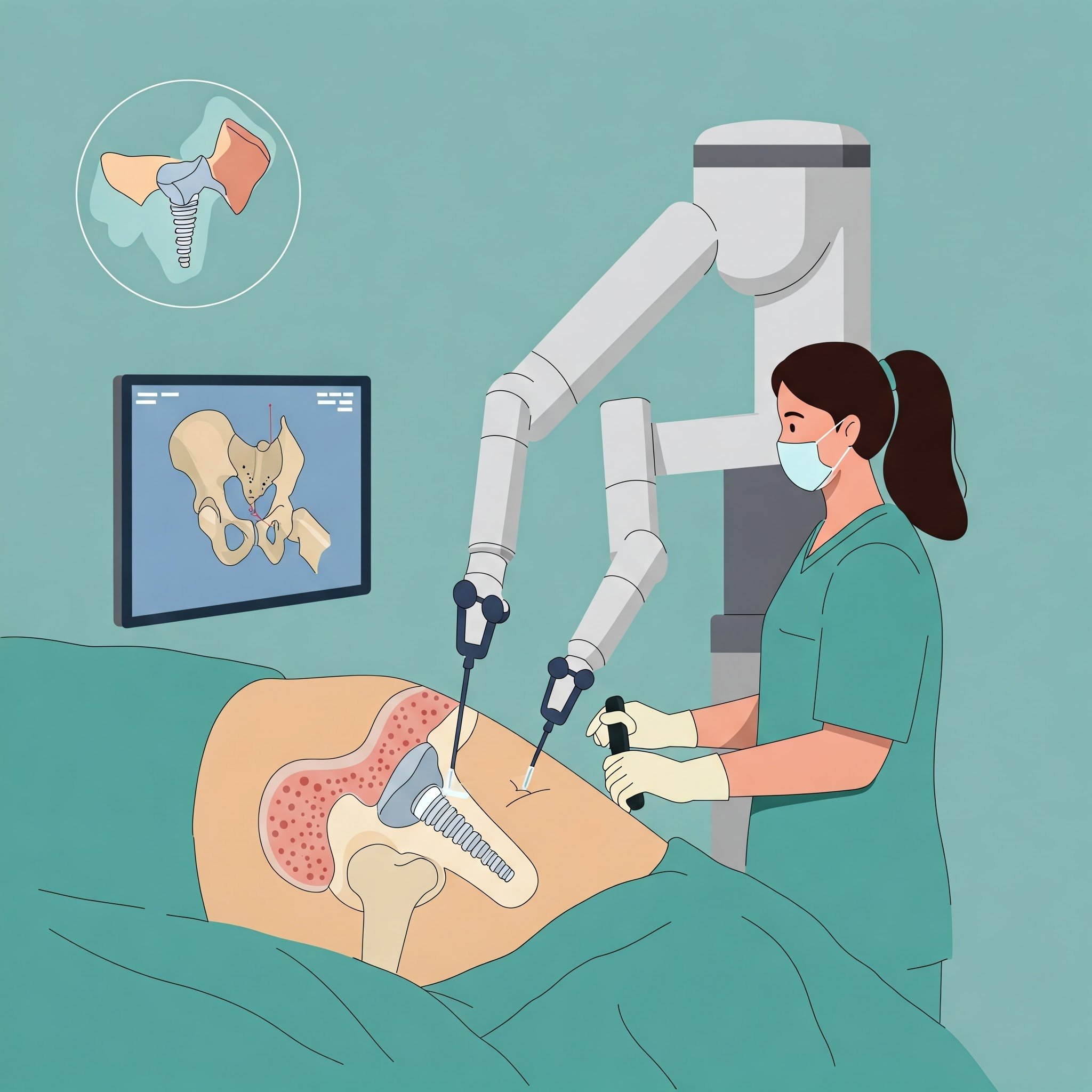
Robotic-assisted THA (RATHA) has emerged as a technology with the potential to enhance surgical accuracy and precision, though further research is needed to confirm its long-term benefits 2. One of the more recent developments in the field of RATHA was the introduction of the MAKO Robotic Arm Interactive Orthopedic System 5. Like other robotic-assisted systems, MAKO uses a robotic arm guided by a 3D computer model derived from a CT scan 5. The acetabulum and femur are registered using intraoperative checkpoints, which allows for a real-time model that guides navigation for acetabular reaming and implant placement 5. Unlike other systems, the robotic arm of the MAKO system is not fully automated and is instead based on haptic feedback technology 5. The surgeon retains partial control of the robotic arm during implantation 5. If the surgeon deviates from the boundaries of the surgical plan, the robotic arm provides tactile resistance 5. Further deviation will trigger an audio alert and shut down the robotic arm 5. Thus, MAKO's navigation system uses a collaboration of user input and robotic guidance rather than an automated execution of the surgical plan 5.
This article provides a comprehensive analysis of the peer-reviewed literature on RATHA, comparing its outcomes, cost-effectiveness, and learning curves to traditional THA techniques. Additionally, we discuss the role of patient-specific instrumentation (PSI) and its impact on accuracy and complications in RATHA. To provide context for this discussion, it is important to understand the history and evolution of THA. The use of hip implants in member countries of the Organization of Economic Co-operation and Development will increase from 1.8 million per year in 2015 to 2.8 million in 2050 6. Total hip arthroplasty (THA) for end-stage osteoarthritis is one of the most effective surgical treatments in medicine 7. Impressive outcomes have been well documented in the literature with patients gaining ambulation and recovery of hip joint function 7. THA reliably decreases pain and improves function and quality of life in patients with advanced hip disease at up to 25–30 years of follow-up 1.
Advantages and Disadvantages of Robotic-Assisted Hip Arthroplasty
Based on the available evidence, RATHA offers several potential advantages over traditional THA techniques:
| Advantages of RATHA | Disadvantages of RATHA |
|---|---|
| * Enhanced surgical planning: RATHA allows for more precise preoperative planning and intraoperative execution, potentially leading to improved implant positioning and alignment 8. * Greater precision: The robotic arm assists in achieving greater precision in tissue removal and implant placement, potentially reducing the risk of complications 8. * Optimal joint alignment: RATHA may facilitate optimal joint alignment, potentially leading to a more natural-feeling joint replacement and reduced wear on the implant 8. * Reduced LLD: Studies suggest that RATHA may result in lower LLD compared to traditional THA 2. * Cost-effectiveness: Some studies indicate that RATHA may be more cost-effective than traditional THA in the long term 9. |
* Increased operative time: RATHA may be associated with longer surgical times compared to traditional THA 4. * Learning curve: Surgeons may require a modest learning curve to become proficient with RATHA, potentially leading to increased operative time initially 11. * Cost: The initial cost of robotic systems can be high, potentially limiting access to this technology 12. * Limited evidence: While the available evidence suggests potential benefits of RATHA, more high-quality studies with long-term follow-up are needed to confirm these findings 13. |
Outcomes of Robotic-Assisted vs. Traditional Hip Arthroplasty
Several studies have investigated the outcomes of RATHA compared to traditional THA. A systematic review and meta-analysis of eight randomized controlled trials (RCTs) involving 1014 patients found no significant difference in major complication rates, revision rates, or patient-reported outcome measures (PROMs) between RATHA and traditional THA 2. However, it is important to acknowledge the lack of long-term outcomes data for RATHA and that a conclusive clinical perspective has yet to be achieved 5. Most combined estimates had low certainty of evidence mainly due to risk of bias, inconsistency, and imprecision 2. Based on the current evidence, there is no important difference in clinical and functional outcomes between RATHA and traditional THA 2. The trivial higher radiological accuracy was also unlikely to be clinically meaningful 2. Regardless, more robust evidence is needed to improve the quality and strength of the current evidence 2.
Another systematic overview of meta-analyses, which included 15 comparative studies with a total of 4824 hips, suggested that RATHA improves component placement and reduces intraoperative complications compared to traditional THA 4. However, RATHA was associated with longer surgical times and an increased risk of postoperative heterotopic ossification, dislocation, and revision 4.
Radiological Outcomes
Accuracy of implant placement, as assessed radiographically, is a key point in the analysis of RATHA outcomes 14. More accurate acetabular component positioning reduces the risk of dislocation and ultimately revision 14. Surgeons use preoperatively determined “safe zones”, as defined by either Lewinnek et al. (inclination 10–30 degrees; anteversion 5–25 degrees) or Callanan et al. (inclination 30–45 degrees; anteversion 5–25 degrees) 14. Emara et al. described in their systematic review that robotic THA had superior acetabular cup positioning within both Lewinnek's and Callanan's safe zones in the 10 studies they reviewed 14. Additionally, Chen et al., in a meta-analysis primarily assessing complications post-robotic THA, found more accurate acetabular cup placement in the robotic cohort, which they perceived to be advantageous towards less experienced surgeons, as the robotic systems allows the surgeon to assess cup placement intra-operatively 14.
Heterotopic ossification (HO) is a post-THA finding that describes abnormal bone growth around soft tissues, conferring increased joint stiffness and reduced movement 14. Chen et al.'s meta-analysis found higher HO rates post-robotic THA; however, Han et al.'s meta-analysis (with the difference between the two being the inclusion of Honl et al.'s prospective study that demonstrated equivocal HO rates) found no significant difference between the robotic and conventional cohorts 14. It is important to note that all observed studies were based on the ROBODOC system 14. Given HO is attributed to muscle trauma, it was initially expected that this should be lower in a robotic THA cohort 14. However, with a more accurate robotic-guided resection, the ROBODOC system requires greater soft tissue exposure for pin placement which may contribute 14.
LLD of varying degrees is relatively common post-THA and is one the leading causes of legal action against orthopedic surgeons 14. It is generally accepted that the patient will be cognizant of the discrepancy if shortening is >10 mm or lengthening is >6 mm 14. Several studies have reported on the resulting LLD between conventional and robotic THA 14. Clement et al. showed significance in restoration of leg length in a robotic treatment arm 14. In nine studies reviewed in their meta-analysis, Kumar et al. showed a statistically significant reduction in LLD in the robotic THA cohort 14. Conversely, Domb et al., in a comparative analysis of 1980 hips managed with one of six surgical techniques, including robotic-guided anterior and posterior THA, conventional and navigation and fluoroscopic-guided THA, demonstrated rates of LLD to be comparable across all treatment arms, and within an acceptable range 14. Emara et al. found in their meta-analysis robotic THA to have a significantly lower LLD across nine studies 14.
Functional Outcomes
In terms of pain, function, and complications, the evidence is mixed 14. Some studies suggest that RATHA may offer mild improvements in post-surgical recovery and better long-term results 14, while others report no significant difference in functional outcomes between RATHA and traditional THA 14. Patient-reported function, global health, and pain were systematically collected preoperatively and at 1, 3, and 6 months postoperatively from patients undergoing primary THA at 26 sites participating in the Comparative Effectiveness of Pulmonary Embolism Prevention After Hip and Knee Replacement 15. Outcomes consisted of the brief Hip disability and Osteoarthritis Outcome Score, the Patient-Reported Outcomes Measurement Information System Physical Health score, and the Numeric Pain Rating Scale 15.
Complications
Studies on complications have also yielded inconclusive results, with some suggesting higher rates of heterotopic ossification with RATHA 14 and others suggesting no difference 14. However, there is evidence to suggest that RATHA may be associated with lower blood loss 14. A major concern about the use of robotics in THA is the potential for perioperative complications 5. Robotics in THA may help reduce the risk of intraoperative fracture 5. Studies show that robotic THA has a lower rate of complications 5.
Cost-Effectiveness of Robotic-Assisted vs. Traditional Hip Arthroplasty
The cost-effectiveness of RATHA compared to traditional THA has been evaluated in several studies. A Markov model analysis found that RATHA was more cost-effective than traditional THA for both Medicare and private payer insurance costs over a 5-year period 9. The study reported an average cost saving of $945 for Medicare and $1810 for private insurance with RATHA, while also generating slightly more quality-adjusted life years (QALYs) 9. Another study utilizing a large national database found that RATHA was associated with significantly lower 90-day episode-of-care costs compared to traditional THA 10. Almost all twenty-one studies demonstrated a positive effect of CT scan-guided robotic-assisted joint arthroplasty on health economic outcomes 16. For studies reporting on 90-day episodes of costs, 10 out of 12 found lower costs in the robotic-arm assisted groups 16.
The cost-effectiveness of RATHA may be influenced by factors such as surgical volume and the specific robotic system used 16. For example, one study found that robotic-arm assisted TKA might be cost-effective when case volume > 24 cases per year 17. This has implications for healthcare providers and payers, as the cost-effectiveness of RATHA may vary depending on the context in which it is used.
Learning Curves for Robotic-Assisted vs. Traditional Hip Arthroplasty
In addition to the learning curve associated with RATHA, another important consideration is the role of patient-specific instrumentation (PSI). Studies have investigated the learning curves associated with RATHA compared to traditional THA. A systematic review of 11 articles evaluating 1351 THA procedures found that RATHA provided immediate improvements in acetabular component placement accuracy and radiographic outcomes compared to traditional THA, with little to no experience required to achieve peak proficiency 11. However, a modest learning curve (12-17 cases) was associated with operative time, which was initially elevated compared to traditional THA (+9-13 min) 11. Another study found that high-volume surgeons have a learning curve of about 20 cases for RATHA, while low and medium-volume surgeons may have a longer learning curve 18. Robotic-arm assisted total knee arthroplasty has a learning curve of 7 cases for integration into the surgical workflow but no learning curve effect for accuracy of implant positioning 18.
Role of Patient-Specific Instrumentation in Robotic-Assisted Hip Arthroplasty
PSI has gained attention for its potential to improve the accuracy of implant placement in THA. A systematic review and meta-analysis of 13 studies (677 THAs) found that PSI was favored for deviation from the preoperative plan for acetabular cup position in terms of both anteversion and inclination 19. PSI was also associated with a lower risk of acetabular cup positioning outside the Lewinnek safe zone and improved postoperative Harris Hip Scores 19. However, no significant differences were found for femoral stem position, intraoperative time, or intraoperative blood loss 19. PSI can play a crucial role in optimizing implant positioning and potentially improving long-term outcomes in RATHA 19. This has implications for patient satisfaction and implant longevity, as improved accuracy may lead to better functional outcomes and reduced need for revision surgery.
Impact of Patient-Specific Instrumentation on Accuracy and Complications
Studies suggest that PSI can enhance the accuracy of implant placement and potentially reduce complication rates in RATHA. A study evaluating a computed dynamic analysis system with patient-specific guides found that the system accurately reproduced dynamic planning in terms of component orientation, osteotomy level, leg length, and offset 20. This suggests that PSI can contribute to achieving optimal implant positioning and minimizing complications associated with malposition. PSI and laser-guided techniques provide accurate and reliable methods for replicating preoperative dynamic planning in THA 20. This technique reduces the risk of complications associated with THA malposition 20.
Conclusion
RATHA is a promising technology with the potential to improve surgical accuracy, precision, and patient outcomes in THA. While the evidence suggests potential benefits in terms of implant positioning, LLD, and cost-effectiveness, more research is needed to fully evaluate the long-term outcomes and compare RATHA to traditional THA techniques. PSI plays an important role in RATHA by enhancing the accuracy of implant placement and potentially reducing complication rates. As technology continues to advance, RATHA may become an increasingly valuable tool for optimizing THA outcomes and improving patient care 21.
However, it is important to acknowledge the limitations of the current evidence base. Many studies have small sample sizes and short follow-up periods. More high-quality RCTs with long-term follow-up are needed to confirm the long-term benefits of RATHA and to compare different robotic systems. Further research is also needed to investigate the optimal use of PSI in RATHA and to determine which patients are most likely to benefit from this technology.
Works cited
1. Long-term outcomes of total hip arthroplasty in patients younger than 55 years: a systematic review of the contemporary literature - PMC, accessed February 17, 2025, https://pmc.ncbi.nlm.nih.gov/articles/PMC6660275/
2. Clinical, functional, and radiological outcomes of robotic assisted ..., accessed February 17, 2025, https://pmc.ncbi.nlm.nih.gov/articles/PMC11189313/
3. Robotic-assisted Total Hip Arthroplasty and Spinopelvic Parameters: A Review, accessed February 17, 2025, https://www.hipandpelvis.or.kr/journal/view.html?uid=761&vmd=Full
4. Clinical and surgical outcomes of robot-assisted versus conventional total hip arthroplasty - EFORT Open Reviews, accessed February 17, 2025, https://eor.bioscientifica.com/downloadpdf/view/journals/eor/6/12/2058-5241.6.200121.pdf
5. www.benjamindombmd.com, accessed February 17, 2025, https://www.benjamindombmd.com/pdf/current-topics-in-robotic-assisted-total-hip-arthroplasty.pdf
6. A systematic review comparing the cost-effectiveness of the direct ..., accessed February 17, 2025, https://eor.bioscientifica.com/view/journals/eor/8/6/EOR-22-0108.xml
7. Minimally Invasive Hip Replacement vs. Traditional Hip Replacement - Arthritis-health, accessed February 17, 2025, https://www.arthritis-health.com/surgery/hip-surgery/minimally-invasive-hip-replacement-vs-traditional-hip-replacement
8. The Benefits of Robotic-Assisted Total Hip Replacement Surgery, accessed February 17, 2025, https://www.bumrungrad.com/en/health-blog/august-2024/the-benefits-of-robotic-assisted-total-hip-replacement-surgery
9. Robotic Arm-assisted Total Hip Arthroplasty is More Cost-Effective Than Manual Total Hip Arthroplasty: A Markov Model Analysis - PubMed, accessed February 17, 2025, https://pubmed.ncbi.nlm.nih.gov/32694323/
10. Advantages of robotic arm-assisted total hip arthroplasty: a 90-day episode-of-care clinical utility and cost analysis - PubMed Central, accessed February 17, 2025, https://pmc.ncbi.nlm.nih.gov/articles/PMC10402783/
11. Contemporary analysis of the learning curve for robotic-assisted total hip arthroplasty emerging technologies - PubMed, accessed February 17, 2025, https://pubmed.ncbi.nlm.nih.gov/38578350/
12. Robots in the Operating Room During Hip and Knee Arthroplasty ..., accessed February 17, 2025, https://pmc.ncbi.nlm.nih.gov/articles/PMC7251009/
13. Comparison of Outcomes After Robotic-Assisted or Conventional Total Hip Arthroplasty at a Minimum 2-Year Follow-up: A Systematic Review - PubMed, accessed February 17, 2025, https://pubmed.ncbi.nlm.nih.gov/34130305/
14. Robotics in Total Hip Arthroplasty: Current Concepts - PMC, accessed February 17, 2025, https://pmc.ncbi.nlm.nih.gov/articles/PMC9695933/
15. Patient-Reported Outcomes Following Total Hip Arthroplasty: A Multicenter Comparison Based on Surgical Approaches - PubMed Central, accessed February 17, 2025, https://pmc.ncbi.nlm.nih.gov/articles/PMC8218222/
16. Understanding economic analysis and cost–effectiveness of CT scan-guided, 3-dimensional, robotic-arm assisted lower extremity arthroplasty: a systematic review - Becaris Publishing, accessed February 17, 2025, https://becarispublishing.com/doi/10.57264/cer-2023-0040
17. Cost-effectiveness analysis of robotic-arm assisted total knee arthroplasty - PLOS, accessed February 17, 2025, https://journals.plos.org/plosone/article/file?id=10.1371/journal.pone.0277980&type=printable
18. The learning curve for robotic-assisted total hip arthroplasty in low ..., accessed February 17, 2025, https://pubmed.ncbi.nlm.nih.gov/38706588/
19. The efficacy of patient specific instrumentation (PSI) in total hip ..., accessed February 17, 2025, https://pmc.ncbi.nlm.nih.gov/articles/PMC9619218/
20. Patient-Specific Instrumentation with Laser-Guide-Navigated THA ..., accessed February 17, 2025, https://www.mdpi.com/2673-1592/5/4/77
21. Pros and Cons of Robotic Assisted Surgery | Carrothers Orthopaedics, accessed February 17, 2025, https://carrothersorthopaedics.co.uk/pros-and-cons-of-robotic-assisted-surgery/
