
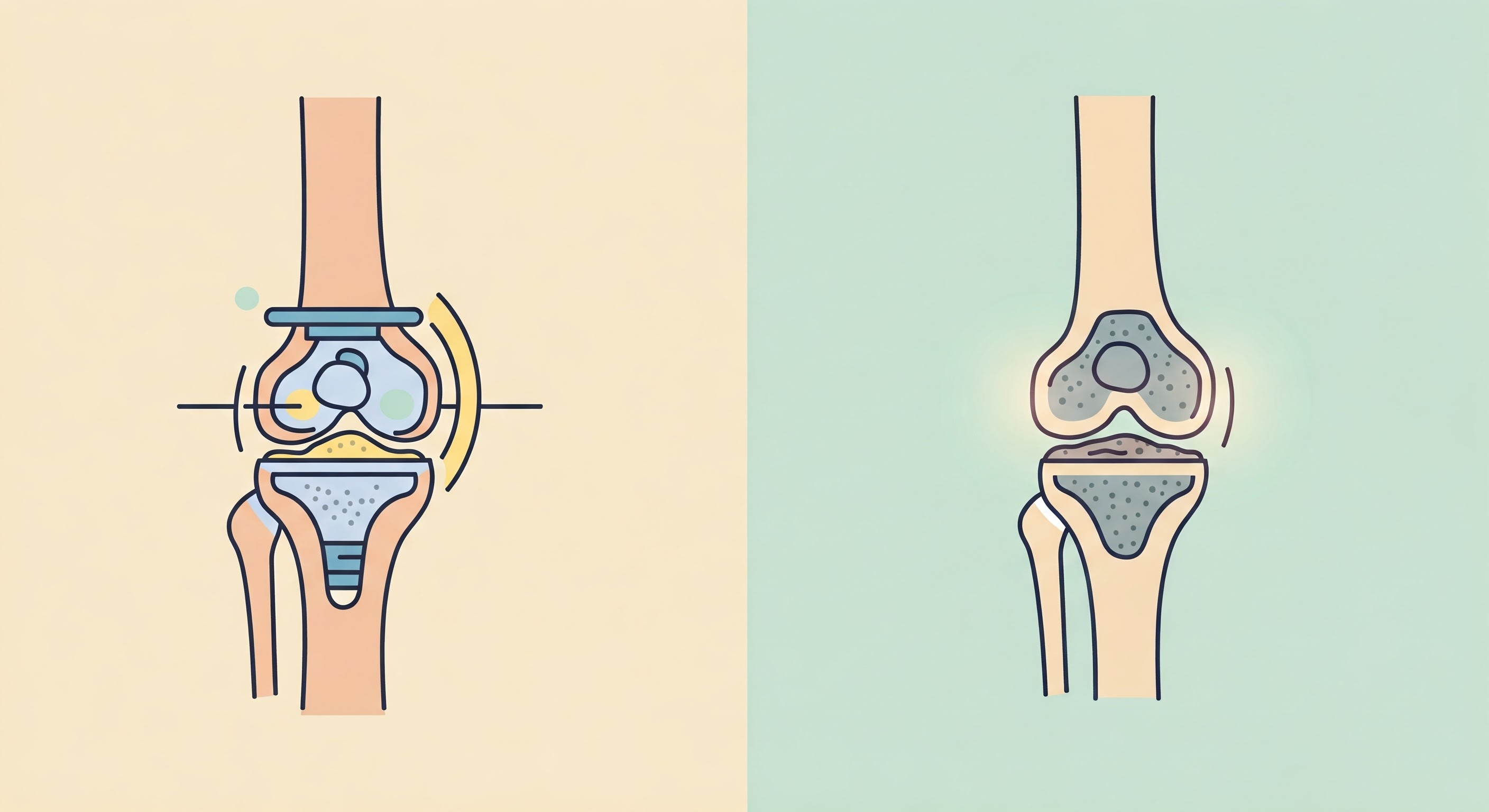
Cemented vs. Uncemented Total Knee Arthroplasty
Total knee arthroplasty (TKA) is a surgical procedure in which the damaged surfaces of the knee joint are replaced with artificial components. There are two primary ways to fixate, or attach, these components to the bone: cemented and uncemented fixation. In cemented TKA, the artificial components are fixed to the bone using bone cement. In uncemented TKA, also known as press-fit TKA, the components have a unique textured surface that encourages new bone growth and assists the bone in growing into the implant for fixation. Some surgeons use a combination of both methods1.
This article will compare and contrast cemented and uncemented TKA in various patient populations, evaluating long-term implant survival, revision rates, and patient-reported outcomes.
Implant Longevity and Revision
Cemented and cementless TKAs demonstrate similar long-term implant survival and revision rates. While cemented TKA has been the traditional gold standard with a long history of use, recent advancements in cementless technology have led to comparable outcomes2. Studies report similar survival rates for both types of fixation, with one study showing a 25-year survival rate of 97% for cementless TKA and 98% for cemented TKA3. Another study found no significant difference in implant survival between the two groups at a minimum follow-up of 8.8 years4.
Revision rates, which indicate the need for a second surgery to address issues with the initial implant, are also comparable between cemented and cementless TKA3. One study found that 3% of cementless TKAs and 2% of cemented TKAs were revised3. Another study with a minimum follow-up of 8.8 years found no significant difference in revision rates between the two groups4. It is important to note, however, that cementless TKA may be associated with a slightly higher revision rate within the first year after surgery5.
Radiostereometric analysis (RSA) is a valuable tool used to assess implant stability and predict long-term survival. This highly accurate imaging technique uses x-rays and tantalum markers implanted during surgery to measure micromotion between the implant and the bone in three dimensions6. By tracking these movements over time, RSA can help identify early signs of potential implant loosening and predict long-term success.
Patient-Reported Outcomes
Patient-reported outcomes (PROs) are essential for evaluating the effectiveness of TKA and patient satisfaction. Studies have shown no significant difference in PROs between cemented and cementless TKA3. One study found no significant differences in the Knee Society total score, change in total score, knee function score, and Western Ontario and McMaster Universities Osteoarthritis Index score between the two groups3. Another study found no significant difference in functional outcome between the two groups at up to 16.6 years follow-up7. These findings suggest that both cemented and cementless TKA provide similar levels of pain relief, functional improvement, and overall satisfaction.
Types of Implants
Cemented TKA
Cemented TKA implants are available in various designs to address different patient needs and anatomical considerations. Some common types include: 8
- Posterior-stabilized implants: These implants are used when the posterior cruciate ligament (PCL) is damaged or deficient. They have a special mechanism that helps stabilize the knee joint in the absence of the PCL.
- Cruciate-retaining implants: These implants are used when the PCL is healthy and intact. They are designed to preserve the natural function of the PCL.
- Unicompartmental implants: These smaller implants are used when only one side of the knee joint is damaged, allowing for a less invasive procedure.
- Mobile-bearing implants: These implants allow for some degree of movement between the femoral and tibial components, potentially reducing wear and tear.
- Fixed-bearing implants: These implants have a fixed connection between the femoral and tibial components, providing greater stability.
- Bicruciate-retaining implants: These implants preserve both the PCL and the anterior cruciate ligament (ACL), aiming for a more natural knee kinematics.
Uncemented TKA
Uncemented TKA implants have undergone significant advancements in recent years, leading to improved outcomes and expanded indications9. Some common types include:
- Porous-coated implants: These implants have a porous surface that encourages bone ingrowth for biological fixation. The evolution of porous coating technology has led to improved 3D shapes, increased friction, and greater similarity to natural bone in terms of texture and porosity9.
- Press-fit implants: These implants are designed to fit snugly into the bone, relying on precise bone cuts and initial mechanical stability for fixation.
- Implants with keels and spikes: Many modern cementless implants incorporate keels, spikes, or pegs to enhance initial stability and rotational control, further promoting bone ingrowth and long-term fixation9.
Surgical Technique
Cemented TKA
The surgical technique for cemented TKA involves meticulous preparation and precise implantation of the components. Key steps include: 10
- Surface preparation: The surgeon prepares the bone surfaces by removing damaged cartilage and bone, creating a smooth and stable foundation for the implant.
- Cement application: The surgeon applies bone cement to both the prepared bone surfaces and the implant, ensuring a strong and uniform bond.
- Pressurization: The surgeon applies pressure to the implant to ensure optimal cement penetration and a secure fit.
- Cement curing: The surgeon allows the cement to cure completely, providing immediate fixation of the implant.
One specific surgical approach for cemented TKA is the Personalized Alignment (PA) technique. This approach aims to restore the native alignment of the knee and limb by performing measured bone resections and minimizing the release of ligaments11. The PA technique emphasizes the restoration of the patient's natural joint line and soft-tissue balance, potentially leading to improved knee kinematics and function.
Uncemented TKA
The surgical technique for uncemented TKA is similar to that of cemented TKA, but it does not involve the use of bone cement12. Instead, the surgeon relies on precise bone cuts and the implant's design to achieve initial stability and promote bone ingrowth13. Key aspects of the procedure include:
- Precise bone cuts: Accurate bone cuts are crucial for ensuring a tight fit between the implant and the bone, maximizing contact and promoting bone ingrowth.
- Implant positioning: The surgeon carefully positions the implant to achieve optimal alignment and stability.
- Soft-tissue balance: The surgeon addresses any soft-tissue imbalances to ensure proper knee kinematics and function.
Patient Populations
Age
The choice between cemented and cementless TKA often depends on the patient's age. Cemented TKA may be preferred for older patients, while cementless TKA may be more suitable for younger patients9. This is because younger patients tend to be more active and place greater demands on the implant, potentially leading to loosening of the cement over time14. Cementless implants, on the other hand, rely on bone ingrowth for fixation, which may be more durable in younger patients with good bone quality14.
Bone Quality
Bone quality is another important factor in determining the appropriate fixation method. Cemented TKA may be a better option for patients with poor bone quality, such as those with osteoporosis, as the cement provides immediate fixation and stability14. Cementless TKA, however, requires strong, healthy bone for successful bone ingrowth14.
The Bone Hardness Test (BHT) is a simple intraoperative assessment that can help determine the suitability of cementless TKA15. The surgeon applies pressure to the resected bone surface with a thumb or index finger. If the surface deflects significantly, the bone hardness may be insufficient for primary stability of a cementless implant, and a cemented implant may be preferred.
Activity Level
While there is limited research specifically comparing outcomes based on activity level, it is generally thought that cementless TKA may be a better option for patients with high activity levels14. The biological fixation achieved through bone ingrowth is considered more durable and less prone to loosening under increased stress and activity.
Complications and Risks
Cemented TKA
Cemented TKA, while generally safe and effective, carries potential complications and risks, including: 16
- Loosening of the implant: Over time, the bone cement may break down or loosen, potentially leading to pain, instability, and the need for revision surgery.
- Infection: Infection is a rare but serious complication that can occur after any surgical procedure. In cemented TKA, the cement may provide a surface for bacteria to grow, increasing the risk of infection.
- Nerve damage: Nerves surrounding the knee joint may be injured during surgery, leading to numbness, tingling, or weakness in the leg or foot.
- Blood clots: Blood clots can form in the legs after surgery, potentially leading to deep vein thrombosis (DVT) or pulmonary embolism (PE).
- Fracture: Bones around the knee joint may fracture during or after surgery.
- Stiffness: Scar tissue formation and limited range of motion can occur after TKA.
- Allergic reaction to bone cement: Although rare, some patients may have an allergic reaction to the bone cement.
- Cement debris: Small particles of cement debris can enter the bloodstream during surgery and potentially affect the lungs17.
Uncemented TKA
Uncemented TKA also has potential complications and risks, including: 18
- Loosening of the implant: While less common with modern implants, loosening can still occur if bone ingrowth is insufficient.
- Infection: As with any surgical procedure, infection is a potential risk.
- Fracture: Bones around the knee joint may fracture during or after surgery.
- Stress-shielding: The implant may shield the surrounding bone from normal stress, potentially leading to bone loss over time.
- Metal corrosion: Wear and tear on the implant can release metal particles, potentially causing inflammation or other adverse reactions.
Conclusion
Cemented and uncemented TKA are both viable options for treating knee pain and disability. The choice between the two depends on various factors, including the patient's age, bone quality, activity level, and surgeon preference. While cemented TKA has a longer track record and provides immediate fixation, cementless TKA offers the potential for more durable, biological fixation, particularly in younger and more active patients.
| Factor | Cemented TKA | Uncemented TKA |
|---|---|---|
| Age | Older patients | Younger patients |
| Bone quality | Poor bone quality | Good bone quality |
| Activity level | Low activity level | High activity level |
| Implant survival | 98% at 25 years 3 | 97% at 25 years 3 |
| Revision rates | 2% 3 | 3% 3 |
| Patient-reported outcomes | Similar 3 | Similar 3 |
| Surgical technique | Uses bone cement | Press-fit |
| Advantages | Immediate fixation, suitable for poor bone quality | Biological fixation, potentially more durable |
| Disadvantages | Risk of cement loosening, potential for cement-related complications | Requires good bone quality, longer healing time |
It is crucial to have a thorough discussion with your surgeon to weigh the risks and benefits of each type of TKA and determine the most appropriate option for your individual needs and circumstances. As technology continues to advance and research provides further insights, the decision-making process for cemented versus uncemented TKA will likely evolve, leading to improved outcomes and patient satisfaction.
Works cited
1. Understanding your Surgery: Cemented vs. Cementless Total Knee Replacement, accessed February 17, 2025, https://www.drpauljacob.com/blog/understanding-your-surgery-cemented-vs-cementless-total-knee-replacement/?bp=25733
2. Cemented versus cementless fixation in total knee arthroplasty - PMC, accessed February 17, 2025, https://pmc.ncbi.nlm.nih.gov/articles/PMC4295702/
3. The 22 to 25-Year Survival of Cemented and Cementless Total ..., accessed February 17, 2025, https://pubmed.ncbi.nlm.nih.gov/32843257/
4. Long-term effects of cemented and cementless fixations of total knee ..., accessed February 17, 2025, https://pmc.ncbi.nlm.nih.gov/articles/PMC8513310/
5. Cementless Compared to Cemented Total Knee Arthroplasty is ..., accessed February 17, 2025, https://pmc.ncbi.nlm.nih.gov/articles/PMC10382689/
6. Radiostereometric analysis of newer cementless total knee ..., accessed February 17, 2025, https://www.aofoundation.org/recon/clinical-library-and-tools/scientific-articles/20_3_preview_radiostereometric-analysis-of-newer-cementless-total-knee-arthroplasty-designs
7. Cemented vs. cementless fixation in primary total knee arthroplasty: a systematic review and meta-analysis in, accessed February 17, 2025, https://eor.bioscientifica.com/view/journals/eor/5/11/2058-5241.5.200030.xml
8. Knee Replacement Implants - OrthoInfo - AAOS, accessed February 17, 2025, https://orthoinfo.aaos.org/en/treatment/knee-replacement-implants/
9. Surgeons advise healthy skepticism for cementless TKA - Healio, accessed February 17, 2025, https://www.healio.com/news/orthopedics/20230616/surgeons-advise-healthy-skepticism-for-cementless-tka
10. Cementing Techniques In Knee Surgery (CeTIKS): a UK expert consensus study - PMC, accessed February 17, 2025, https://pmc.ncbi.nlm.nih.gov/articles/PMC10480017/
11. Persona® Personalized Alignment™ Total Knee Arthroplasty - Zimmer Biomet, accessed February 17, 2025, https://www.zimmerbiomet.com/content/dam/zb-corporate/en/education-resources/surgical-techniques/specialties/knee/persona-the-personalized-knee/1578.2-GLBL-en%20Persona%20Kinematically%20Aligned%20TKA%20SurgTech-digital1.pdf
12. Cementless Total Knee Arthroplasty Houston, TX | Knee Pain Cypress, TX - Advanced Orthopaedics & Sports Medicine, accessed February 17, 2025, https://www.advancedosm.com/cementless-total-knee-arthroplasty-orthopaedic-sports-medicine-specialist-cypress-houston-tx/
13. Cementless Total Knee Replacement: Guidance for Best Practices, accessed February 17, 2025, https://www.jnjmedtech.com/en-NZ/pdf/122027-190828-cementless-best-practicespdf
14. Cemented vs. Cementless Knee Replacement - R. Michael Meneghini, MD, accessed February 17, 2025, https://www.meneghinimd.com/specialties/cemented-vs-cementless-knee-replacement/
15. Midterm Results of Cementless Total Knee Arthroplasty: A Retrospective Case Series, accessed February 17, 2025, https://openorthopaedicsjournal.com/VOLUME/12/PAGE/196/FULLTEXT/
16. Complications of Total Knee Arthroplasty - Medscape Reference, accessed February 17, 2025, https://emedicine.medscape.com/article/1250540-overview
17. What Is Cemented Knee Replacement? | Center for Orthopaedic Surgery & Sports Medicine, accessed February 17, 2025, https://www.centerfororthosurgery.com/what-is-cemented-knee-replacement/
18. Cementless total knee arthroplasty - PMC, accessed February 17, 2025, https://pmc.ncbi.nlm.nih.gov/articles/PMC4842397/
