

Trauma resuscitation begins with securing and maintaining the ABCs: airway, breathing, and circulation. Evaluation of the musculoskeletal system must be deferred to these priorities because when a patient cannot get oxygen into the lungs or cannot circulate oxygenated blood to the brain, ischemic damage occurs within 4 minutes. Muscle and bone are not as sensitive. This central fact of physiology, therefore, establishes the priorities of patient care. All injuries to the extremities—even major injuries—must be ignored until the airway is secured, breathing established, and circulation ensured. That said, musculoskeletal medicine is still an important part of trauma care because bones and soft tissues and the neurovascular systems they surround are often affected by high-energy trauma. In fact, injuries to the bones can impede both breathing (as in the case of multiple rib fractures) and circulation (as in the case of pelvic and femoral fractures, which can cause blood loss to the point of shock). This chapter will explore some of the musculoskeletal aspects of trauma medicine. It is not intended to be a definitive summary. The interested reader is referred to the Advanced Trauma Life Support (ATLS) manual published by the American College of Surgeons for a more complete overview.1
Epidemiology
Trauma, which includes unintentional injury, homicide, and suicide, is the leading cause of death for people between the ages of 1 and 44 years, and it is eighth among the leading causes of death at any age.2 However, fewer than 1% of patients who sustain trauma actually die. For example, in 1995, approximately 150,000 deaths occurred as a result of traumatic injury; however, that same year, 2.6 million people were hospitalized and 37 million required emergency department care for trauma-related injuries.3 In fact, almost 40% of all emergency department visits are the result of patients seeking care for trauma-related injuries.
In the United States, motor vehicles accidents account for most accidental deaths and are the second most common cause of nonfatal accidental injury at all ages.4 The most important factors that influence the risk of a motor vehicle accident are speed and alcohol or drug intoxication. Speed increases the risk of an accident by reducing driver reaction time and vehicle stability; it also increases the risk that a given accident will lead to a fatality.
Falls are the leading cause of nonfatal injury requiring hospital admission, but they do not often result in death. The most important factor that influences both the risk and consequences of a fall is age. For patients younger than 5 years, one third of all emergency department visits for injury are the result of falls, but 97% of these patients are not admitted to the hospital. In older children, injuries from falls are associated with play; in adults, injuries from falls are associated with working on ladders, roofs, etc. For patients age 65 years or older, falls are the leading cause of accidental death. In this age group, nonfatal falls often result in musculoskeletal trauma, most commonly fractures of the hip and distal radius. Hip fractures will significantly impair the quality of life even if death does not result. Both environmental and host factors increase the risk of accidental falls in people older than 65 years. Environmental factors include inadequate lighting and unstable or slippery floor surfaces. Host factors include impaired vision, altered mental status, and muscle weakness.3,5,6
Presentation
The goal of trauma care is to maximize patient survival and functional outcome after injury. Reaching this goal requires an accurate, organized appraisal of the injuries followed by prompt resuscitation. The methods of evaluation and resuscitation promoted by ATLS are widely used in the United States and call for a sequence of care that includes a primary survey to identify immediately life-threatening injuries, resuscitation to stabilize the patient’s vital signs, reevaluation of the vital signs, and then a more detailed secondary survey, with specific radiographic and laboratory tests performed as indicated.
The primary survey is meant to identify and treat immediately life-threatening injuries. In addition to the ABCs of trauma care, emergency medical personnel evaluate disability resulting from central nervous system injury and make sure the patient is fully exposed by removing all clothing to rule out occult life-threatening injuries.1 Using the mnemonic ABCDE (airway, breathing, circulation, disability, exposure), these five steps are considered from the perspective of the musculoskeletal medicine physician as follows:
Airway
An intact or patent airway implies that the patient is capable of moving air between the mouth and nose and the lungs. Control of the airway by endotracheal intubation is indicated for airway obstruction or pending airway obstruction, as might be seen with neck swelling. Endotracheal intubation should be undertaken with particular care in unconscious patients or in those who have documented or suspected spinal cord injuries (ie, those who report neck pain or have sustained significant trauma). The patient’s head should be immobilized with rolled towels, foam padding, or a combination of sandbags, a plastic cervical spinal collar, and tape (Fig. 1).
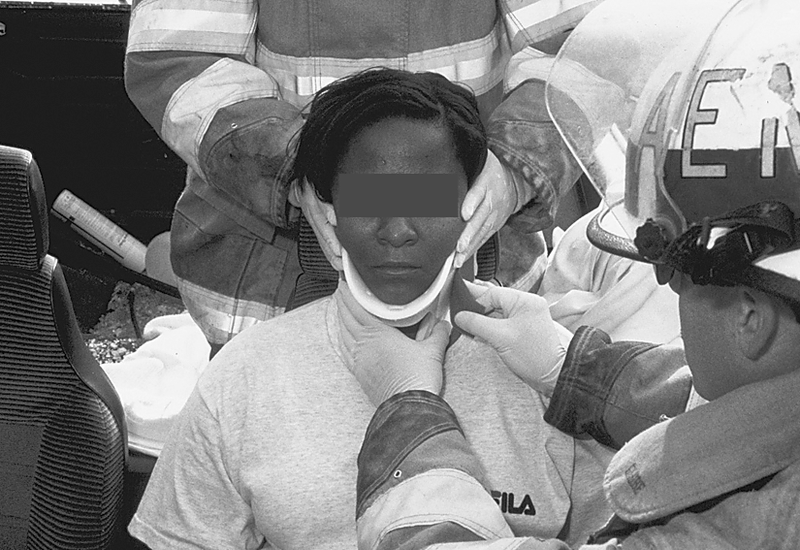
Figure 1 Immobilization of the cervical spine is essential to prevent further injury.
(Reproduced with permission from Browner BD, Pollak AN, Gupton CL (eds): American Academy of Orthopaedic SurgeonsEmergency: Care and Transportation of the Sick and Injured, ed 8. Sudbury, MA, Jones and Bartlett Publishers, 2002, p 702.)
Breathing
Inadequate ventilation is usually caused by hemothorax, pneumothorax, or musculoskeletal trauma to the chest wall resulting in a flail chest. A flail chest occurs after multiple rib fractures and results when a segment of the chest wall is no longer stable. The loose segment floats freely and moves in during inspiration and out during exhalation, exactly the opposite of normal chest wall dynamics. Air may enter the pleural space at the site of injury during inspiration, resulting in a sucking chest wound. Pulmonary contusion and limited respiratory effort as a result of pain (splinting) are associated with chest trauma. Treatment includes evacuation of the pneumothorax, application of an occlusive dressing on sucking chest wounds, and stabilization of the floating segment of the chest wall.
Circulation
Shock occurs when oxygen-rich blood is not delivered in adequate amounts to the peripheral tissues. Clinical signs of shock include rapid, faintly palpable, peripheral pulses; pallor; reduced skin temperature; and sweating. Initially, patients may seem anxious, but, as shock progresses, lethargy and decreased level of consciousness are seen. Tachycardia is the most sensitive sign of shock in the injured patient; a heart rate that is persistently faster than 120 beats/min in adults or 160 beats/min in children younger than 6 years should be treated as shock.
The most common cause of shock resulting from trauma is bleeding. A source of external bleeding should be identified and stopped during the primary survey. Common sources of bleeding are extremity, facial, and scalp wounds. Bleeding from extremity wounds is best controlled by direct pressure. The use of hemostats and suture ligatures to control bleeding in the emergency department is discouraged because it may lead to the inadvertent damage of nerves and tendons near the source of bleeding. Life-threatening bleeding from an extremity wound usually indicates a partial laceration of an artery. Complete division of an artery produces spasm and clot formation that will usually stop the bleeding. Following partial transection of an artery, spasm occurs, but it will not completely occlude the vessel lumen and bleeding will continue. Because the venous system maintains lower pressure, life-threatening bleeding from extremity veins is unusual.
If no external source of bleeding is identified during the primary survey, other potential causes of shock must be investigated, such as internal bleeding from pelvic, abdominal, or thoracic injuries. Even closed extremity or pelvic fractures (ie, fractures that have not penetrated the skin) can be responsible for significant blood loss (Fig. 2). Note that not all shock is a result of blood loss. Although there is adequate blood volume, the heart may be incapable of circulating it (cardiogenic shock). For example, cardiac tamponade from bleeding into the pericardium should be suspected in the setting of a penetrating trauma near the heart. Injury to the spinal cord, resulting in loss of vasomotor tone and peripheral vasodilation, can also produce shock. This type of shock, called neurogenic shock, should be suspected in the setting of a spinal injury (Fig. 3). Unlike hemorrhagic and cardiogenic shock, neurogenic shock is characterized by hypotension without tachycardia. Initial treatment is with crystalloid administration, but vasopressors also may be required. Before vasopressors are administered, the potential for concurrent hemorrhagic shock should be evaluated and then treated if necessary.
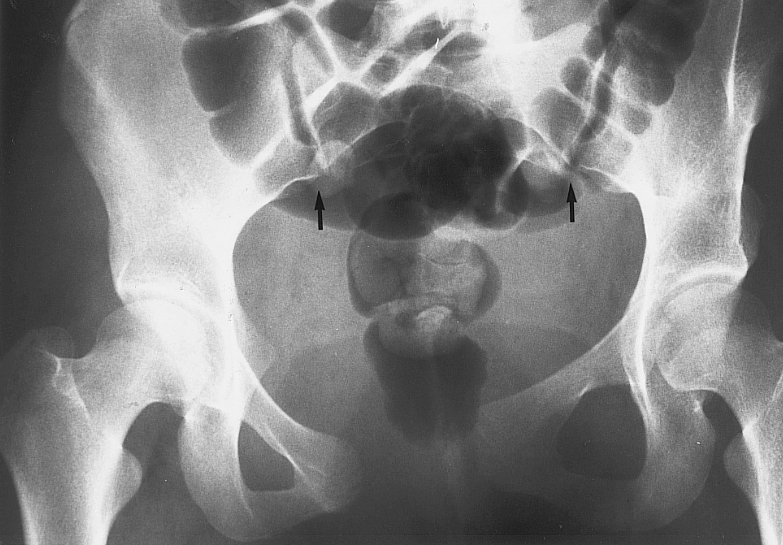
Figure 2 Pelvic fracture can be associated with significant blood loss. Closure of the “open-book” pelvis, by manually compressing the right and left ilium to bring the pubic bones together, can often stop ongoing blood loss. In this radiograph, in addition to the obvious widening of the symphysis, there is subtle widening of the sacroliliac joints posteriorly (arrows).
(Reproduced with permission from Tile M (ed): Fractures of the Pelvis and Acetabulum, ed 2, Baltimore, MD, Williams & Wilkins, 1995.)
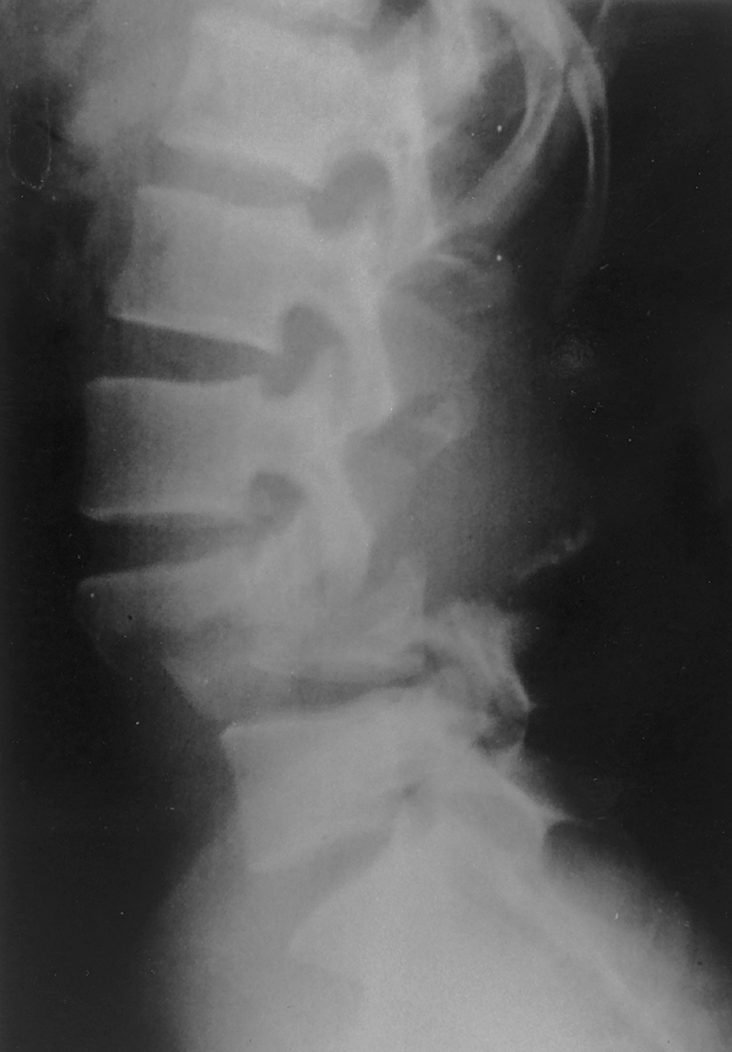
Figure 3 Lateral radiograph showing a cervical spine fracture with displacement, which poses a high risk of neurologic injury.
(Reproduced with from Spivak JM, Vaccaro AR, Cotler JM: Thoracolumbar spine trauma: I: Evaluation and classification. J Am Acad Orthop Surg 1995;3:345-352.)
Neurologic Disability
A brief neurologic examination is indicated to identify patients with potential intracranial injuries and/or intoxication. A detailed neurologic examination is not part of the primary survey. However, it is important to document both the initial neurologic status and any changes in status occurring in the emergency department.
Exposure
The final step of the primary survey is to remove all the patient’s clothing so that a complete inspection for injuries can be performed. Care is taken to maintain body temperature by using radiant warmers, administering warm fluids, and covering the patient with warm blankets after the primary survey.
Treatment and Prevention
Resuscitation
The initial steps of resuscitation proceed simultaneously with the primary survey. Once the airway is secure, ventilation with 100% oxygen is initiated. At least two large-bore (16-gauge or larger) intravenous catheters are inserted in almost all trauma patients. Insertion sites in the extremities are preferred. If there is significant musculoskeletal or vascular injury, a site remote from the trauma should be selected. In children, fluids can be administered directly into the medullary canal of the tibia or femur, but intravenous catheterization is preferred because fluid reaches the circulating volume faster.
For patients with hypotension and tachycardia, 2 L of lactated Ringer’s solution (20 mL/kg for children) is rapidly infused. If the vital signs are corrected after 2 L of crystalloid is administered, maintenance fluids are initiated. If the vital signs are not stabilized, an additional 2-L bolus is given, and transfusion with blood products is indicated. Blood that is not crossmatched (type O negative) is used if exsanguination is imminent; otherwise, type-specific, crossmatched (type-specific) blood is used.
Secondary Survey
The secondary survey is a more complete evaluation that is performed once the ABCs have been addressed. The physical examination is performed in a systematic fashion, moving from head to toe. The neck is inspected for penetrating wounds, swelling, hematoma, and other abnormalities. Any patient who is not conscious, has been involved in a high-energy accident, or has evidence of direct trauma to the head and neck requires radiographs to rule out cervical spinal injury. If a complete series of plain radiographs is not adequate to rule out injury, CT is indicated because it is often difficult to visualize the lower cervical spine on radiographs. Until cervical spinal injury can be ruled out, the patient should remain immobilized on a spine board and in a rigid collar. Abnormalities in the reflexes and deficits in sensory and motor function must be documented at this point.
Next, the anterior, posterior, and flanks of both the abdomen and chest must be inspected. This requires logrolling the patient from side to side with care to maintain the neck in a neutral position. A rectal examination is performed at this time and should always precede insertion of an indwelling urinary catheter in case of urethral injury. Significant findings during the rectal examination include gross blood in the rectal vault, indicating anorectal injury; loss of rectal sphincter tone, indicating spinal cord injury; and a high-riding prostate, indicating urethral injury. Stability of the pelvis is assessed by rocking the iliac crests from side to side. Instability implies a pelvic fracture.
Each extremity, including the hands and feet, are inspected for deformity and penetrating wounds. Evidence of fractures includes abnormal position, swelling, and instability of the extremity. Potentially fractured bones are initially splinted until a definitive evaluation is performed. Sensation and motor function of the extremities are assessed. Potential vascular injuries are evaluated by inspection for penetrating wounds in proximity to major vessels and associated hematoma. The peripheral pulses are palpated and compared with the contralateral side. Diminished or asymmetric pulses, isolated extremity ischemia, and expanding hematoma are indications for surgical exploration of the involved vessel.
Complications
Extremity trauma may be complicated by compartment syndrome, which occurs if the interstitial pressure within a fascial compartment rises above capillary closing pressure. This prevents oxygen delivery to tissue within the involved compartment. If untreated, compartment syndrome can lead to irreversible tissue injury and necrosis. Compartment syndrome is traditionally associated with injuries such as open and closed fractures but may also occur after soft-tissue crush injury and vascular trauma. Compartment syndrome may also appear following repair of a vascular injury. The first sign is pain out of proportion to the apparent injury, especially with passive motion. Nerve dysfunction, including paralysis and paresthesia, and loss of arterial pulses are late signs and cannot be used to make the diagnosis. By the time these appear, irreversible damage may have already occurred.
If compartment syndrome is suspected because of the mechanism of injury or physical findings, pressures can be directly measured by devices that can be inserted into the muscle compartment of concern. If compartment pressure is sufficiently elevated, fasciotomy is indicated. Fasciotomy allows the soft tissues to expand, thereby reducing compartment pressure and improving capillary function. Ideally, fasciotomy is performed in the operating room, but if transfer to the operating room will result in undue delay, fasciotomy can be done in the emergency department.
The mangled extremity severity score (MESS) can help physicians make decisions about when to attempt to save an extremity as opposed to performing primary amputation. Four characteristics of the injured extremity are scored, including the energy of the trauma, the presence of shock, the extent of limb ischemia, and the patient’s age (Table 1).
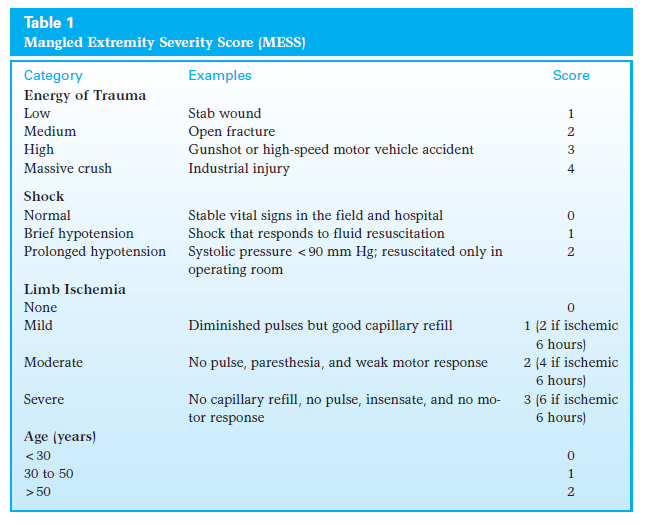
Primary amputation should be considered if the MESS is greater than six. It is unlikely, given such a score, that attempted limb salvage would be successful. Primary amputation spares the patient the complications of repeated and perhaps futile surgeries. Primary amputation of any extremity should be carried out when 6 hours or more of warm ischemia have transpired, which on the basis of ischemia and energy alone, would result in a MESS score of at least seven. In this circumstance, the muscle will not be viable even if perfusion could be restored. Also, for leg injuries associated with division of the tibial nerve, amputation should be considered. The reason is that even if the tibial nerve were repaired, a neurogenic pain syndrome would likely develop that is so disabling that most patients would be more functional with an amputation and rehabilitation with a prosthesis. Finally, complex extremity salvage operations are not appropriate when there are other life-threatening injuries that preclude a lengthy surgical procedure.7
Imaging
Patients with a history of significant trauma are presumed to have a cervical spine injury until proven otherwise. If the patient is awake and alert, the cervical spine can be evaluated clinically. If the patient has normal range of motion and no pain, imaging studies are not required. Otherwise, obtaining plain radiographs in the emergency department is the first step in evaluation. Three views, including lateral, AP, and odontoid projections, are obtained.8 For patients with neurologic deficits, neurosurgical or orthopaedic consultation is indicated; plain radiographs, CT, or MRI is required (Fig. 4).
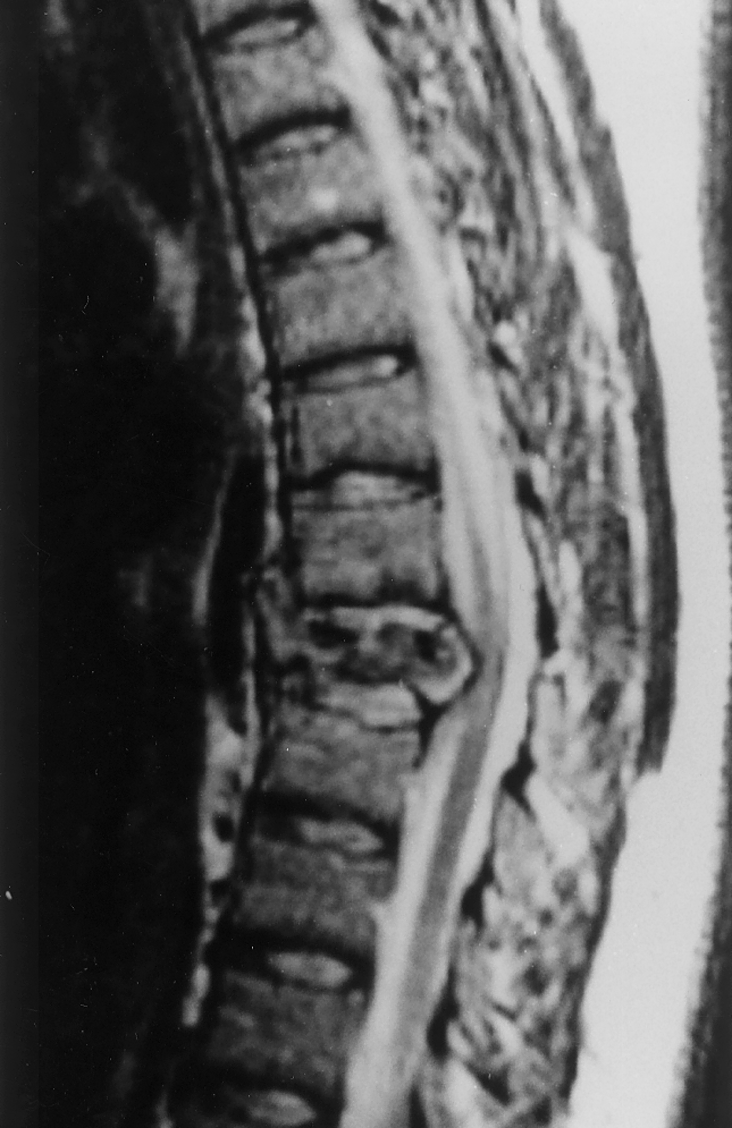
Figure 4 T2-weighted MRI scan of the thoracic spine showing canal encroachment by fracture fragments.
(Reproduced from Spivak JM, Vaccaro AR, Cotler JM: Thoracolumbar spine trauma: I. Evaluation and classification. J Am Acad Orthop Surg 1995;3:345-352.)
When high-quality radiographs cannot be obtained or when the patient reports neck pain or is not able to cooperate with a physical examination, CT of the cervical spine is indicated. A protective cervical collar should not be removed until the patient is alert enough to participate in an examination. A pelvic radiograph is indicated to diagnose pelvic fractures, which can be a source of significant occult bleeding and lead to hemorrhagic shock. Rapid application of an external fixator may compress the fragments to reduce the bleeding.
Patients with diminished but not absent pulses are candidates for vascular imaging studies. Angiography has a sensitivity of up to 100% and a specificity of up to 98% for diagnosing arterial injuries (Fig. 5). However, peripheral angiography after trauma carries a risk of minor complications of up to 4% and a risk of iatrogenic injury that requires surgical repair in nearly 1% of patients.9 In addition, angiography is expensive and time consuming. Unlike angiography, duplex ultrasound scanning is noninvasive and poses essentially no risk. Duplex studies have a sensitivity that approaches 100% and a specificity of up to 97% for diagnosing vascular injuries when interpreted by expert radiologists.10 However, most surgeons find ultrasound images substantially more difficult to interpret than angiograms, and their usefulness is accordingly limited.
Bleeding from bony fragments of the pelvis or from the rich plexus of veins surrounding the pelvis usually stops once the fragments are reduced and compressed. This can be rapidly accomplished with external fixation. Pelvic fractures often disrupt branches of the internal iliac arteries, which can result in brisk bleeding and hemorrhagic shock. Less commonly, bleeding occurs from branches of the external iliac arteries. Embolization is a very effective way to treat this type of bleeding. If there is persistent shock and no specific site of bleeding is identified, embolization of one or both internal iliac arteries should be performed. This maneuver is both well-tolerated and effective. Surgical exploration of an acutely bleeding and fractured pelvis is difficult and carries a higher risk of complications.11
Prevention
The term “accident” implies a random, uncontrollable event. However, scientific study of accidents has found that they are highly complex but reproducible events. Therefore, it is reasonable to consider the role of prevention in the management of trauma. This includes the identification of potential hazards and their elimination. Prevention also implies taking steps to decrease the consequences of accidents that do occur, including minimizing the chances that a given accident will lead to injury, by using seat belts, for instance; minimizing the chances that a given injury will lead to disability or death, which is what emergency medical services strive to do; and minimizing the chances that a given disability will lead to impairment, by employing high-quality health care and rehabilitative services.12
The responsibility for preventing motor vehicle accident trauma lies with government (designing safe roads and intersections) and industry (making safe cars), but ultimately it is the individual who must take appropriate steps to ensure his or her own safety. This includes driving at reasonable speeds and not driving under the effects of alcohol.
Key Terms
Compartment syndrome Ischemia of the nerves and muscles within a fascial compartment caused by elevated pressure within the compartment; frequently seen in association with tibial fractures
Flail chest A condition in which three or more ribs are fractured in two or more places, or in association with a fracture of the sternum, so that a segment of chest wall is effectively detached from the rest of the thoracic cage.
Mangled extremity severity score (MESS) A rating scale for classifying lower extremity trauma based on age, shock, limb ischemia, and skeletal and/or soft-tissue damage
Primary survey An emergency examination during which a patient is assessed and treatment priorities are established based on the patient’s injuries, stability of vital signs, and injury mechanism
Secondary survey A comprehensive evaluation of a patient that is performed after resuscitation to detect injuries not noted on the primary survey
References
1. American College of Surgeons Committee on Trauma: Advanced Trauma Life Support Program for Doctors: ATLS, ed 6. Chicago, IL, American College of Surgeons, 1997.
2. National Center for Injury Prevention and Control: Ten Leading Causes of Death, 1995. Atlanta, GA, Centers for Disease Control and Prevention, 1998.
3. Health: United States: Injury Chartbook: 1996-1997. Hyattsville, MD, National Center for Health Statistics, 1997.
4. Annest JL, Conn JM, James SP: (eds): Inventory of Federal Data Systems in the United States for Injury Surveillance, Research and Prevention Activities. Atlanta, GA, National Center for Injury Prevention and Control, 1996.
5. Rivara FP, Alexander B, Johnston B, et al: Population-based study of fall injuries in children and adolescents resulting in hospitalization or death. Pediatrics 1993;92:61-63.
6. Tinetti ME, Speechley M, Ginter SF: Risk factors for falls among elderly persons living in the community. N Engl J Med 1988;319:1701-1707.
7. Johansen K, Daines M, Howey T, et al: Objective criteria accurately predict amputation following lower extremity trauma. J Trauma 1990;30:568-573.
8. Mirvis SE, Hastings G, Scalea TM: Diagnostic imaging, angiography, and interventional radiology, in Mattox KL, Feliciano DV, Moore EE (eds): Trauma, ed 4. New York, NY, McGraw-Hill Health Professions Division, 2000, pp 285-288.
9. Reid JD, Weigelt JA, Thal ER, et al: Assessment of proximity of a wound to major vascular structures as an indication for arteriography. Arch Surg 1988;123:942-946.
10. Shackford SR, Rich NH: Peripheral vascular injury, in Mattox KL, Feliciano DV, Moore EE (eds): Trauma, ed 4. New York, NY, McGraw-Hill Health Professions Division, 2000, pp 1011-1046.
11. Agolini SF, Shah K, Jaffe J, et al: Arterial embolization is a rapid and effective technique for controlling pelvic fracture hemorrhage. J Trauma 1997;43:395-399.
12. Haddon W Jr.: The changing approach to the epidemiology, prevention, and amelioration of trauma: The transition to approaches etiologically rather than descriptively based. Am J Public Health Nations Health 1968;58:1431-1438.
