

Skeletal ligaments are highly organized, fibrous tissues that connect bone to bone. Some ligaments are large and easily seen or felt; others are small and subtle. All share the task of protecting the joints from instability and allowing normal motion to occur with minimal resistance.
The orientation of a ligament relative to the plane of the joint it crosses determines its mechanical function. For example, the anterior talofibular ligament, the structure most commonly injured in an ankle sprain, attaches the distal fibula to the lateral side of the talus, sloping somewhat anteriorly as it courses toward its distal attachment. Thus, it resists inversion of the ankle joint, especially when the ankle is plantar flexed (the forefoot pointed slightly toward the floor).
Physiologic Function
Ligaments are like ropes in that they offer little resistance to compression, but they are strong in tension. A structure such as a ligament, whose mechanical properties depend on the orientation of the force applied, is anisotropic. To stabilize the joint, most ligaments work in pairs. In the ankle, the lateral talofibular ligament is balanced by the deltoid ligament on the medial side.
A ligament’s resistance to tension differs slightly compared with that of a tendon, the tissue that attaches a muscle to bone. A tendon is uniformly stiff, and it does not elongate much when pulled. This stiffness ensures that the entire tug of the muscle is used to move the joint and that no force is wasted by simply elongating the tendon. A ligament does, however, have some built-in laxity in response to low tension forces. This lower stiffness allows the joint to withstand small deforming forces without damage—just as a tree may bend and not break in response to wind. At higher tension, however, the ligament becomes stiffer, thus keeping the joint stable.
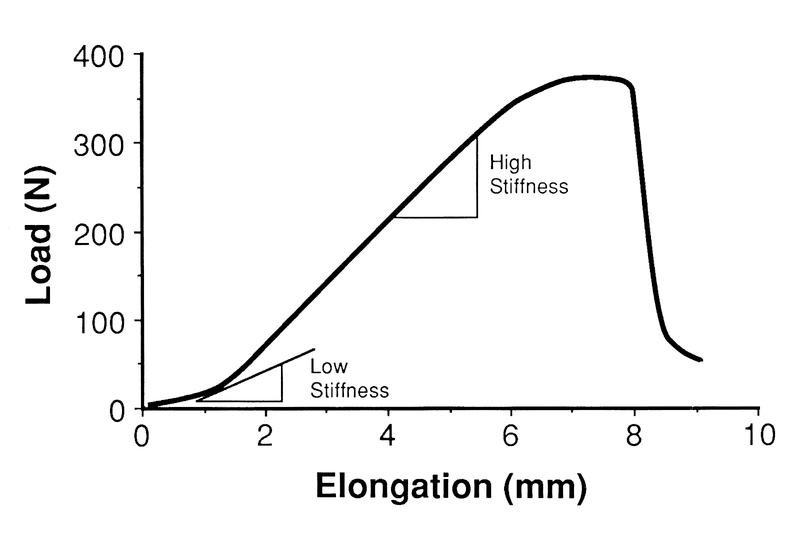
Figure 1 The mechanical response of the tissue can be illustrated by plotting a load versus elongation curve or a stress versus strain curve. The slope of this curve defines the stiffness of the tissue. The load-elongation curve shown in the graph is typical of that of ligaments, with an initial region of low stiffness (the toe region) and a second region of high stiffness (linear region).
(Reproduced from Woo SLY, An KN, Frank CB, et al: Anatomy, biology, and biomechanics of tendon and ligament, in Buckwalter JA, Einhorn TA, Simon SR (eds): Orthopaedic Basic Science: Biology and Biomechanics of the Mulsculoskeletal System, ed 2. Rosemont, IL, American Academy of Orthopaedic Surgeons, 2000, pp 581-616.)
The structural properties of tissue can be described by measuring the relationship between stress and strain (Fig. 1). Stress is the deforming force, defined as the amount of load per unit of cross-sectional area of the tissue. Strain is defined as the amount of tissue elongation divided by the original tissue length—a percentage of the deformation. When a material is stressed, a given strain will be observed.
Consider, for example, an individual walking over rocky terrain. Whenever weight is disproportionately borne on the medial side of the foot, an inversion force is placed on the lateral ankle. When the forces are small, the anterior talofibular ligament stretches in response to the load and springs back to its normal length once the force abates. When the forces are increased and the joint threatens to give way, the ligament becomes taut and barely elongates at all. Of course, when the force exceeds the ligament’s own strength, such as that produced when a jumping basketball player lands unevenly on another player’s foot, the ligament will tear and no longer stabilize the joint.
It is worth noting that the extent of ligament disruption does not always predict the degree of clinical instability that an individual will perceive. There are instances in which the lateral ankle ligaments are completely torn and yet there may not be much instability, as the individual can use his or her muscles (the peroneus longus and brevis) to actively stabilize the joint. Conversely, in some cases, even once the torn ligament heals, the individual may still sense subtle instability. This perceived instability may occur because the nerves within the ligament that sense movement and displacement can be damaged in a severe sprain. When these nerves are injured, the individual may lose proprioception and report a poor sense of control, even if instability is not objectively confirmed.
Normal Histology and Composition
The gross inspection of a ligament reveals band-like connective tissue, with little suggestion of its microscopic complexity. In fact, skeletal ligaments are intricate amalgams of extracellular matrix proteins that are maintained by a diverse population of cells. Ligaments are typically composed of longitudinally oriented fascicles, 20 to 400 &mgr;m in diameter, that course between bony insertion sites. The fascicles consist of densely organized collagen fiber bundles that are approximately 20 &mgr;m wide.
When viewed along the longitudinal axis of the fascicles, an organized, sinusoidal waveform can be appreciated. This pattern is referred to as the crimp. The longitudinal orientation of fibers and the crimp within them produce the unique structural properties of ligament, namely, anisotropy and increased stiffness in response to increased load. The longitudinal orientation of the fascicles produces anisotropy: the ligament on the whole behaves like a rope because its elemental constituents are molecular ropes. The crimp is responsible for the nonlinear stiffness of ligament.1 As noted above, the stiffness of a ligament increases with increasing tension. This change in stiffness occurs because some of the fibrils within the crimp region are bent like a spring when the ligament is not under any tension. When tension is first applied, the crimp elongates (Fig. 2).
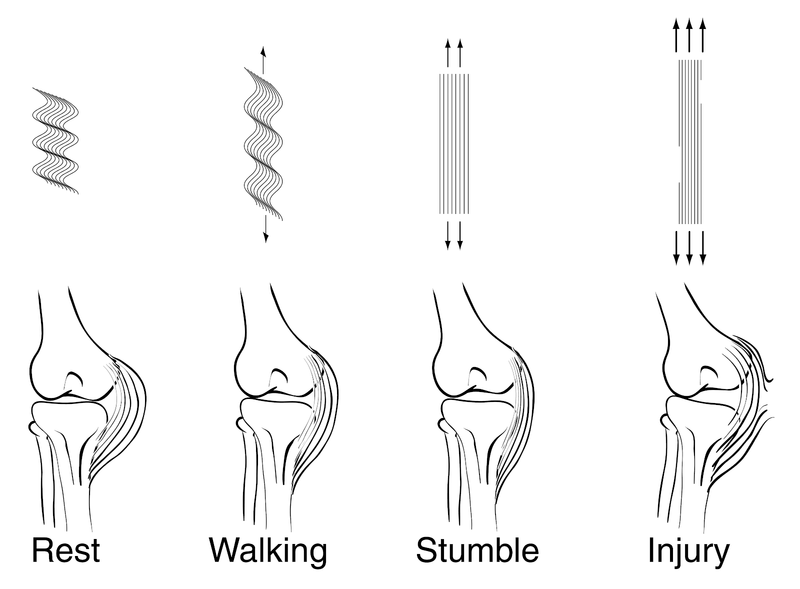
Figure 2 Schematic representation of the elongation of the medial collateral ligament as progressively stronger valgus stresses are applied to the knee. Initially, the wavy collagen fibers straighten, but as stronger forces are placed across the knee, the fibers within the ligament begin to rupture, resulting in ligament injury.
After the crimp is maximally stretched, however, any additional displacement requires stretching of the individual collagen fibrils themselves.2
Ligament cells are typically oriented along the longitudinal axis of the tissue. These cells have been distinguished histologically on the basis of nuclear shape and the presence of a lacunar space. Three principal cell types have been described: fusiform, ovoid, and spheroid. Fusiform cells are spindle-shaped and have been noted to be intimately related to the crimped collagen fibers. Ovoid and spheroid cells are typically found in columns, with amorphous extracellular matrix in the pericellular space. The specific function of these types of cells is unknown.
The vascular supply of ligaments typically originates in the blood vessels near the joint surfaces. Bundles of individual collagen fibrils within the ligament are surrounded by a vascularized layer of loose connective tissue known as the endoligament. The surface of the entire ligament is also covered with a vascularized layer called the epiligament. The vascularity of ligaments is not necessarily constant throughout their entire length. In the anterior cruciate ligament (ACL) of the knee, for example, there is greater vascularity at the femoral end, with vessels seen predominantly in the epiligament and endoligament. Few vessels are seen in the fibers themselves. The cells within the fibers depend primarily on diffusion of nutrients from the surrounding vascularized tissues.
Nerve fibers are typically located near the vessels, also predominantly in the epiligament. Four types of cells have been identified in the ligaments of the knee, specifically Ruffini receptors, pacinian receptors, Golgi receptors, and free unmyelinated nerve endings. The neurosensory role of these receptors has been supported by studies demonstrating somatosensory evoked potentials with mechanical stimulation of the human ACL,3 as well as changes in electromyographic function after disruption of the ligament.
Mechanoreceptors in ligament play an important role in the body’s proprioception by helping to provide the sense of where the body is in space. In an injured ligament, this function can be disrupted, causing disability that is seemingly out of proportion to the objective skeletal injury. When the ligament has healed but these nerve pathways have not yet been reestablished, an individual not staring directly at his or her foot may have a poor sense of where the foot is relative to the ground. This subtle clumsiness may be reported as instability: an individual will say that he or she simply does not “trust” the ankle even if an examiner cannot document objective instability. It may take a while for proprioception to return—long after the ligament is healed—but it may be restored more quickly with physical therapy and rehabilitation.
Ligament attaches to bone in two ways. In the direct attachment pattern, four histologic zones are seen4 (Fig. 3).
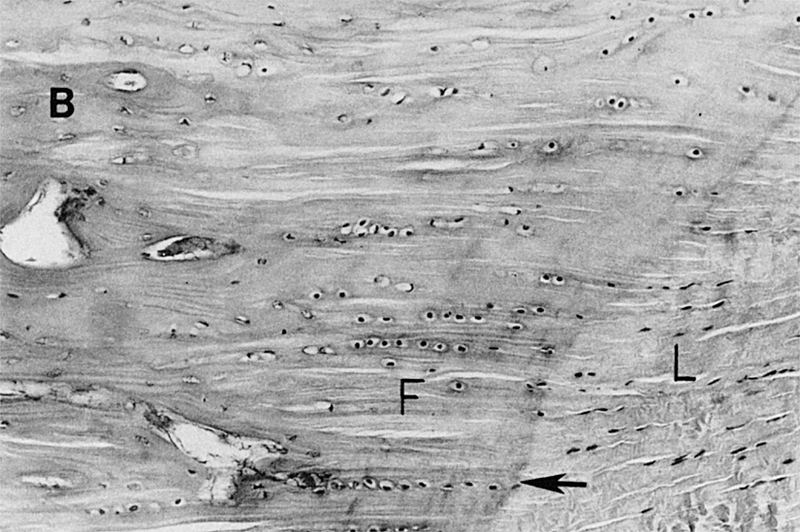
Figure 3 The four zones of the direct insertion of the medial collateral ligament into the femur. The deep fibers of the ligament (first zone) (L) pass through a well-defined area (arrow) combining a zone of uncalcified fibrocartilage and a zone of calcified fibrocartilage (second and third zones) (F) before inserting into the bone (fourth zone) (B).
(Reproduced with permission from Woo SLY, Gomez MA, Sites TJ, et al: The biomechanical and morphological changes in the medial collateral ligament of the rabbit after immobilization and remobilization. J Bone Joint Surg Am 1987;69:1200-1211.)
The first zone contains the ligament itself, the second zone contains nonmineralized fibrocartilage, the third zone contains mineralized fibrocartilage, and the fourth zone contains bone. Some ligamentous fibers pass directly into bone without an intervening layer of fibrocartilage. In this so-called indirect attachment, the fibers of the ligament blend with those of the periosteal layer.5
Collagen makes up 70% to 80% of the dry weight of ligaments. There are at least 15 distinct types of collagen, all of which are macromolecular triple helices composed of three amino acid alpha chains. All alpha chains are composed of repeating triplets of polypeptides. The most common sequence begins with the small amino acid glycine, followed typically by proline and hydroxyproline. Hydroxylysine (with or without a sugar attached) is seen frequently as well. Because of the geometry of the proline molecule itself, each alpha chain is wound into a left-handed helix. These in turn intermingle into one long, right-handed triple helix. This spiral configuration gives collagen the distinct ability to resist tensile forces.
The type of collagen is defined by the molecular constituents of the amino acid chains as well as the presence of specific nonhelical domains. More than 90% of the collagen found in ligament is fibrillar type I collagen, with most of the remainder thought to be type III. Type II is found in articular cartilage and is more suited to resist compression. Fibrillar type I collagen is produced intracellularly and modified extracellularly by cleavage. Once modified extracellularly, these molecules then aggregate into microfibrils. A microfibril is composed of a staggered array of adjacent collagen molecules, each offset by a quarter of its length. This allows many oppositely charged amino acids to align and bond, giving the fibril additional tensile strength (Fig. 4).
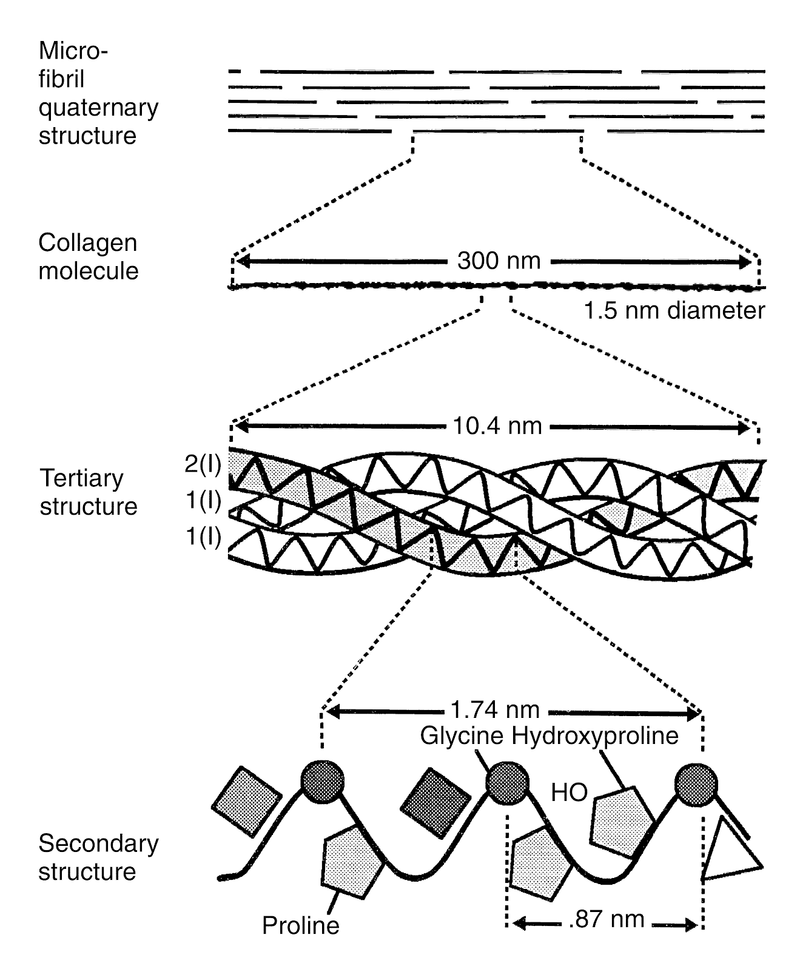
Figure 4 Schematic representation of the structural organization of collagen into the microfibril. The secondary structure is a single helix, and the tertiary structure is a triple helix.
(Reproduced from Woo SLY, An KN, Frank CB, et al: Anatomy, biology, and biomechanics of tendon and ligament, in Buckwalter JA, Einhorn TA, Simon SR (eds): Orthopaedic Basic Science: Biology and Biomechanics of the Musculoskeletal System, ed 2. Rosemont, IL, American Academy of Orthopaedic Surgeons, 2000, pp 581-616.)
Collagen is synthesized and degraded continuously, with a half-life of 300 to 500 days. Consequently, after a period of years, an individual essentially rebuilds his or her native ligaments. This turnover is akin to the remodeling of bone; however, in contrast to the process in bone, the factors regulating collagen remodeling have yet to be elucidated.
Proteoglycans, such as chondroitin 4-sulfate and dermatan sulfate, make up less than 1% of the total dry weight of ligaments. Proteoglycan molecules are polar and thus hydrophilic, binding water within the ligament. Ligaments also contain elastin, fibronectin, and other glycoproteins. Up to 70% of the wet weight of ligaments is water, which is both structurally bound to collagen and freely associated with the interfibrillar gel.
Development and Aging
Ligaments develop in the periarticular mesenchymal tissue, with a layer of synovium separating them from the joint spaces. Development of the ACL, for example, begins with fibroblasts aligning between the femoral and tibial attachment sites. Collagen fibrils are deposited between the cells, parallel to the longitudinal axis of the ligament. The organelles of the fetal and young adult rat ligament cells contain much rough endoplasmic reticulum and a prominent Golgi apparatus, which suggests that these are actively synthesizing cells. As the cells deposit more and more collagen, the bundles of matrix push the cells apart, thus forming the mature ligament with a lower density of cells and higher collagen content.
Studies of growth in rabbit medial collateral ligaments (MCLs) have demonstrated consistent elongation of the ligament, in contrast to the focal centers of growth located at the physes (ie, growth plates) in long bones.6 At the site where ligament inserts into bone, bone cells divide rapidly, and the collagen of the ligament is incorporated into the bone. This active bone remodeling at the insertion site allows the ligament to move in concert with the longitudinal growth of the bone. Therefore, the ligament remains attached to the bone’s metaphyseal region.
Changes in cell content and ligament structure as a function of aging are not yet well known in humans. In animal models, however, it has been shown that the stiffness of the MCL of the knee reaches a maximum at maturity and then gradually declines.7It is not yet known whether this phenomenon is present in all ligaments or in all species. The strength of the attachment of ligament to bone is also suspected to vary with age; adults tend to rupture their ACL in its midsubstance, whereas in skeletally immature patients, the injury more commonly occurs in a bony avulsion of the attachment site of the ligament.
Pathophysiology
Injury and Repair
Damage to a ligament is technically termed a sprain. Sprains are graded according to the amount of gross displacement of the joint appreciated on clinical examination and microscopic findings. A grade 1 sprain is associated with pain but no joint instability on clinical examination. This represents intrafibrous injury to the ligament. A grade 2 sprain occurs when some but not all fibers have been torn; because some fibers are still in continuity, the joint is only minimally unstable when the ligament is stressed. A grade 3 sprain is a complete tear of the ligament. Sprains can be caused both by contact or noncontact mechanisms (such as twisting); in fact, any mechanism that produces tension on the ligament can cause injury. Ligament injuries are common, accounting for 25% to 40% of all knee injuries,8,9 and they are present, by definition, in all joint dislocations.
Ligaments can be broadly divided into those that heal and those that do not, although the propensity for healing is more apt to be a function of the local environment rather than the ligament tissue itself. Ligaments with potential to heal, such as the MCL of the knee, do so by progressing through three characteristic stages: inflammation, proliferation, and remodeling.10,11 The inflammatory phase begins within hours of the injury and predominates throughout the first 7 to 10 days after the injury.12,13 This phase is characterized by the presence of necrosis, inflammatory cells, and the growth of neovascular tissue on the surface of the ligament remnant.13 Corresponding injury to local capillaries causes hematoma formation and signals the continued migration of inflammatory cells. Because inflammation initiates the healing response, use of medications that inhibit inflammation may impede the repair.
The proliferative phase is characterized by an increase in cell density in the ligament remnants with ovoid cells and gradual neovascularization of the entire ligament remnant.12,13 New collagen formation—the provisional scar—and cell migration from the torn ligament ends into the granulation tissue are also seen during this phase.12 Thus, the space between the torn ends of the original ligament is filled with a matrix containing disorganized proteins and many cells. In the rabbit MCL, this phase has started by 10 days and peaks at 21 days after rupture.13
The transition to the remodeling phase is characterized by a decrease in the proliferative fibroblast response and an increase in matrix alignment.12,13 Thus, there is less cellularity and vascularity and denser collagen within the scar. Over time, this collagen becomes more aligned with the natural tensile forces of the given joint. In the rabbit MCL, this phase starts at 21 days and continues for several years.13
The progression from inflammation to proliferation to remodeling also has been reported in other dense, connective tissues, such as tendon and skin. The product of this process is a functional fibrovascular scar. Through the process of remodeling, this scar becomes like the original, uninjured tissue—but not perfectly so. Although remodeling begins as early as 6 weeks after injury, the final reorganization of the tissue (and thus recreation of normal mechanical properties) is not complete for up to 1 year after injury.
Some ligaments, especially intra-articular ligaments such as the ACL, fail to heal after rupture, even when they are sutured back together. It is not clear whether this lack of clinical healing is caused by an inability to initiate a healing response, an inhibition of the response, or simply a lack of nutrition to support healing. It is likely that the failure of these tissues to heal is the result of a combination of factors.
Because of their healing potential, most injuries to ligaments found outside the joint, or extra-articular ligaments, can be treated successfully with immobilization or primary repair. Other treatments, such as ligament reconstruction, are used for intra-articular ligament injuries. For example, the ACL, which is an intra-articular ligament, is commonly treated by removal of the torn ligament and replacement with a tendon graft that is secured in bony tunnels. This graft is only an approximation of the normal ligament, as it is currently impossible to recreate the complex geometry of the native ACL with an artificial ligament. Moreover, it is probable that some of the neurologic function (ie, proprioception) is lost when the ligament is torn.
Even those ligaments that heal require well-conceived treatment. It is known that immobilization can lead to joint stiffness. This is because without the appropriate signals provided by normal mechanical stress, the healing tissue fails to orient itself in the correct direction. This helter-skelter formation of scar causes adhesions. Prolonged immobilization also weakens intact ligaments, as well as their insertion into bone. These processes are reversible, but reversing them takes time.
Systemic Diseases
The Ehlers-Danlos syndromes are a heterogeneous group of syndromes that cause laxity and weakness of ligaments, skin, and blood vessels. There are at least nine clinical and genetic subtypes, all of which are caused by mutations in fibrillar collagen genes and genes that modify fibrillar collagen. For example, Ehlers-Danlos type I is an autosomal dominant disorder caused by a mutation in the gene that is coding for collagen type V, which is important for forming collagen I fibrils. This defect in fibril formation leads to decreased ligament stiffness and joint laxity.
Marfan’s syndrome is an autosomal dominant disease caused by a defect in the gene that is coding for fibrillin. Fibrillin is a large glycoprotein that is a structural component of elastin-containing microfibrils. The gene defect results in decreased fibrillin formation and a structurally weakened elastin. As elastin is one of the structural proteins in ligaments, clinical manifestations of the disease include ligament laxity, loose joints, and other connective tissue problems, such as aortic dilation.
Research and New Directions
Function and Physiologic Response of Various Cells
Although many cells (including vascular cells, nerve cells, myofibroblasts, and fibroblasts) have been identified in ligaments, the contribution of each cell type to normal ligament function and healing after injury is not completely known. It is thought that better characterization of the normal responses of these cells and the signals that modulate them can allow us to augment the healing process.
Growth Factors and Tissue Engineering
Reconstruction of the ACL, while providing functional stability, does not prevent the premature onset of osteoarthritic changes after a knee injury.14 This may be because reconstruction allows only an approximation of the native ligament. Scientists are therefore seeking new treatment methods to promote healing of torn intra-articular ligaments to preserve innervation and the precise ligament geometry.15
Gene Therapy
Injured ligaments heal with tissue that is often mechanically inferior to the original tissue, probably because the collagen of the repair tissue is not identical to the original. Investigators are studying the possibility of using gene therapy to direct the healing response to reproduce the original, native collagen structure.
Key Terms
Anisotropic Having unlike mechanical properties in different directions; that is, the mechanical properties depend on the orientation of the applied force
Crimp An organized, sinusoidal waveform of ligament fascicles that provides minimal stiffness in response to light stress but increased stiffness in response to increased stress
Ehlers-Danlos syndromes A heterogeneous group of syndromes that cause laxity and weakness of ligaments, skin, and blood vessels
Elastin One of the structural proteins in ligaments
Endoligament The vascularized layer of loose connective tissue that surrounds bundles of individual collagen fibrils within a ligament
Epiligament The vascularized layer that covers the surface of the entire ligament
Fascicles Densely organized fiber bundles in muscle and ligament
Fibrillin A large glycoprotein that is a structural component of elastin-containing microfibrils
Hematoma A collection of blood resulting from injury
Ligaments Highly organized, fibrous tissues that connect bone to bone
References
1. Dorlot JM, Sidi MAB, Tremblay GM, et al: Load elongation behaviour of the canine anterior cruciate ligament. J Biomech Eng 1980;102:190-193.
2. Diamant J, Keller A, Baer E, et al: Collagen: Ultrastructure and its relation to mechanical properties as a function of ageing. Proc R Soc Lond B Biol Sci 1972;180:293-315.
3. Pitman MI, Nainzadeh N, Menche D, et al: The intraoperative evaluation of the neurosensory function of the anterior cruciate ligament in humans using somatosensory evoked potentials. Arthroscopy 1992;8:442-447.
4. Cooper RR, Misol S: Tendon and ligament insertion: A light and electron microscopic study. J Bone Joint Surg Am 1970;52:1-20.
5. Laros GS, Tipton CM, Cooper RR: Influence of physical activity on ligament insertions in the knees of dogs. J Bone Joint Surg Am 1971;53:275-286.
6. Muller P, Dahners LE: A study of ligamentous growth. Clin Orthop 1988;229:274-277.
7. Woo SL, Ohland KJ, Weiss JA: Aging and sex-related changes in the biomechanical properties of the rabbit medial collateral ligament. Mech Ageing Dev 1990;56:129-142.
8. DeHaven KE, Lintner DM: Athletic injuries: Comparison by age, sport, and gender. Am J Sports Med 1986;14:218-224.
9. Praemer A, Furner S, Rice DP: (eds): Musculoskeletal Conditions in the United States, ed 2. Rosemont, IL, American Academy of Orthopaedic Surgeons, 1999, p 170.
10. Andriacchi T, Sabiston P, DeHaven K, et al: Ligament: Injury and repair, in Woo SLY, Buckwalter JA (eds): Injury and Repair of the Musculoskeletal Soft Tissues. Park Ridge, IL, American Academy of Orthopaedic Surgeons, 1988, pp 103-128.
11. Arnoczky SP: Physiologic principles of ligament injuries and healing, in Scott WN (ed): Ligament and Extensor Mechanism Injuries of the Knee: Diagnosis and Treatment. St Louis, MO, Mosby-Year Book, 1991, pp 67-81.
12. Jack EA: Experimental rupture of the medial collateral ligament of the knee. J Bone Joint Surg Br 1950;32:396-402.
13. Frank C, Amiel D, Akeson WH: Healing of the medial collateral ligament of the knee: A morphological and biochemical assessment in rabbits. Acta Orthop Scand 1983;54:917-923.
14. Daniel DM, Stone ML, Dobson BE, et al: Fate of the ACL-injured patient: A prospective outcome study. Am J Sports Med 1994;22:632-644.
15. Murray MM, Martin SD, Spector M: Migration of cells from human anterior cruciate ligament explants into collagen-glycosaminoglycan scaffolds. J Orthop Res 2000;18:557-564.
