

Adult Rheumatoid Arthritis
Rheumatoid arthritis (RA) is a chronic inflammatory disease that is probably triggered by an antigen and presents as an inflammatory reaction against the synovium in the joint (Fig. 1
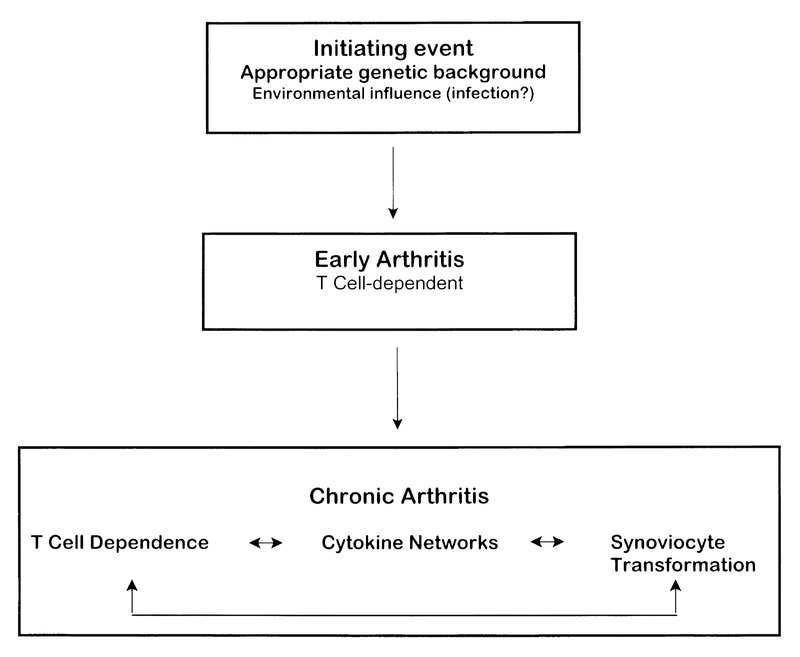
Figure 1 Pathogenesis of RA is complex, involving immune processes lead byT cells, cytokine-driven events (responsible for most of the erosive events), and fibroblast-like synoviocyte transformation, resulting in pannus formation, hypercellularity, and hyperplasia.
(Reproduced from Recklies AD, Poole AR, Banerjee S, et al: Pathophysiologic aspects of inflammation in diarthrodial joints, in Buckwalter JA, Einhorn TA, Simon SR (eds): Orthopaedic Basic Science: Biology and Biomechanics of the Musculoskeletal System, ed 2. Rosemont, IL, American Academy of Orthopaedic Surgeons, 2000, pp 489-530.)
This immune process leads to a proliferative synovitis (pannus formation), which proceeds to destroy the joint. Clinically, RA follows a course of waxing and waning, but it results in progressive disability over time. Patients with RA may be disabled from the disease beyond its effect in the joints. For example, RA can cause systemic manifestations, such as fatigue, weight loss, or anemia. In addition, RA is often treated with potent drugs; thus, patients are potentially exposed to complications from medications.
The initial effects of RA in the joint are manifest as stiffness, and the disease may progress to complete destruction of the articular surfaces. The damage is inflicted by the proliferative synovium itself, which tends to physically invade the joint space, as well as by enzymes that the synovium and reactive white blood cells release. RA also affects the ligaments of the joint; therefore, instability and deformity are characteristic (Fig. 2
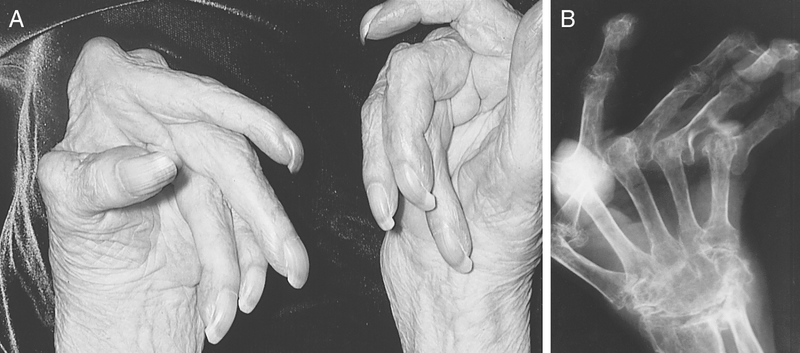
Figure 2 Advanced RA. Note that the fingers are deviated toward the ulnar side of the hand because synovitis destroys the tendon sheath. A, Clinical appearance. B, Radiographic appearance.
(Reproduced from Greene WB: Essentials of Musculoskeletal Care, ed 2. Rosemont, IL, American Academy of Orthopaedic Surgeons, 2001, p 213.)
RA represents the intersection between musculoskeletal medicine and the basic science of immunology and inflammation. It is therefore a rich and, at times, recondite subject. This chapter perforce is but an overview.
Epidemiology
RA affects approximately 1% of the population in the United States. Approximately two of every three patients with RA are female.1 RA typically occurs in patients between the ages of 40 and 60 years, although there is a juvenile form that can be found in those younger than 16 years. There appears to be a genetic susceptibility to this condition, as a monozygotic twin of a patient with RA is more likely to have the condition than a dizygotictwin. However, genes are not the only factor affecting susceptibility because even a monozygotic twin has only approximately a 15% chance of having RA when the twin has it.2,3
Pathophysiology
The exact etiology of RA is not known. It is thought that exposure to an antigen in a genetically susceptible host leads to an antibody production directed against the synovium.In this model, the antigen activatesT cells, which produce cytokines.These mediators stimulate antibody production by B cells.4-6 Among these antibodies is the classic rheumatoid factor that binds to IgG. These antibodies are then deposited as immune complexes in the synovium and in cartilage. Activation of other white blood cells promotes a chronic inflammatory state (Fig. 3
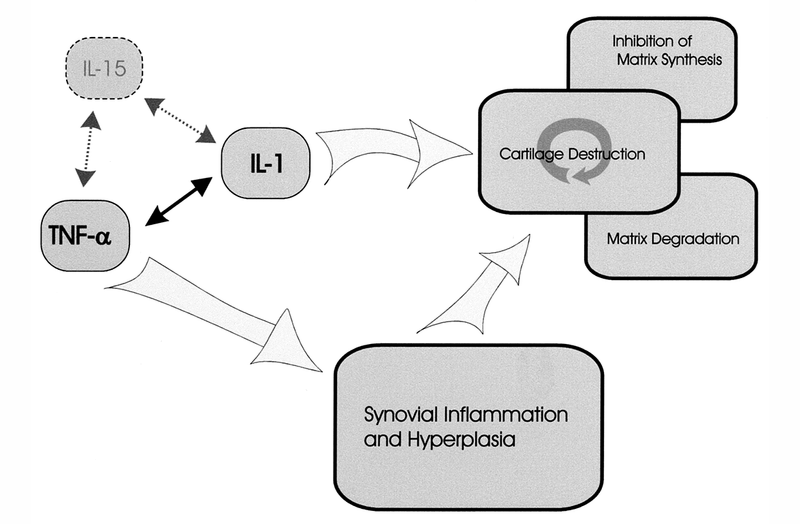
Figure 3 Cytokines found in the joint initiate and perpetuate many different inflammatory processes. TNF-α is thought to control many of the processes attributed to inflammatory cells in the joint fluid, and IL-1 is thought to act within the articular cartilage itself. The role of IL-15 in this hierarchy is currently hypothetical, but existing data suggest that IL-15 may act to initiate the T-cell driven autoimmune process.
(Reproduced from Recklies AD, Poole AR, Banerjee S, et al: Pathophysiologic aspects of inflammation in diarthrodial joints, in Buckwalter JA, Einhorn TA, Simon SR (eds): Orthopaedic Basic Science: Biology and Biomechanics of the Musculoskeletal System, ed 2. Rosemont, IL, American Academy of Orthopaedic Surgeons, 2000, pp 489-530.)
Synovial proliferation follows this immune activation, a process called pannus formation. The pannus is hyperplastic synovium with fibroblasts, blood vessels, macrophages, and lymphocytes. The synovial cavity of the joint becomes filled with fluid (an inflammatory effusion). The pannus itself, synovial fluid inflammatory cells, and bone-based osteoclasts attack cartilage and bone, resulting in joint destruction.7-9 This destruction produces two characteristic radiographic features of RA: marginal erosions and symmetric narrowing of the joint space medially and laterally. Osteoarthritis, by contrast, tends to produce asymmetric joint space narrowing, beginning on thepoint of maximal force bearing or previous trauma.
Extra-articular manifestations of RA can occur, the most common of which is a subcutaneous nodule found near the joint. Rheumatoid nodules contain granulation tissue and inflammatory white blood cells. The synovitis of RA often extends to the tendon sheath as well, leading to its destruction. In patients with RA of the hand, loss of the tendon sheath causes ulnar deviation of the fingers because the tendons no longer remain tethered to the digit. In some patients with RA, inflammation in the heart, lung, or blood vessels may also occur.
The destruction of the joint in patients with RA is modulated by various factors. These include various cytokines as well as specific matrix-destroying enzymes.10 These factors are elaborated from the synovial macrophagesand invading T cells. The activation of these cells is thought to be responsible for the extra-articular manifestations of the disease.
Presentation
The presentation of RA depends on the stage of the disease. Moreover, expression of the disease varies not only from individual to individual but also within the same individual over time. RA often begins as an acute period of nonspecific complaints, such as malaise and joint pain. Characteristically, patients have diffuse joint tenderness and swelling, accompanied by morning stiffness lasting for at least 1 hour. The commonly accepted criterion is that these findings must be present for at least 6 weeks to make a diagnosis of RA (transient inflammation may have other, more benign causes). Patients with RA will demonstrate tender, warm, and swollen joints and have pain with motion. When the disease is long-standing, there will be characteristic objective findings, such as ulnar deviation of the fingers and radialdeviation of the wrist caused by erosion of the extensor tendon sheath. Flexion or extension deformities of the fingers are also common.
Diagnostic Imaging
Imaging for RA in its early stages may not be diagnostic. Because RA begins by attacking soft tissue before bone, in its early stages, signs are not readily apparent on plain radiographs. As the disease progresses, osteopenia caused by increased blood flow and osteoclast activity can be detected. Marginal erosions of the bone are seen as the pannus begins to destroy bone. As the disease progresses, symmetric joint space narrowing occurs, culminating in total destruction of the articular surface (Fig. 4
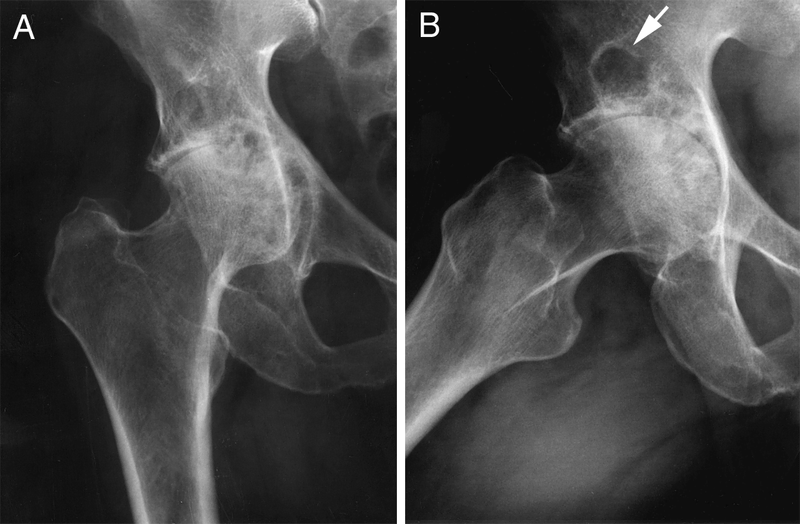
Figure 4 AP (A) and lateral (B) radiographs of the hip of a 56-year-old man with RA show moderate diffuse periarticular osteopenia, loss of joint space, and extensive acetabular cyst formation (arrow).
(Reproduced from Lachiewicz PF: Rheumatoid arthritis of the hip. J Am Acad Orthop Surg 1997;5:332-338.)
RA can cause instability of the cervical spine when tenosynovitis near the C1-C2 junction destroys the transverse ligament holding the odontoid.11,12 A cervical spine radiograph is therefore mandatory prior toelective endotracheal intubation of patients with RA.
Laboratory Studies
Laboratory studies may be helpful in the diagnosis of RA, but RA is not conclusively diagnosed on the basis of any single laboratory test result. The most useful laboratory test is probably the aspiration and analysis of the joint fluid, which is performed not so much to make the diagnosis of RA, but to exclude two other conditions that may mimic it: infectious arthritis and gout. When infectious arthritis or gout is present, bacteria or urate crystals usually are apparent on analysis of aspirated joint fluid. The fluid in RA is typically characterized by increased neutrophil concentration but only to moderate levels; cell counts are usually in the 5,000 to 50,000 range. A complete blood cell count of patients with RA may show an elevated white blood cell count in the peripheral circulation and anemia as well. Two useful tests for evaluating systemic inflammation involve determining the serum C-reactive protein concentration and the erythrocyte sedimentation rate.
Circulating rheumatoid factor also can be measured. The sensitivity of rheumatic factor for the diagnosis of RA is approximately 80%; therefore, it is a poor screening test. However, its relatively high specificity (approximately 95%) allows it to be used as a confirmatory test. Serial monitoring of rheumatoid factor levels does not offer valuable clinical information. In general, patients with RA who do not have circulating rheumatoid factor have a more benign course.
A number of clinical features have been associated with an unfavorable prognosis. These include persistent polyarticular synovitis for more than 2 years, the presence of articular erosions, and the presence of extra-articular manifestations. Extra-articular manifestations may be general and include fatigue, low-grade fever, weight loss, or anorexia; or they may be organ-specific and include subcutaneous nodules, interstitial lung disease, pleural effusions, or neuropathy. The presence of extra-articular manifestations usually mandates aggressive antirheumatic therapy.
Treatment and Prevention
There is no known prevention for RA. Nonetheless, aggressive treatment of early forms of the disease can be viewed as a preventive measure in that damage is prevented—that is, the disease process is arrested before it is able to destroy joints.
The management of RA is centered on drug therapies, although patient education, supportive counseling, and exercise are also essential to attain a good outcome. The pharmacologic therapy of RA is directed to relieve joint pain, limit inflammation, andretard joint destruction. Because the inflammation of RA is mediated by cytokines, drugs that block them are most effective. Nonsteroidal anti-inflammatory drugs (NSAIDs) are nonspecific inhibitors of prostaglandin synthesis. Accordingly, they can control joint pain, but they do not retard joint destruction. Corticosteroids are also used to limit inflammation. Both NSAIDs and corticosteroids expose the patient to the risk of complications. NSAIDs increase the risk of gastrointestinal bleeding and renal dysfunction, whereas the long-term use of corticosteroids frequently produces osteoporosis and other serious complications.
Another category of drugs used to treat RA is called disease-modifying antirheumatic drugs (DMARDs). The goal of using DMARDs is to prevent joint destruction. The most frequently used DMARD is methotrexate, which can slow the progression of joint destruction in patients with RA. Methotrexate is a known inhibitor of folate metabolism; however, its precise effect on RA is not clear. Other DMARDs include immunosuppressive medications, such as sulfasalazine or cyclosporine, and newer biologic agents directed at inhibiting the actions of tumor necrosis factor (TNF)-α or interleukin-1 (IL-1).
The surgical treatment of patients with RA includes joint arthroplasty for damaged joints, fusion of unstable joints, and tenosynovectomy to prevent tendon rupture.
Differential Diagnosis
RA can be confused with other forms of inflammatory arthritis, such as systemic lupus erythematosus and viral arthritis. It may also be confused with septic arthritis and gout because both are inflammatory conditions that produce fluid in the joints and pain. Appropriate laboratory tests, however, should be able to differentiate these conditions from RA. RA can also be confused with seronegative spondyloarthropathies, inflammatory joint diseases that occur in the absence of rheumatoid factor (hence, the term seronegative). These conditions affect the sacroiliac joint and frequently the spine and include ankylosing spondylitis and psoriatic arthritis. Although clinically important and scientifically interesting, an in-depth discussion of seronegative spondyloarthropathies is beyond the scope of this book.
Juvenile Rheumatoid Arthritis
Juvenile rheumatoid arthritis (JRA) may present as a systemic disease or as one affecting only the joints. Approximately 5% to 10% of children with JRA present with systemic signs, including fever, rash, pericarditis, or hepatosplenomegaly. These patients may have significant laboratory abnormalities, including leukocytosis and anemia. Although this form of disease can occur at any age, most cases are seen in patients younger than 10 years. The degree of joint involvement in this form of JRA can range from mild arthalgias to florid swelling of all joints. Children with this form of the disease appear acutely and gravely ill and may require hospitalization.
Epidemiology
JRA is classified as pauciarticular when it affects four or fewer joints over the first 6 months of the disease and as polyarticular when more than four joints are affected. Both types present with joint swelling over a period of weeks to months. Girls with pauciarticular disease are at high risk for eye involvement (chronic uveitis); boys with this subtype may develop a spondyloarthropathy (spinal arthritis). In children with polyarticular disease, the presence of rheumatoid factor in the blood (found in about 20% of patients) is a risk factor for a more persistent and destructive arthritis.
Pathophysiology
Factors similar to those implicated in RA are thought to affect JRA as well. Specifically, genetic predisposition (HLA-DR4 in seropositive JRA, HLA-DR4 in pauciarticular type I, and HLA-B27 in pauciarticular type II), unknown environmental triggers, and immune reactivity are all thought to be possible causes. The inflammatory synovitis that is the hall-mark of JRA does not differ among subtypes and is generally more vascular than that seen in adults.
Diagnosis
Diagnosis is made by the demonstration of persistent arthritis in one or more joints for a minimum of 6 weeks, the exclusion of other diagnoses and, in the case of systemic disease, the presence of either fever or rash.
Treatment
Once the diagnosis of JRA is established, a therapeutic plan is devised based on the subtype and severity of disease. NSAIDs are standard initial therapy. In systemic disease, second-line agents such as hydroxychloroquine or methotrexate may be added early in the disease course; corticosteroids may be required for pericarditis or disease that is unresponsive to other therapies. Most children with pauciarticular disease will respond to an appropriate NSAID. Intra-articularcorticosteroids may be needed, and occasionally second-line agents such as sulfasalazine are added. Patients with persistent, severe systemic or polyarticular disease who do not adequately respond to methotrexate therapy are candidates for treatment with anti-TNF drugs. Low-dose, short-term corticosteroid therapy may be needed. Long-term corticosteroid use in children is avoided because steroids may cause growth retardation, iatrogenic Cushing’s disease, osteoporosis, fractures, and hypertension.
In addition to drug therapy, children with JRA must be carefully monitored for growth abnormalities, nutritional problems, and school and social dysfunction. Psychological and emotional health may be difficult to maintain in the presence of chronicdisease. Therapeutic exercise programs can maximize joint motion and minimize muscle atrophy.
Other Inflammatory Arthritides
Gout is an inflammatory arthritis associated with elevated serum levels of urate (hyperuricemia). Hyperuricemia results from increased production or impaired excretion of uric acid. Acute inflammatory arthritis results when crystals of uric acid are deposited in joints. The synovium subsequently becomes hyperemic and swollen, but pannus formation does not occur in acute cases. Neutrophils ingest urate crystals and release mediators of inflammation. With treatment, these crystals can be removed, and the joint can be returned to normal. Gout has a chronic form in which tophi (chalky deposits of urate surrounded by inflammatory cells) are formed adjacent to the joint. In chronic gout, the synovium reacts to the formation of these tophi by becoming hyperplastic, and pannus is formed that leads to erosion of bone. Tophi typically arise close to the joints, but they may also appear in the soft tissue at some distance from the joint or even in other tissues located far from joints (eg, the ear).
Epidemiology
Gout is less common than RA. Unlike RA, it is more prevalent in men by a factor of 9:1. Elevated levels of urate are not synonymous with the presence of gouty arthritis.13 Many people with transiently elevated urate levels will never have arthritis; in those who do, however, the urate levels are often elevated for years before the disease is manifest in the joints.
Pathophysiology
The most common form of gout occurs because of decreased excretion of urate by the kidney. Less common causes of this condition include enzymatic defects or diseases with increased nucleotide production. Diet tends to have a direct effect on gout. Excessive organ meat consumption can lead to increased urate levels, and drinking alcohol tends to block the excretion of urate. Taken together, a diet rich in alcohol and organ meats is likely to aggravate gout.
Presentation
Most people with hyperuricemia are asymptomatic. Some will have an acute gouty flare and experience increasing pain over a short number of hours, which typically occurs in only one joint—most often the metatarsophalangeal joint of the great toe. People who experience these types of episodes may report recent alcohol consumption or have a known history of asymptomatic hyperuricemia. Objective findings include marked tenderness, erythema, warmth, swelling, and severe limitation of motion. Patients with chronic forms of the disease may also have palpable tophi.14
Diagnostic Imaging
In its initial stage, gout is comparable on radiographs to RA because only soft-tissue swelling is seen; however, as the disease progresses, erosions and ultimately joint destruction may be apparent. The erosions that occur with gout are characteristic and may be easily discerned from those that occur with RA. In patients with gout, new bone formation partially surrounding a tophus creates a characteristic overhanging margin (Fig. 5
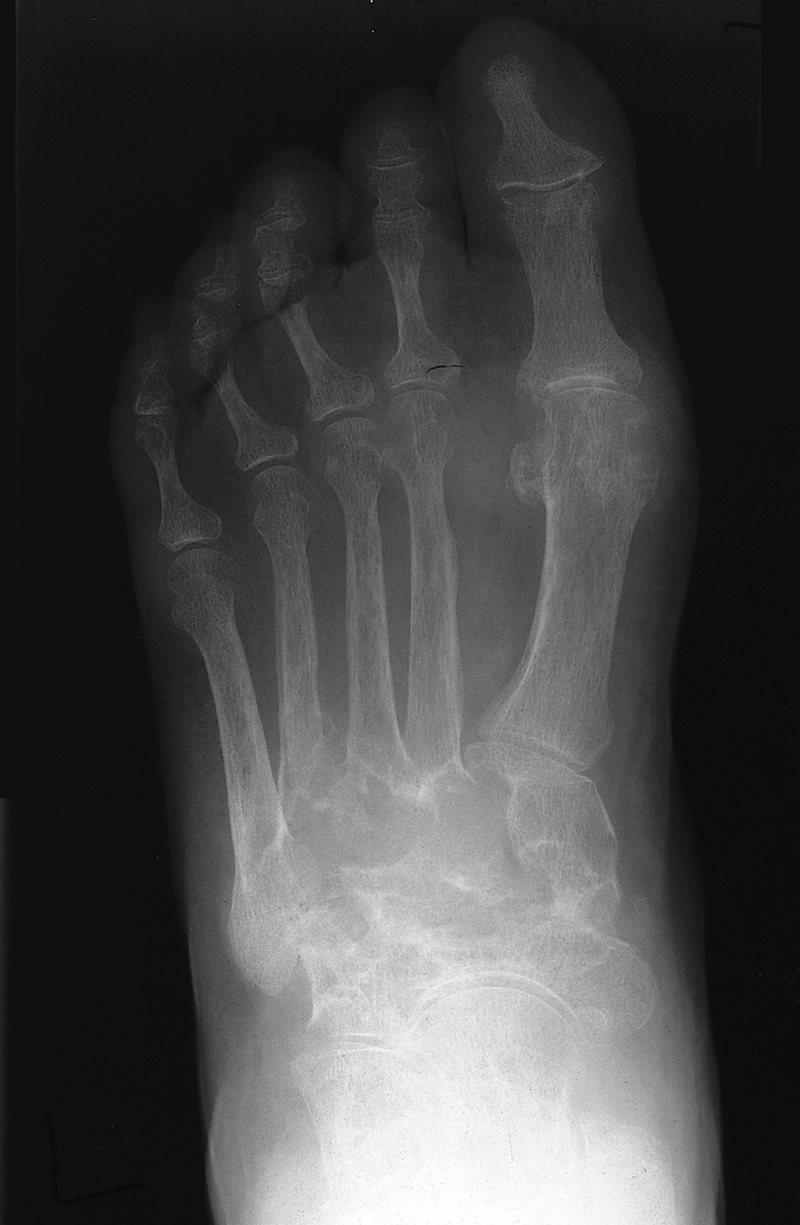
Figure 5 AP view of the foot shows erosions with an overhanging margin in the distal medial metatarsal of the metatarsophalangeal joint of the great toe. Note that the central joint space is not narrowed or compromised. A lateral view will further delineate the size and location of the erosion.
Laboratory Studies
The measurement of serum urate levels is not particularly helpful in diagnosing gout because gout will not develop in many patients with elevated urate levels. Some patients with active gout may have a normal serum urate level at the time of presentation. Other circumstances may result in hyperuricemia, such as renal insufficiency or ingestion of drugs (eg, thiazide diuretics).
Gout is diagnosed by laboratory testing of the synovial fluid. This fluid will show high levels of white blood cells and, more importantly, characteristic needle-shaped monosodium urate crystals. Because monosodium urate crystals are negatively birefringent (doubly refractive), the precise identification of crystals is made with polarized light. Calcium pyrophosphate may also deposit as crystals in the joint (a condition called pseudogout); these crystals are positively birefringent.
Treatment and Prevention
Gouty arthritis can be prevented by reducing elevated urate levels with diet modification or medication. Dietary recommendations include decreased ingestion of purines and decreased alcohol consumption. Drugs that lower serum urate levels include probenecid, which promotes the excretion of urate in the urine, and allopurinol, a xanthine oxidase inhibitor that decreases the synthesis of uric acid.
Colchicine can be used to treat acute episodes of gout because it blocks neutrophil phagocytosis of urate crystals. NSAIDs, of course, can be used to relieve pain and acute inflammation. Historically, indomethacin has been the agent of choice, but other NSAIDs can be equally effective.15 For patients with chronic renal insufficiency, corticosteroids are the drug of choice.
Key Terms
Gout An inflammatory arthritis associated with deposition of urate crystals in the joint
Hyperuricemia Elevated serum levels of urate
Juvenile rheumatoid arthritis A chronic inflammatory disease in children that is characterized by pain, swelling, and tenderness in one or more joints and may result in impaired growth and development
Rheumatoid arthritis A chronic inflammatory disease that is probably triggered by an antigen-mediated inflammatory reaction against the synovium in the joint
Tophi Chalky deposits of urate surrounded by inflammatory cells
References
1. Lee DM, Weinblatt ME: Rheumatoid arthritis. Lancet 2001;358:903-911.
2. Aho K, Koskenvuo M, Tuominen J, et al: Occurrence of rheumatoid arthritis in a nationwide series of twins. J Rheumatol 1986;13:899-902.
3. Silman AJ, MacGregor AJ, Thomson W, et al: Twin concordance rates for rheumatoid arthritis: results from a nationwide study. Br J Rheumatol 1993;32:903-907.
4. Jenkins RN, Nikaein A, Zimmermann A, et al: T cell receptor V beta gene bias in rheumatoid arthritis. J Clin Invest 1993;92:2688-2701.
5. Uematsu Y, Wege H, Straus A, et al: The T-cell-receptor repertoire in the synovial fluid of a patient with rheumatoid arthritis is polyclonal. Proc Natl Acad Sci USA 1991;88:8534-8538.
6. Wagner UG, Koetz K, Weyand CM, et al: Perturbation of the T cell repertoire in rheumatoid arthritis. Proc Natl Acad Sci USA 1998;95:14447-14452.
7. Shiozawa S, Shiozawa K, Fujita T: Morphologic observations in the early phase of the cartilage-pannus junction: Light and electron microscopic studies of active cellular pannus. Arthritis Rheum 1983;26:472-478.
8. McCachren SS, Haynes BF, Niedel JE: Localization of collagenase mRNA in rheumatoid arthritis synovium by in situ hybridization histochemistry. J Clin Immunol 1990;10:19-27.
9. Gravallese EM, Darling JM, Ladd AL, et al: In situ hybridization studies of stromelysin and collagenase messenger RNA expression in rheumatoid synovium. Arthritis Rheum 1991;34:1076-1084.
11. Bland JH: Rheumatoid arthritis of the cervical spine. J Rheumatol 1974;1:319-342.
12. Kauppi M, Sakaguchi M, Konttinen YT, et al: Pathogenetic mechanism and prevalence of the stable atlantoaxial subluxation in rheumatoid arthritis. J Rheumatol 1996;23:831-834.
13. McCarty DJ: Gout without hyperuricemia. JAMA 1994;271:302-303.
14. Lawry GV II, Fan PT, Bluestone R: Polyarticular versus monoarticular gout: A prospective, comparative analysis of clinical features. Medicine (Baltimore) 1988;67:335-343.
15. Emmerson BT: The management of gout. N Engl J Med 1996;334:445-451.
