

Shoulder and Arm
Inspection
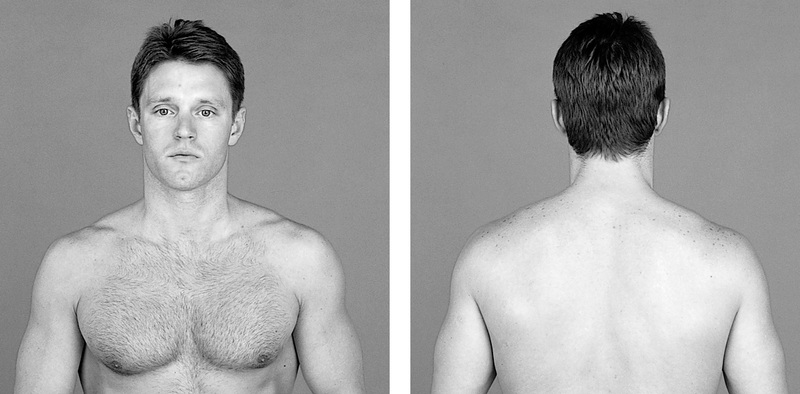
Look for erythema, ecchymosis, and swelling. Noting deformity and atrophy is particularly important. In the shoulder this may be difficult to appreciate because atrophy of the large muscles of the shoulder girdle must be severe to recognize it. Although infraspinatus and supraspinatus atrophy can be identified by inspection of the respective fossae posteriorly, the best way is to note any asymmetry from side to side.
Range of Motion
Shoulder motion consists of motion at three joints: AC, glenohumeral and scapulothoracic. Begin the examination with an assessment of active range of motion. If abnormal, it must be compared with passive range of motion.
Forward flexion
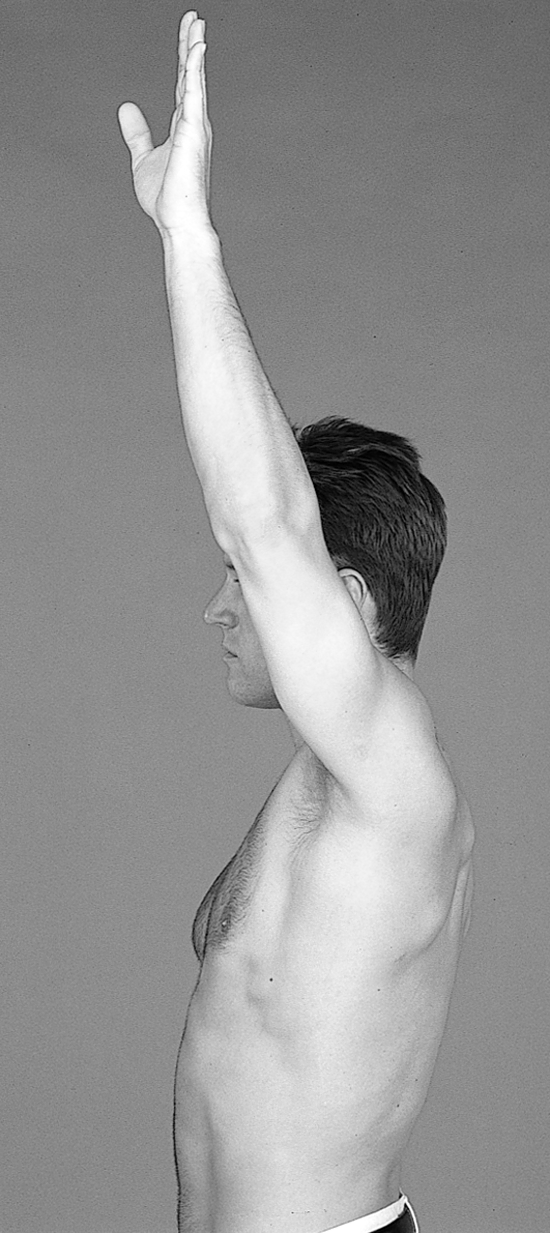
What to do: Ask the patient to elevate the arms above the head in the forward (or sagittal) and coronal planes.
Normal: Ability to forward flex to 165º.
Interpretation: If the patient is unable to do this, passive motion must also be evaluated. Restricted active motion alone suggests a neurologic or muscular cause, such as a rotator cuff tear. Restricted passive motion suggests a mechanical block, most commonly frozen shoulder. Supraspinatus (rotator cuff muscle) is typically needed to initiate the motion but not to hold it.
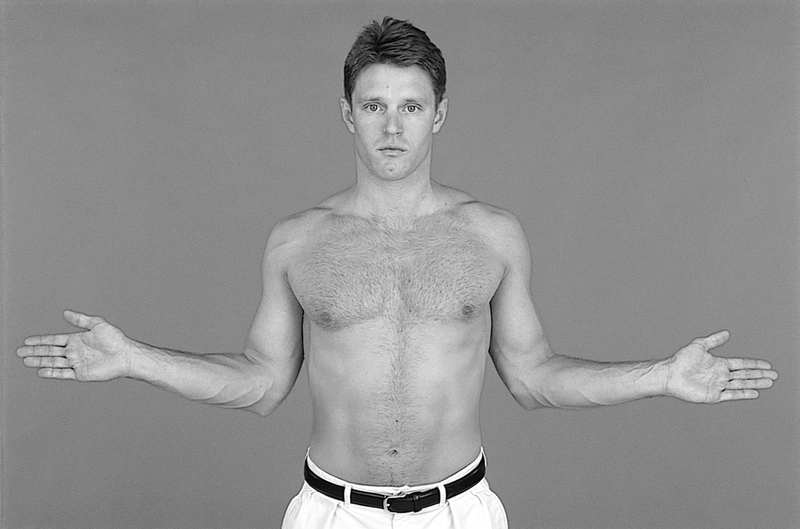
External rotation
What to do: With the patient’s arm held against the chest wall and the elbow flexed to 90º, rotate the patient’s shoulder externally.
Normal: 45º to 90º.
Interpretation: Lack of external rotation is often observed in patients with a frozen shoulder or glenohumeral arthritis. A radiograph can help distinguish between these two diagnoses.
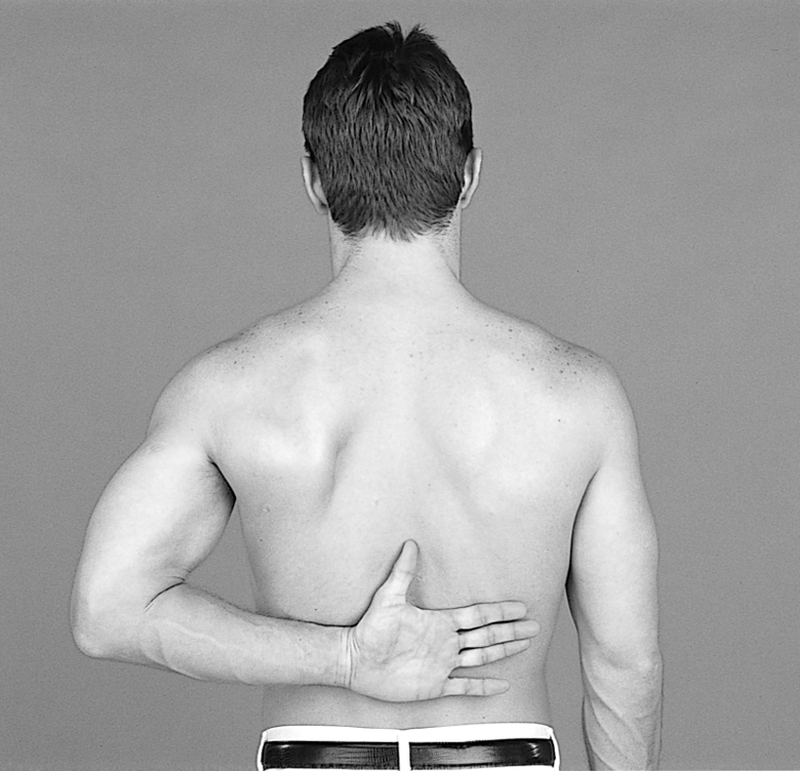
Internal rotation
What to do: Ask the patient to bring the arm behind the back. Record the vertebral level the patient can reach.
Normal: Internal rotation to the midthoracic spine.
Interpretation: Lack of internal rotation can be associated with a frozen shoulder or glenohumeral arthritis. In addition, patients with rotator cuff tears or contracture of the posterior capsule typically have restricted internal rotation resulting from pain.
Motor Testing
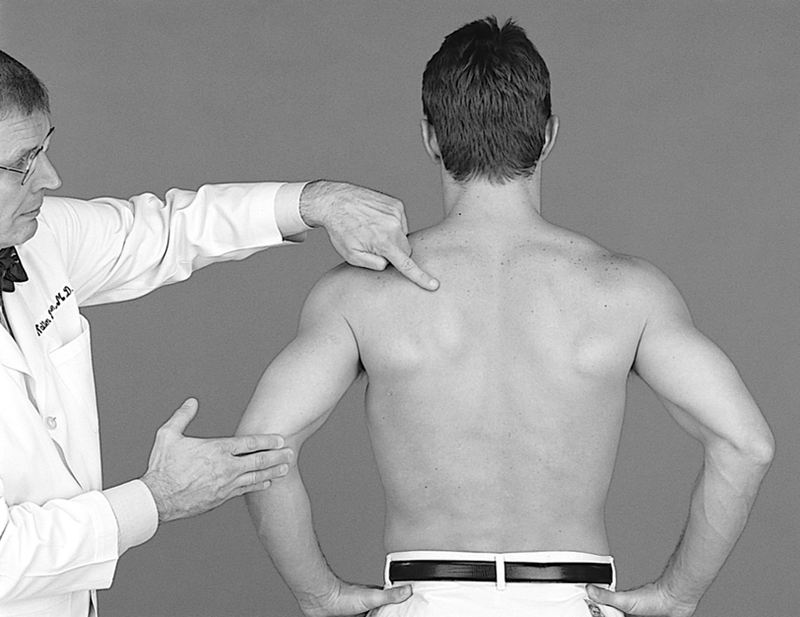
Rhomboideus major and rhomboideus minor (dorsal scapular nerve, C5)
What to do: Ask the patient to place both hands on the side of the iliac crest. Stand beside the patient and push the patient’s arm and elbow anteriorly with one hand and palpate the vertebral border of the scapula with the other hand.
Normal: Rhomboids palpable and scapula maintained against the chest wall.
Interpretation: Winging can indicate a brachial plexus injury.
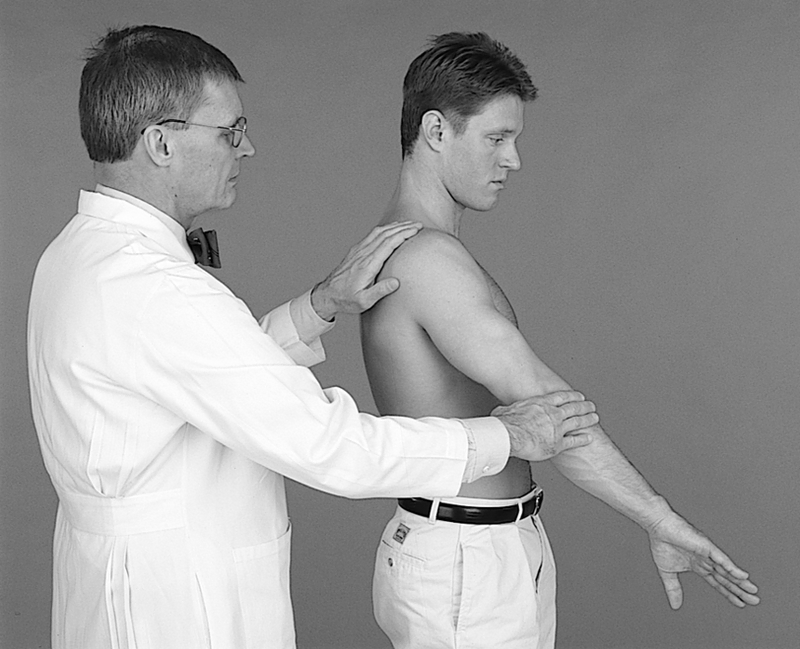
Supraspinatus (suprascapular nerve, C5-C6)
What to do: Ask the patient to abduct the arm in the scapular plane (ie, halfway between the front and the side of the body) and maximally rotate the arm internally so that the thumb points toward the floor. Then apply downward force to the patient’s arm against resistance.
Normal: Good muscle strength maintained against resistance without pain.
Interpretation: Failure to maintain this position results in the “drop arm sign” and suggests a supraspinatus tear. Mild weakness or pain may suggest tendinitis.
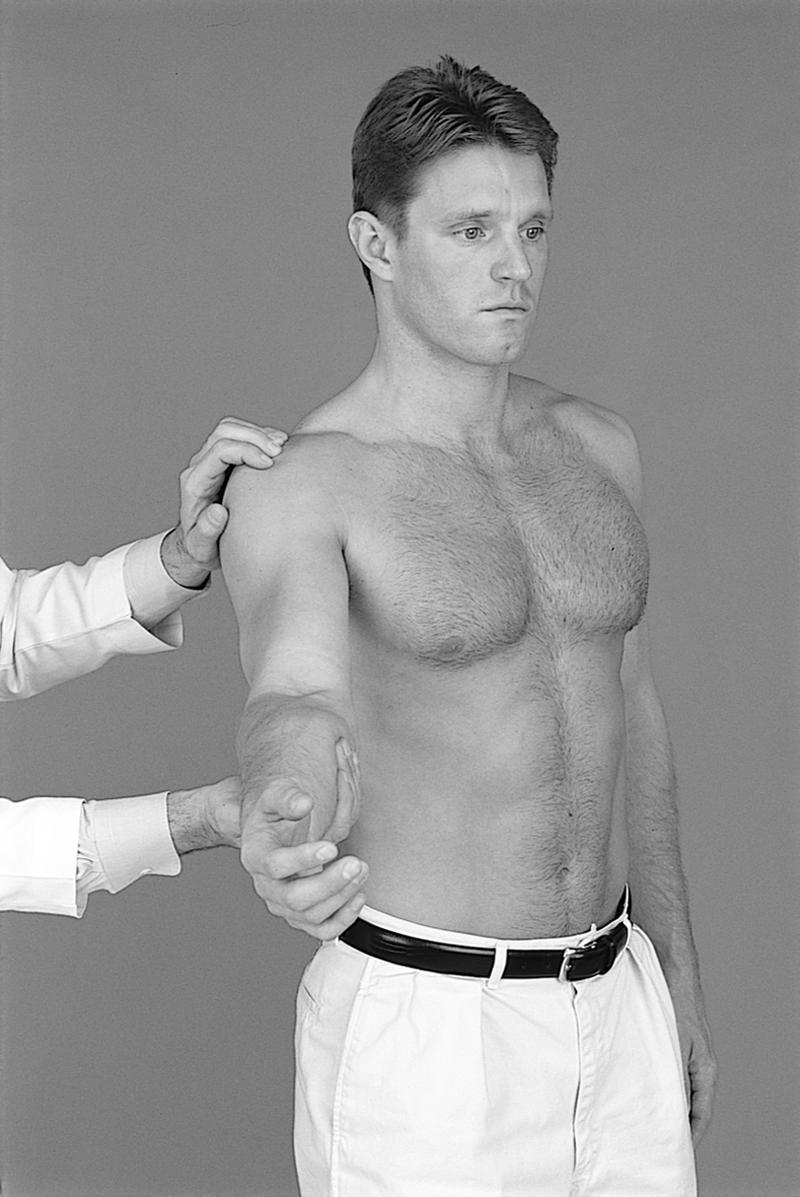
Infraspinatus (suprascapular nerve, C5-C6)
What to do: Ask the patient to place the arm comfortably at the side so that the elbow is positioned against the chest wall and flexed 90o with the forearm in neutral rotation. Then ask the patient to externally rotate the arm against internal rotation resistance applied at the wrist.
Normal: Adequate muscle strength maintained against resistance.
Interpretation: Inadequate muscle strength usually indicates a rotator cuff tear. Injury to the suprascapular nerve, including compression from a cyst, can also result in inadequate muscle strength.
Comment: If the arm is not held at the side, the posterior deltoid can externally rotate the arm and mask an injury to the posterior rotator cuff.
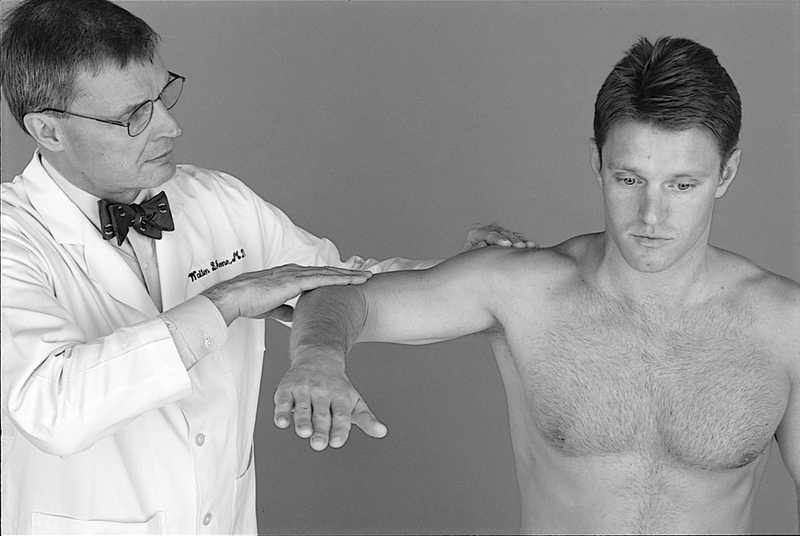
Deltoid (axillary nerve, C5-C6)
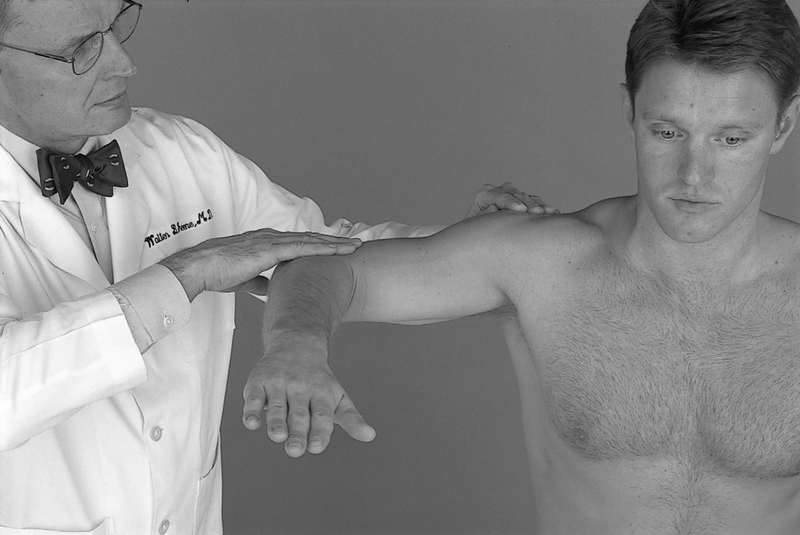
What to do: Ask the patient to abduct the arm to 90o. Then apply maximal downward force to the lateral aspect of the elbow with one hand and palpate all portions (anterior, middle, and posterior) of the deltoid muscle with the other hand.
Normal: Adequate muscle strength maintained; no defects felt in the muscle.
Interpretation: Deltoid weakness can be caused by injury to the axillary nerve, which commonly occurs with proximal humerus fracture or glenohumeral dislocation.
Comment: If the patient is in too much pain to move the arm (ie, after a fracture), test the sensory function of the axillary nerve by palpating the area where the deltoid inserts on the lateral humerus.
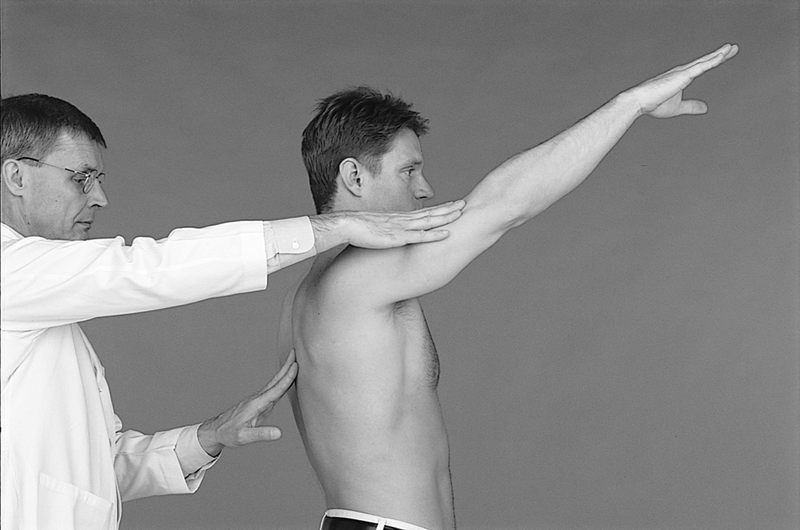
Serratus anterior (long thoracic nerve, C5-C6-C7)
What to do: Stand behind the patient and ask the patient to elevate the arm from the resting position at the side of the body. With one hand, apply steady downward force to the arm, resisting the patient, while using the other hand to palpate the scapula.
Normal: Scapula held against chest wall with arm elevation.
Interpretation: Inability to maintain the scapula in the normal position is called “scapular winging.” This usually occurs from a stretch injury to the long thoracic nerve.
Comment: “Scapular winging” can also be observed by viewing the patient from behind as the patient performs a “wall push-up,” ie, pushing the body away from a wall.
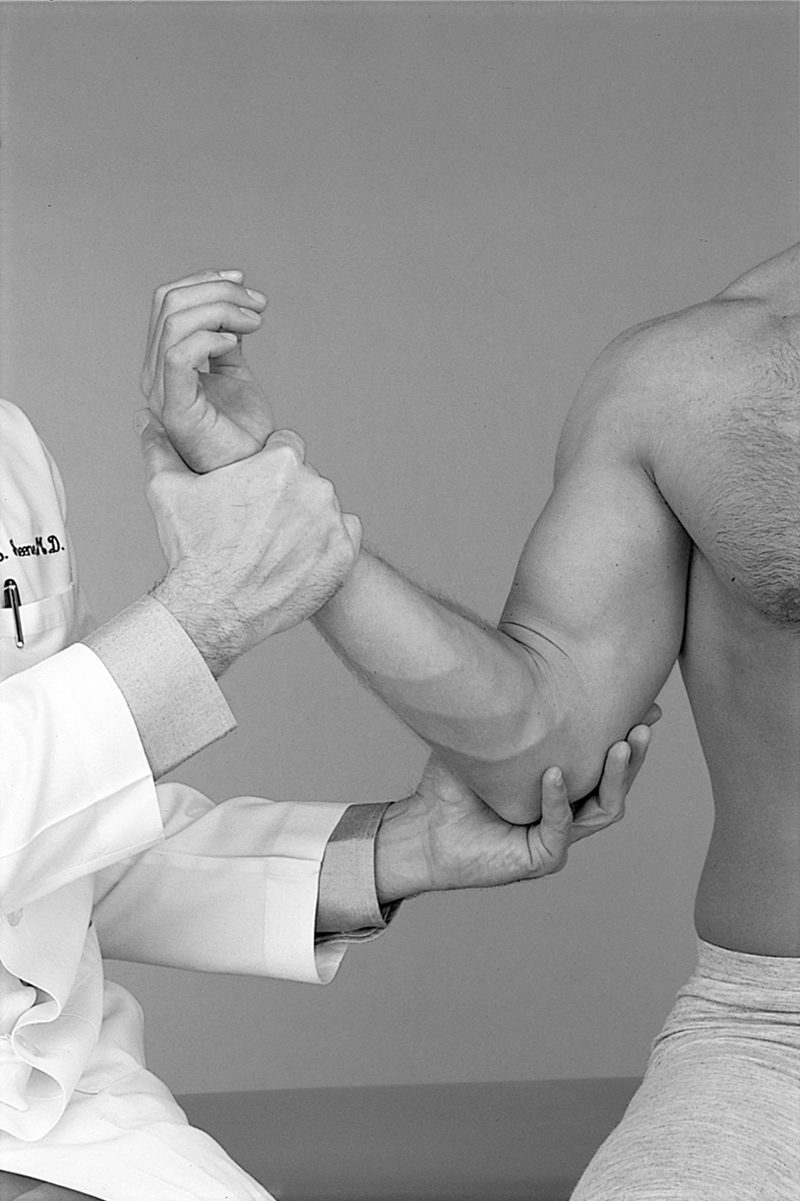
Biceps brachii (musculocutaneous nerve, C5-C6)
What to do: Stand in front of the patient and ask the patient to flex the elbow.
Normal: Adequate muscle strength maintained against resistance.
Interpretation: A soft-tissue mass in the middle of the arm (Popeye sign) may be consistent with a rupture of the long head of the biceps, resulting in retraction of the muscle belly. Tendinitis causes pain near the origin of the tendon.
Comment: Rupture of the long head of the biceps may be seen as a component of subacromial impingement syndrome and rotator cuff tears.
Special Tests
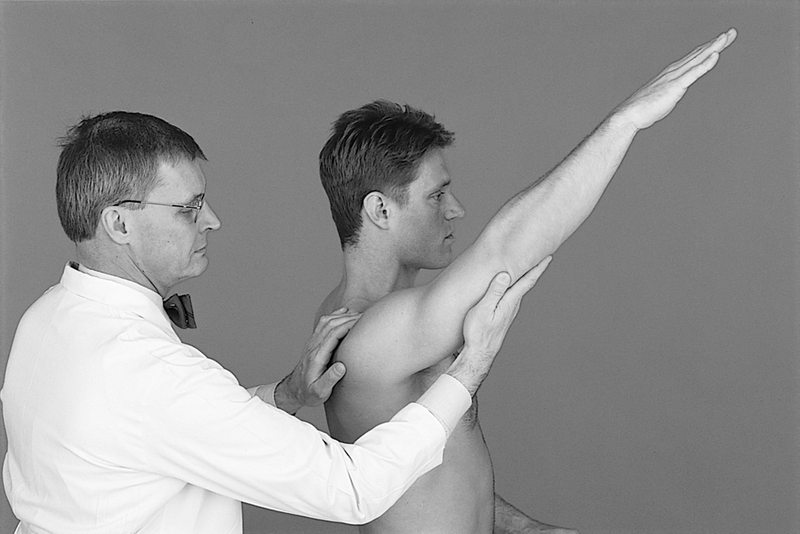
Neer impingement sign
What it tests: The presence of subacromial impingement, a constellation of conditions that includes subacromial bursitis, rotator cuff tendinitis, and chronic rotator cuff tears.
What to do: Ask the patient to stand with the arms resting comfortably at the sides. Stand either behind or beside the patient. Grasp the patient’s forearm with one hand and stabilize the shoulder girdle with the other hand over the trapezius, clavicle, and scapula. Then, with the arm in slight internal rotation, elevate the arm.
Normal: No pain.
Interpretation: If the patient has impingement, the affected structures are mechanically compressed (ie, impinged) beneath the acromion, producing pain as the arm is elevated above 90º. Limited passive elevation of the shoulder, as occurs with a frozen shoulder, invalidates the test because no mechanical impingement is produced.
Comment: To distinguish weakness caused by muscle deficiency and from that caused by pain, inject lidocaine into the subacromial space; weakness caused by pain is temporarily “cured” by this technique (the impingement test).
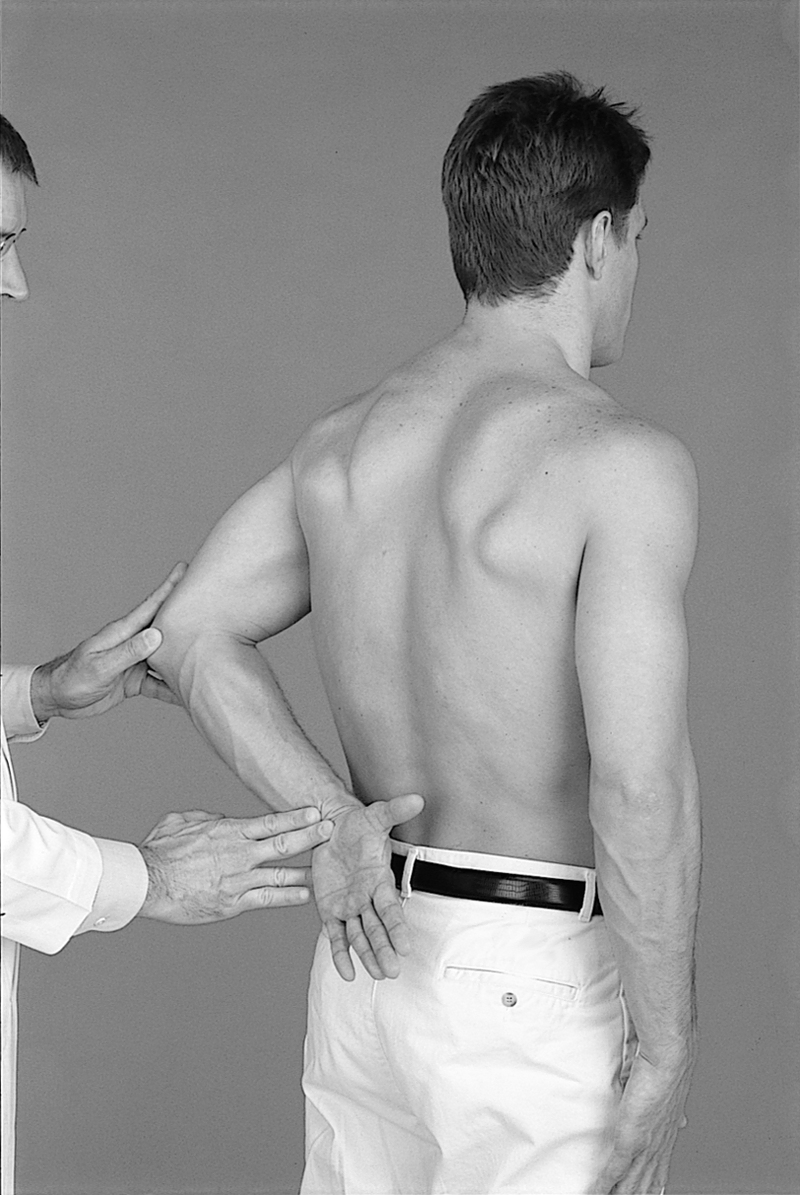
Lift-off test
What it tests: The integrity of the subscapularis musculotendinous unit. Since there are multiple internal rotators (ie, pectoralis major, latissimus dorsi), a tear of the subscapularis can be masked.
What to do: Ask the patient to maximally internally rotate the arm and then lift the hand off the back.
Normal: Patient can lift hand off of back.
Interpretation: With a rupture of the subscapularis musculotendinous unit, the patient will be unable to lift the hand off of the back.
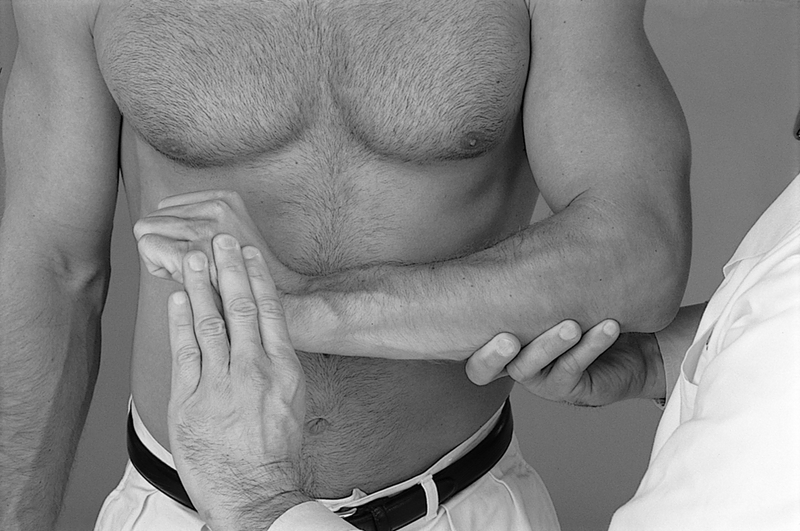
Comment: This test may be difficult to perform in patients with severely limited motion or extreme pain in the resting shoulder. Massive tears of the subscapularis can be detected in such cases by demonstrating more passive external rotation on that side because the resistance of the subscapularis is lost. The belly press test may be used if the patient cannot internally rotate. To perform this test, the patient is asked to press the palm against the belly and keep the elbow out in front of the plane of the body. Inability to keep the elbow in front of the body is considered a positive test result.
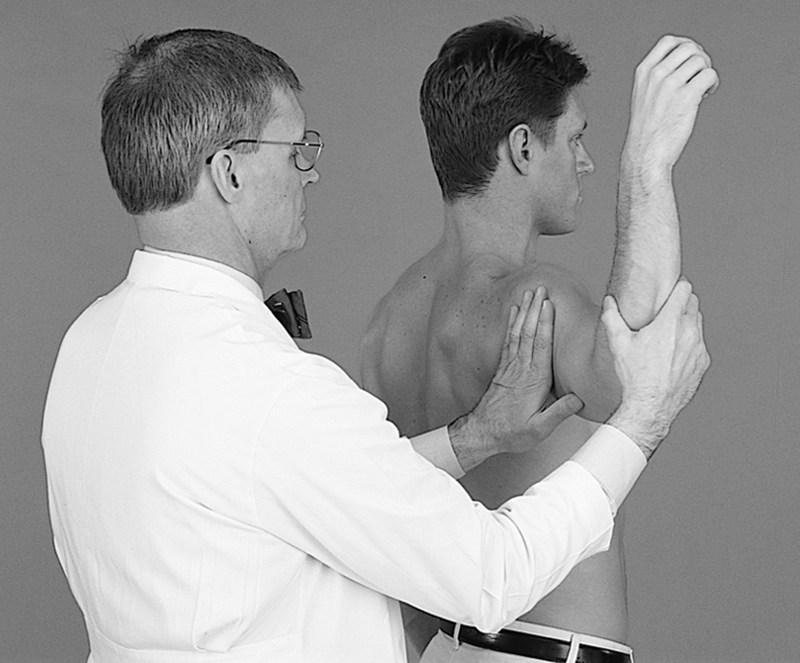
Apprehension test
What it tests: Anterior glenohumeral instability.
What to do: Position the patient’s arm to 90o of abduction and maximal external rotation (typically to 90o or beyond—the position of an arm cocked to throw).
Normal: No sense of apprehension or pain.
Interpretation: The test places the arm in a position in which the inferior glenohumeral capsulolabral complex normally tightens and resists anterior translation of the humeral head on the glenoid fossa. Injury to this complex allows subluxation or impending dislocation of the humeral head during the maneuver. When the patient demonstrates apprehension or describes a sensation that the shoulder is beginning to slide out of position, the test result is considered positive.
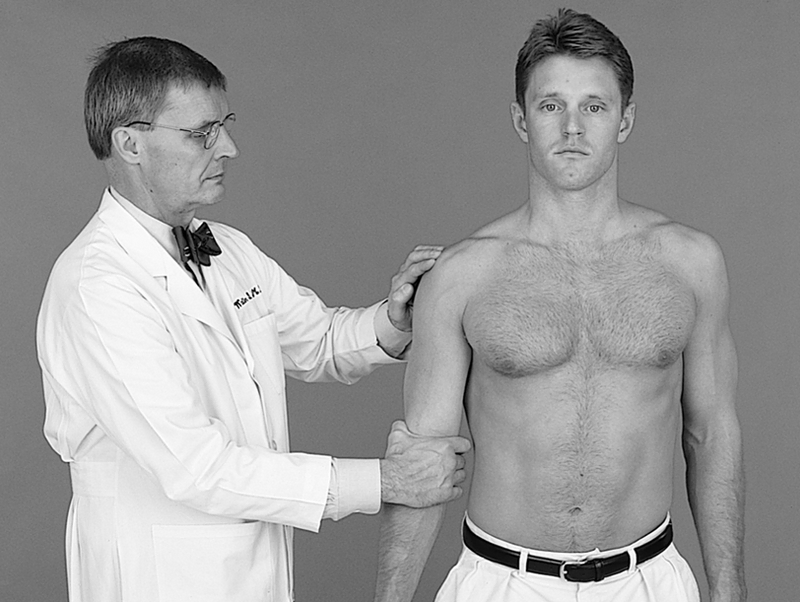
Sulcus sign
What it tests: Inferior glenohumeral laxity.
What to do: Ask the patient to stand with the arms resting comfortably at the sides. Stand beside the patient. With one hand, grasp the elbow and apply steady downward force to the arm. With the other hand, stabilize the shoulder girdle by resting the hand over the clavicle, scapular spine, and trapezius.
Normal: Less than 1 cm of inferior translation of the humerus, with no visible “sulcus” (ie, indentation of the skin). However, normal can be 1+ (1 cm), 2+ (2 cm), or 3+ (>2 cm). Therefore, it is critical to note any asymmetry from side to side.
Interpretation: This maneuver creates inferior translation of the humeral head on the glenoid fossa. If it translates down to or below the rim of the glenoid fossa, a sulcus may be seen between the lateral aspect of the acromion and the humeral head.
Comment: If this test result is positive, check other joints (ie, passive hyperextension of the fingers) for generalized laxity, which may suggest a collagen disorder.
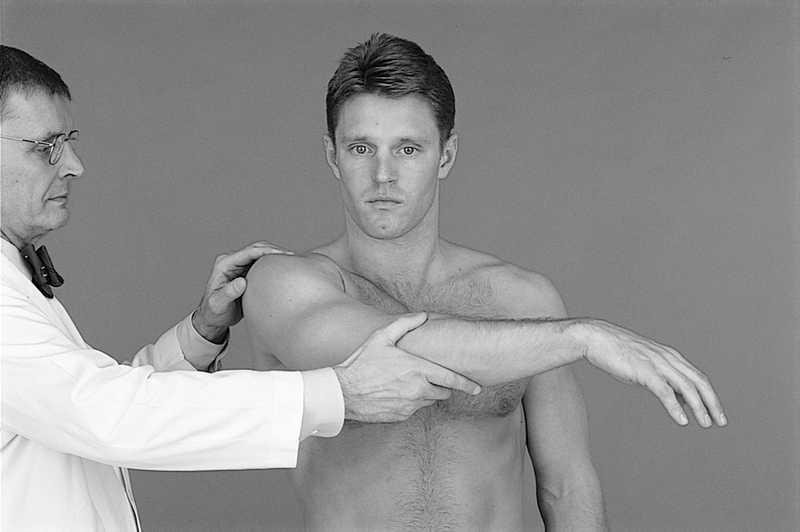
Cross-body adduction
What it tests: Since cross-body adduction loads the AC joint, pain with this maneuver suggests pathology.
What to do: Locate the AC joint with one hand. With the other hand, elevate the patient’s arm to 90o in the sagittal plane. Then, gradually adduct the arm across the patient’s body.
Normal: No pain at the AC joint.
Interpretation: Discomfort will occur when inflammation or arthrosis is present because this maneuver compresses the distal end of the clavicle against the medial aspect of the acromion at the AC joint. Reproduction of symptoms at the AC joint is a positive test result.
Comment: It is critical to localize the discomfort to the AC joint. For example, a tight capsule may create pain behind the shoulder rather than at the AC joint.
Elbow and Forearm
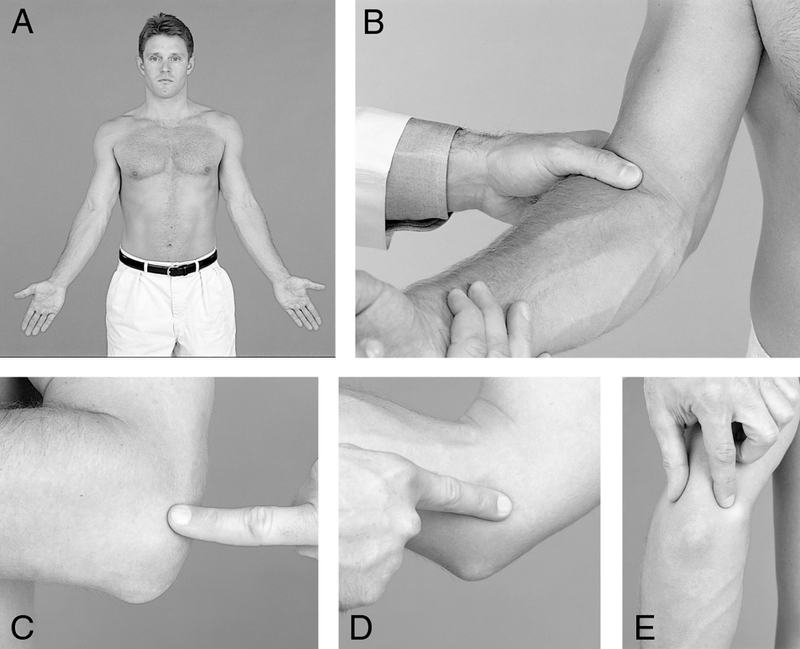
Inspection
Look for swelling and redness, especially at the olecranon bursa or the “carrying angle,” which is made by the humeral shaft and the forearm and is normally about 10º. In addition, look for any sign of trauma, such as ecchymosis in the antecubital fossa (as seen with distal biceps rupture). Scarring of the skin may be responsible for joint contractures.
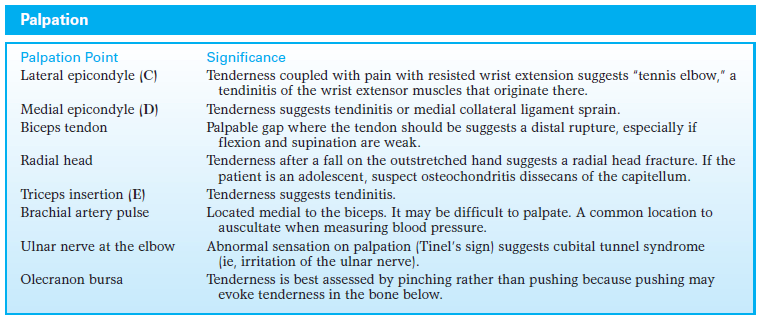
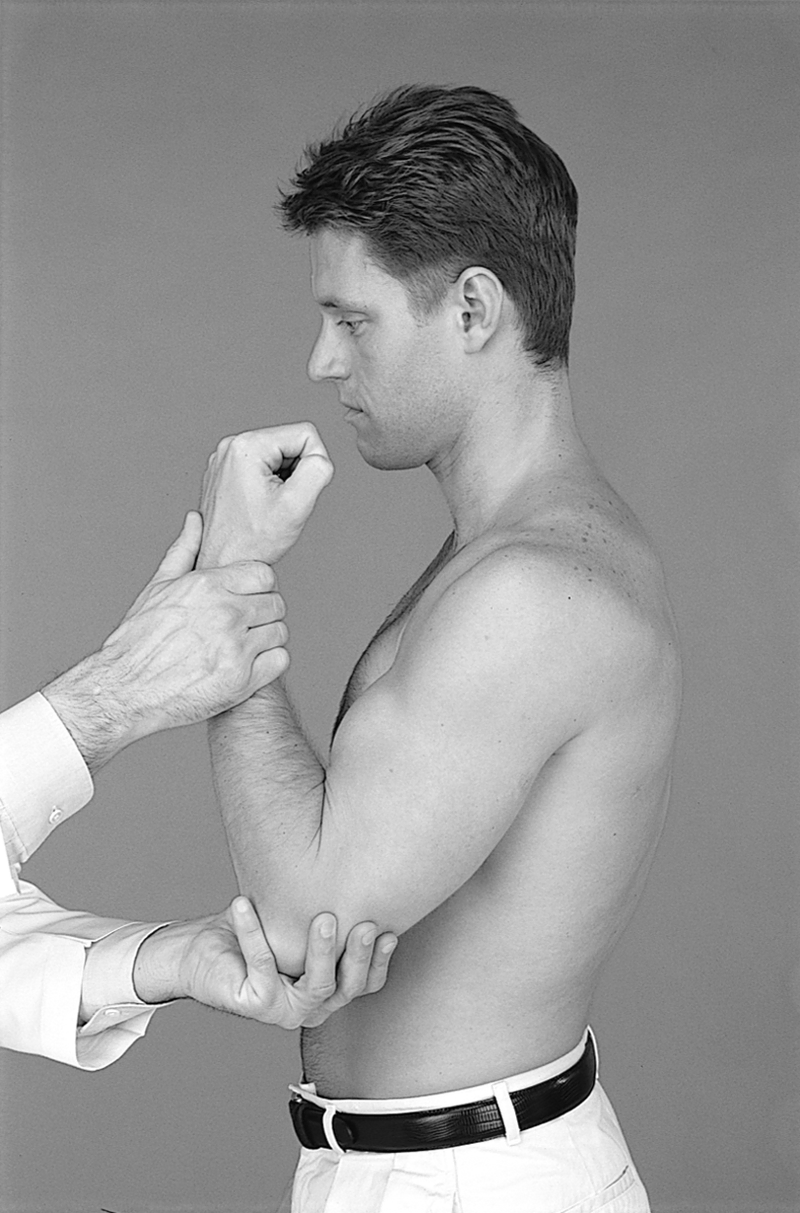
Elbow flexion
What to do: Ask the patient to face you with the arms resting comfortably at the side. Grasp the patient’s distal forearm. Ask the patient to maximally flex the elbow while you resist that motion.
Normal: Ability to flex to 135º with good strength and no pain.
Interpretation: If the patient cannot do this, you must exclude a mechanical block to motion by flexing the patient’s elbow. If passive motion is normal but active motion is not, the cause may be a ruptured musculotendinous unit (most likely the biceps), a neurologic injury (to the musculocutaneous nerve or the C6 nerve root), or a result of pain.
Comment: The brachialis powers this motion. Therefore, even with a distal biceps rupture, flexion is maintained.
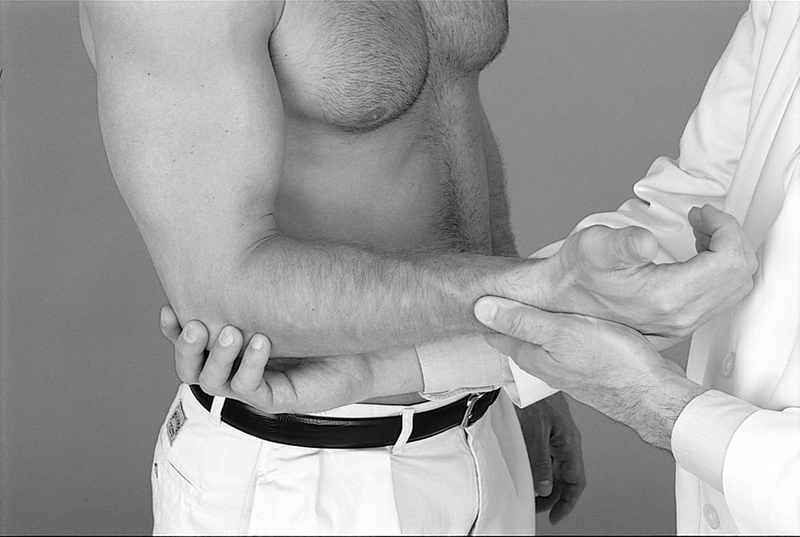
Elbow extension
What to do: Ask the patient to hold the elbow flexed to 90º. Then grasp the patient’s forearm and ask the patient to extend the elbow while resisting this motion.
Normal: Extension to 0º with good strength and no pain.
Interpretation: A normal examination implies the presence of an intact triceps muscle and tendon and an intact radial nerve. The triceps is the sole elbow extensor, powered by the radial nerve; less than up to 7º of extension may be considered normal if present bilaterally.
Comment: This motion must be tested with the arm elevated to remove any assistance gravity would provide if tested with the arm hanging.
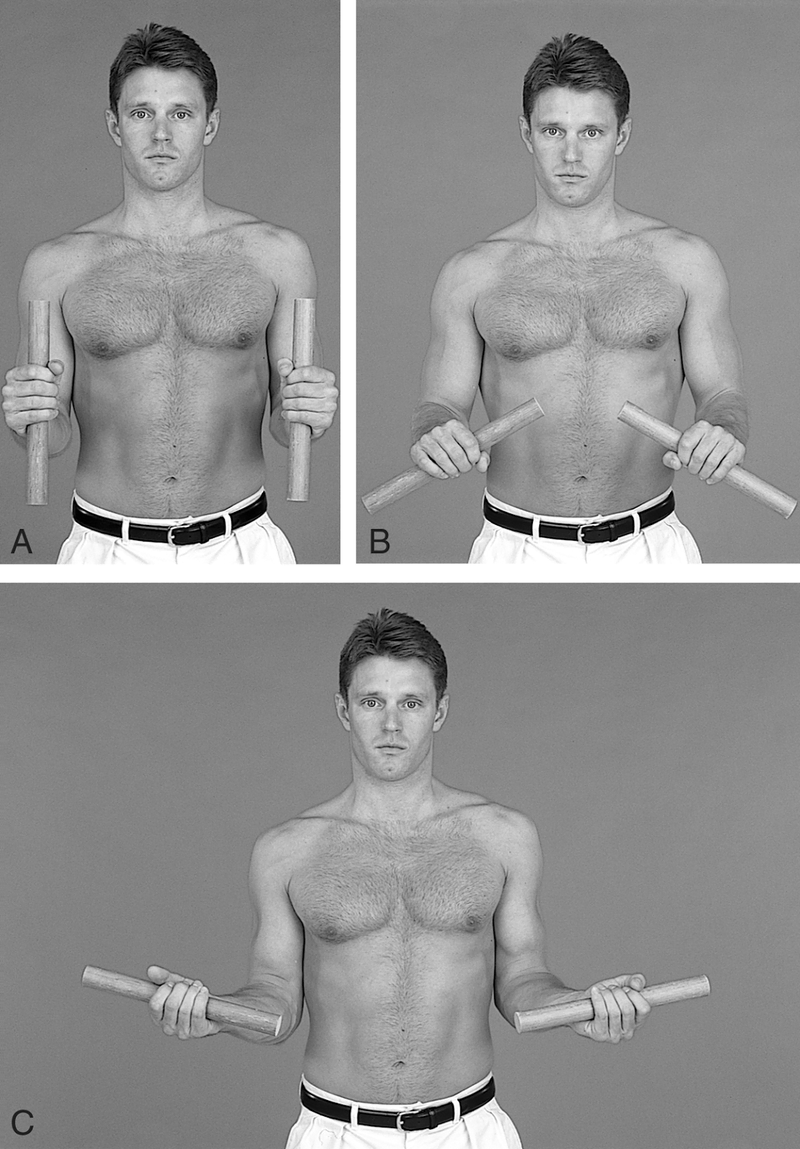
Forearm supination
What to do: Ask the patient to face you with the arm held at the side and the elbow flexed. Then ask the patient to rotate the palms to face the ceiling. This can be tested with and without resistance.
Normal: Nearly 90º of motion (ie, the palms should fully face the ceiling).
Interpretation: This motion is powered by the biceps, since it inserts on the radius. A rupture of the distal biceps will substantially weaken supination, even when the supinator muscle is intact.
Comment: Supination and pronation take place at the joint between the distal humerus (capitellum) and the radius, as well as between the proximal and distal radioulnar joints.
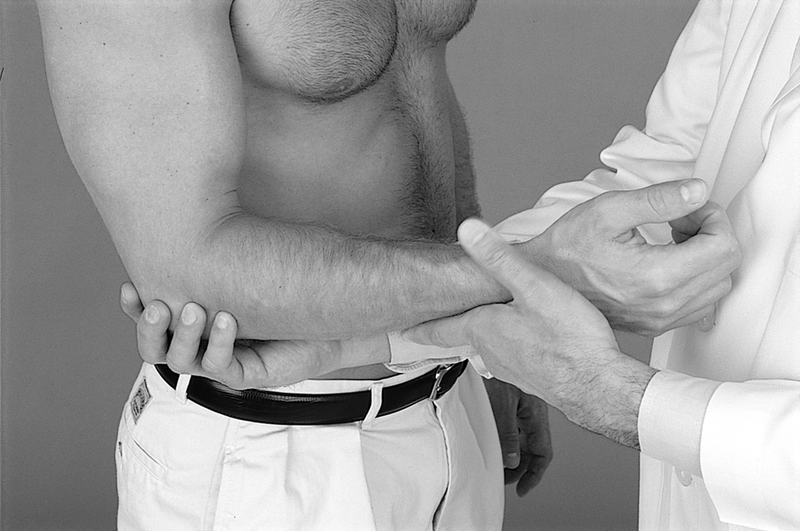
Forearm pronation
What to do: Ask the patient to face you with the arm held at the side and the elbow flexed. Then ask the patient to rotate the palms to face the floor. This can be tested with and without resistance.
Normal: Nearly 90º of motion (ie, the palms should fully face the floor).
Interpretation: Abnormal passive motion can occur following fractures of the elbow, forearm, or wrist.
Comment: This motion is powered by the pronator teres and assisted by the pronator quadratus, both of which are supplied by the median nerve.
Special Tests
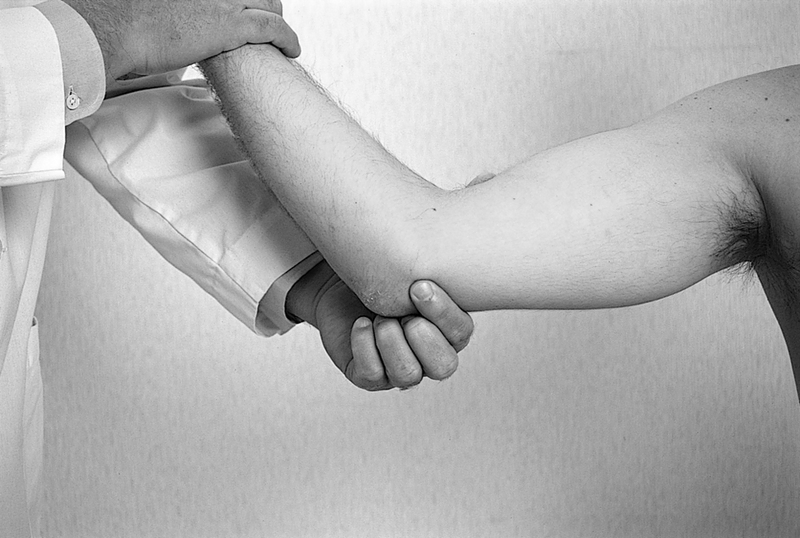
Tinel’s sign
What it tests: Irritation of the ulnar nerve at the elbow (cubital tunnel syndrome).
What to do: Gently tap the patient’s elbow near the medial border of the proximal ulna, just distal to the elbow joint over the ulnar nerve.
Normal: Patient should not report any abnormal sensation (“electric shocks”) in the hand, although mild discomfort localized to the elbow is normal.
Interpretation: Paresthesias radiating to the ulnar side of the hand suggest irritation of the ulnar nerve at the cubital tunnel.
Hand and Wrist
Inspection
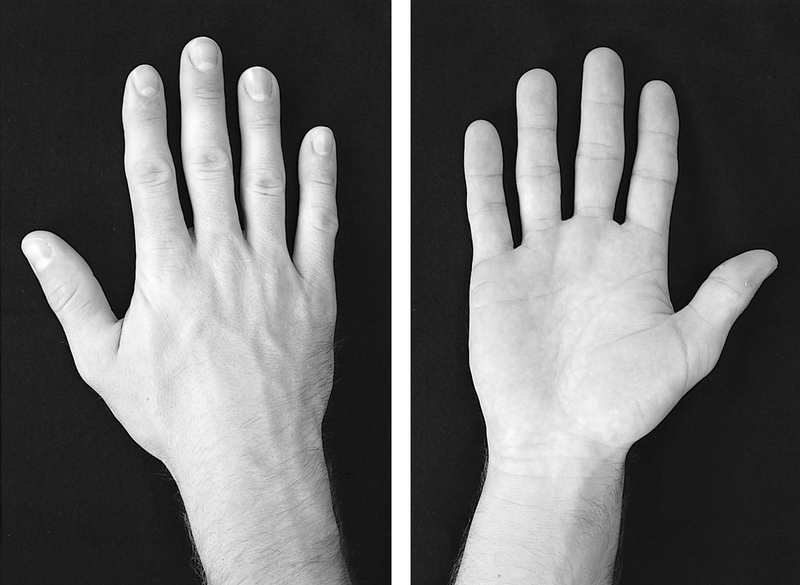
Begin inspection by simply observing the patient using the hands. The alignment of the fingers should be noted, as well as any pitting or discoloration of the nails. Atrophy of the thenar muscles (innervated by the median nerve) or the intrinsics between the metacarpals (innervated by the ulnar nerve) should also be noted. While in a resting position, all of the fingers should be slightly flexed. Check for angular and rotational deformities at the joints.
Forearm rotation
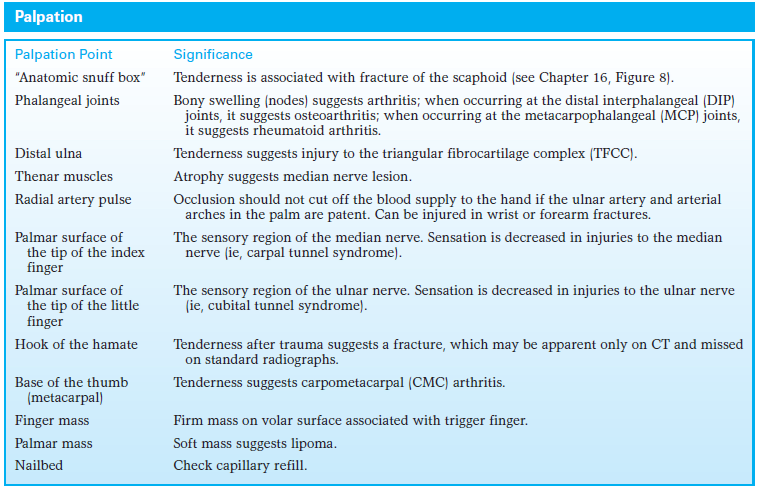
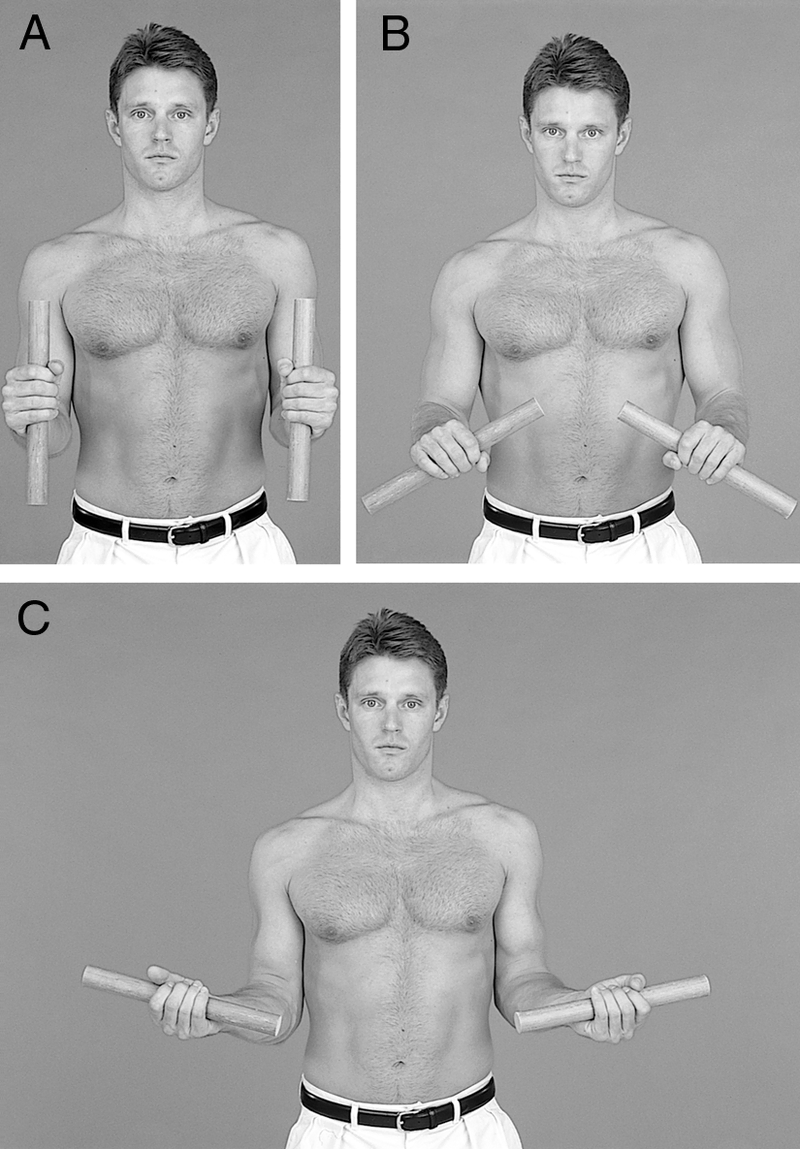
What to do: To assess pronation, place the patient’s arm at the side with the elbow flexed to 90°. With the plane of the patient’s palm perpendicular to the floor while maintaining elbow position, rotate the thumb toward the body. To assess supination, use a maneuver similar to that used to assess pronation, but rotate the thumb away from the body.
Normal: 80° of both supination and pronation.
Interpretation: Loss of passive motion implies disease at either elbow or wrist joints. Active pronation is powered by the pronator muscles; supination is powered by the biceps.
Wrist flexion
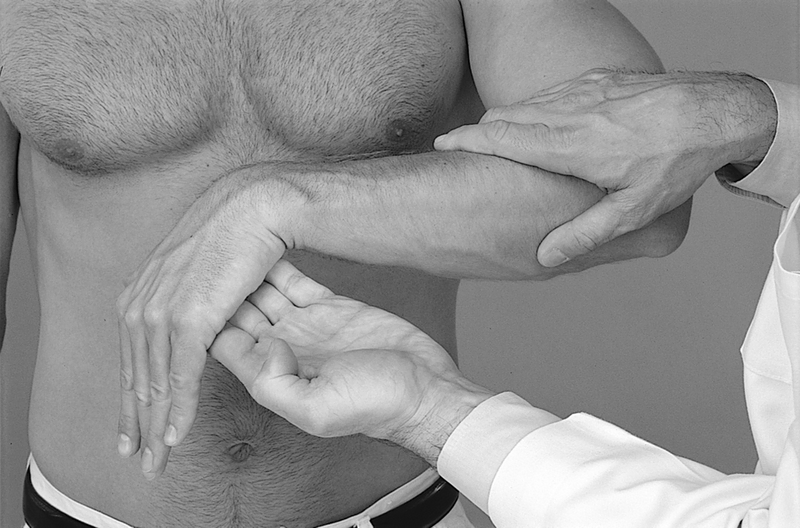
What to do: Support the patient’s forearm, and place one hand on the patient’s palm; the patient’s wrist should be in neutral position. Ask the patient to flex the wrist as you apply resistance to the palm. For passive motion testing, there should be no resistance. Instead, with the patient relaxed, bend the wrist by applying force across the dorsum of the hand.
Normal: Nearly 90º of flexion, with good strength and no deviation to the radial or ulnar side.
Interpretation: Flexion is powered by the flexor carpi radialis (median nerve) and the flexor carpi ulnaris (ulnar nerve). Pain at the anterior medial epicondyle, the origin of both of these muscles, suggests medial epicondylitis (ie, golfer’s elbow). Flexion loss may indicate intra-articular pathology (ie, carpal instability). Diminished wrist flexion is usually well tolerated.
Comment: The patient’s fingers should be extended to avoid some wrist flexion by the finger flexor muscles.
Wrist extension
What to do: Support the patient’s forearm and place one hand on the dorsum of the hand; the patient’s wrist should be in neutral position. Ask the patient to extend the wrist as you apply resistance to the hand. A passive motion test is performed by extending the wrist by placing force on the palm.
Normal: 70º of extension.
Interpretation: Extension is powered by the extensor carpi radialis longus and the extensor carpi radialis brevis, which are innervated by the radial nerve, primarily at the C6 level. Pain at the lateral epicondyle, the origin of both of these muscles, suggests tendinitis, (ie, tennis elbow). As with flexion loss, loss of extension may indicate an intra-articular pathology. However, loss of extension is less well tolerated for normal wrist function.
Comment: The fingers should be held in flexion during this maneuver.
Finger flexion and extension
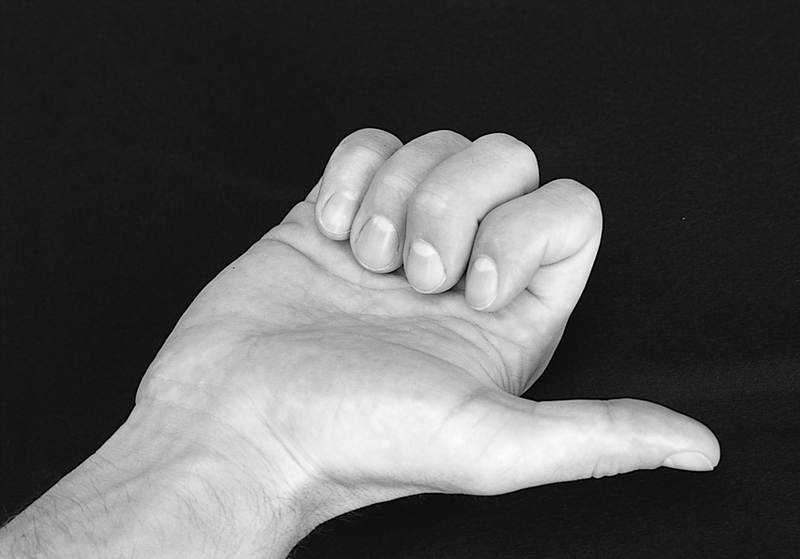
What to do: With the patient’s hand supinated, ask the patient to make a full fist by flexing the fingers to the palm.
Normal: The fingertips should touch the distal palmar crease. In addition, the patient should be able to extend all fingers completely straight (0º of extension).
Interpretation: Any lack of flexion or extension should be checked both actively and passively. Passive restriction of motion is usually caused by arthritis of the joint or joint contracture; active restriction can be caused by muscle weakness or neurologic impairment. Trauma to a flexor or extensor tendon with stiffness can also produce active and passive restriction in motion.
Comment: Finger flexion and extension is a composite movement of the MCP, PIP, and DIP joints. If any finger lacks full flexion or extension, each joint should be examined to identify the affected joint.
Finger abduction and adduction
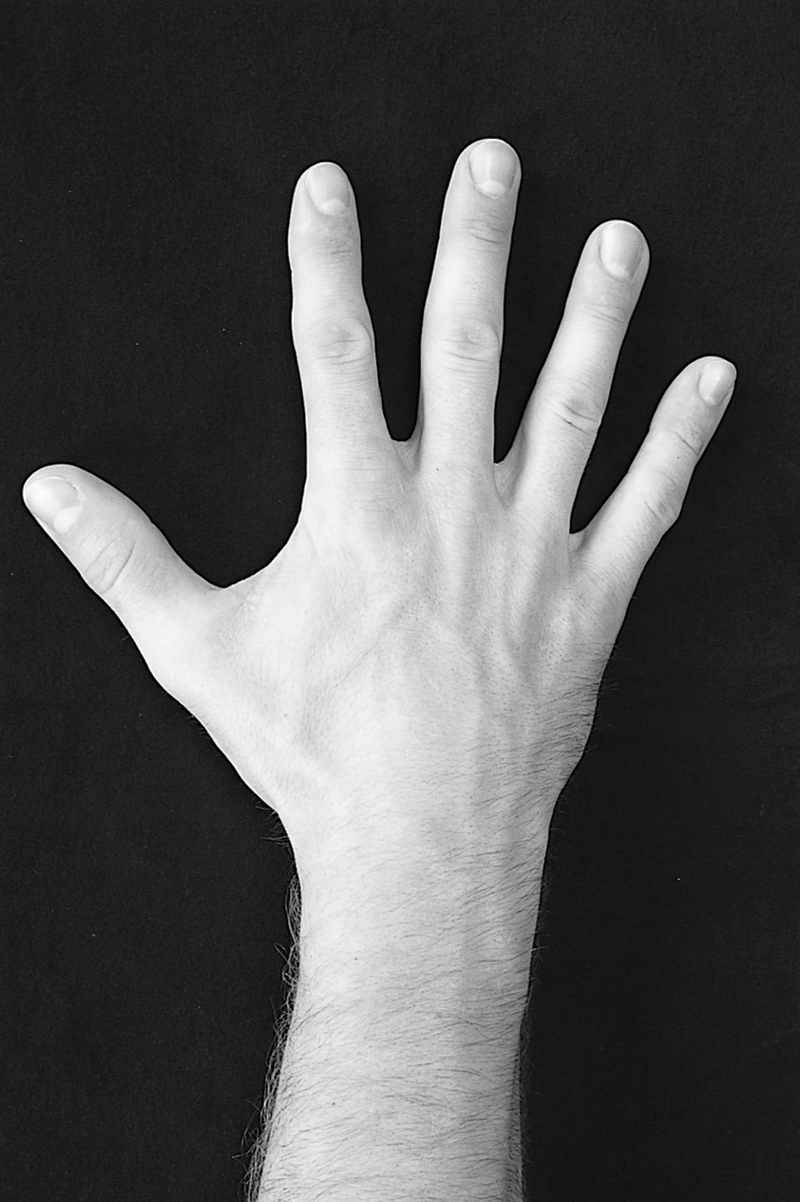
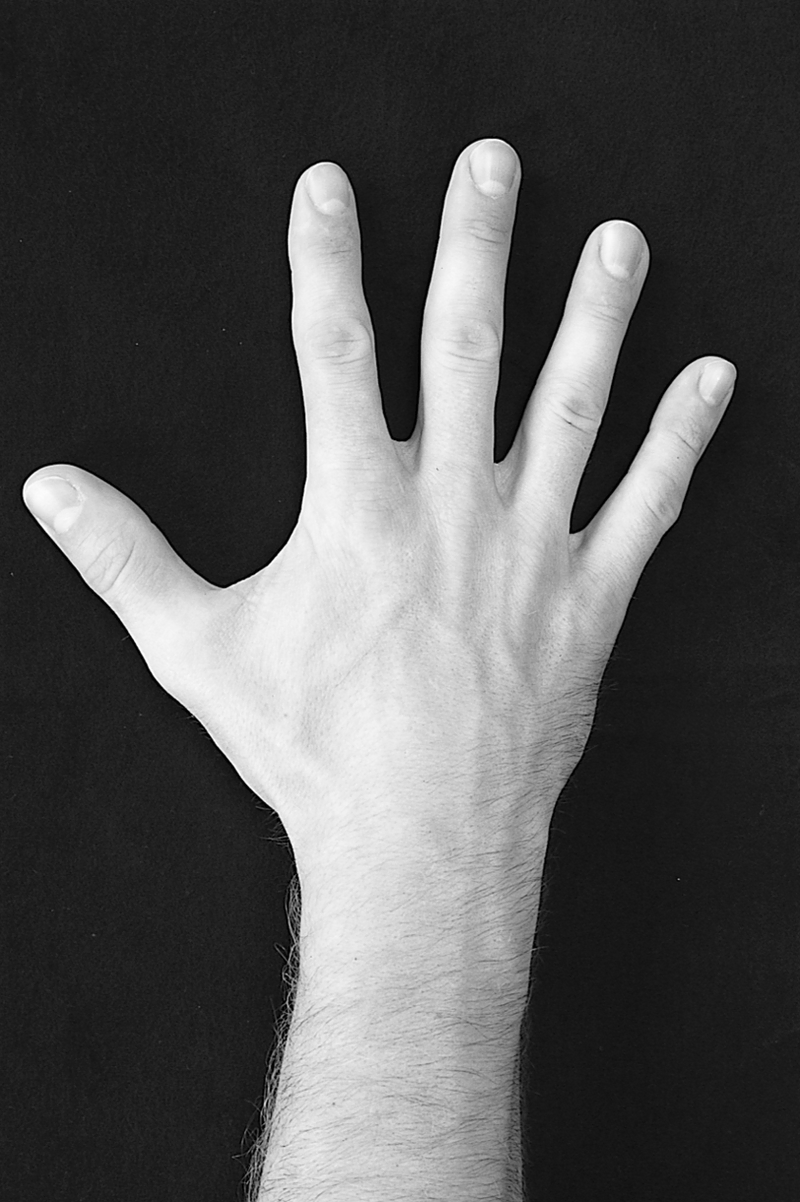
What to do: With the patient’s fingers extended, ask the patient to fully abduct and adduct the fingers.
Normal: The fingers should fully adduct together, and separate approximately 20º.
Interpretation: Restricted abduction is usually caused by intrinsic muscle weakness.
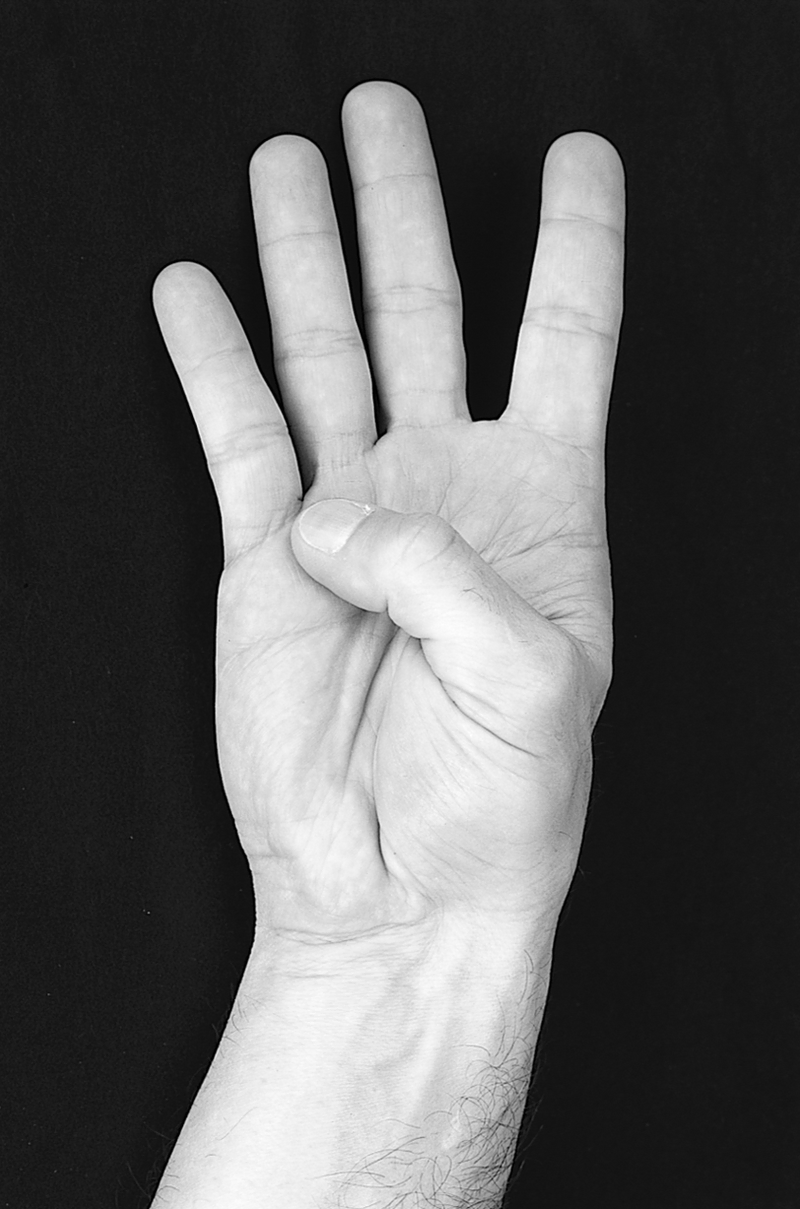
Thumb opposition
What to do: Ask the patient to bring the thumb across the palm towards the base of the little finger.
Normal: The patient should be able to bring the thumb to the MCP joint of the little finger.
Interpretation: Restricted opposition can be caused by pathology of the CMC, MCP, or interphalangeal (IP) joint of the thumb. It can also be secondary to muscle weakness.
Comment: Thumb opposition is a composite movement of the CMC, MCP, and IP joints of the thumb. It is powered by the thenar muscles (ie, the abductor pollicis brevis, opponens pollicis, and flexor pollicis brevis).
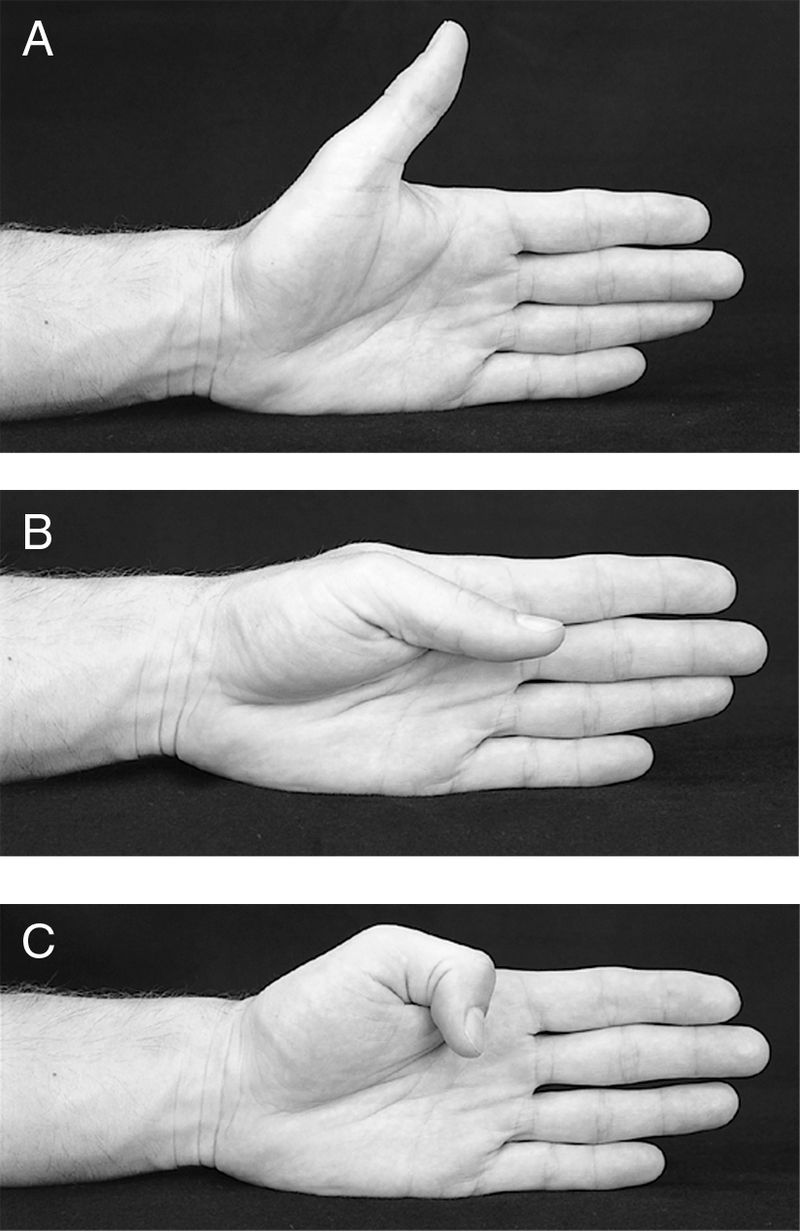
Thumb flexion and extension
What to do: Ask the patient to bend and extend the thumb in the plane of the palm.
Normal: Flexion at the MCP joint is usually 50º to 60º, and flexion at the IP joint is usually 55º to 75º. Extension should be 0º at the MCP joint and 5º to 10º at the IP joint.
Interpretation: Restricted flexion and extension are most commonly caused by stenosing tenosynovitis (trigger thumb). Patients may demonstrate “locking” or “catching” during active motion.
Comment: A trigger thumb may be tender at the palmar base of the thumb. Pain may limit flexion, and locked flexion may intermittently occur.
Muscle Testing
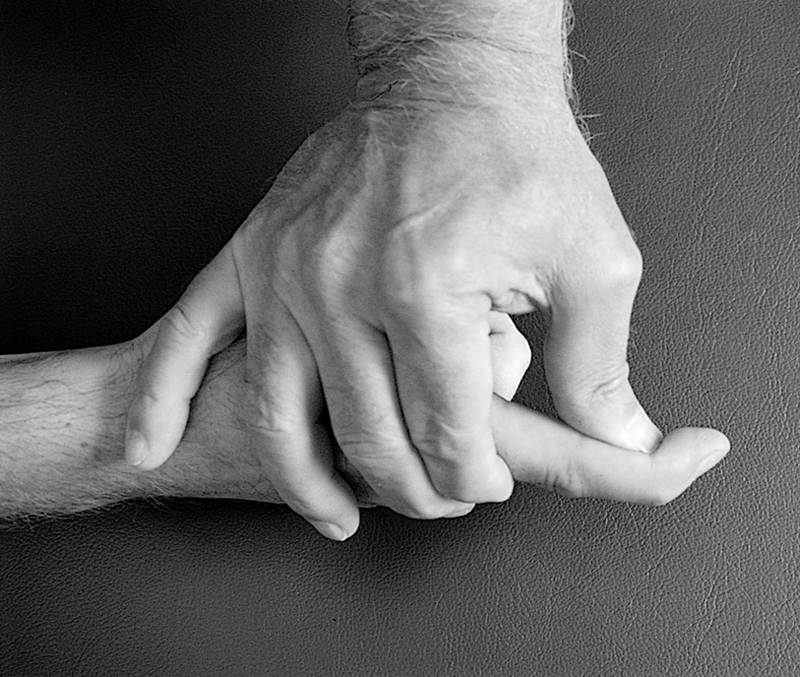
Finger/DIP flexion (flexor digitorum profundus)
What to do: Hold the finger with the PIP joint in extension, and ask the patient to bend the finger.
Normal: 90º.
Interpretation: Inability to flex only one finger’s DIP joint suggests flexor digitorum profundus injury or bony avulsion.
Comment: This test is done when trauma or laceration is suspected. Assess routine DIP and PIP flexion by asking the patient to make a fist.
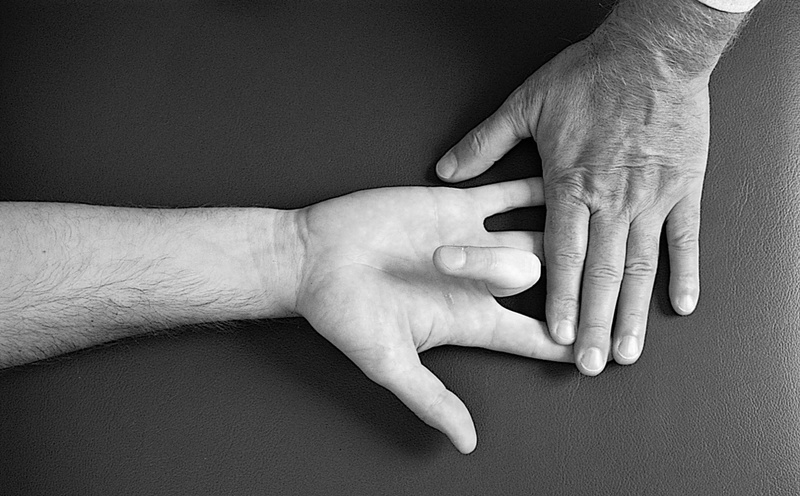
Finger/PIP flexion (flexor digitorum superficialis)
What to do: Grasp those fingers not being tested and hold those PIP and DIP joints in extension. Ask the patient to flex the finger not being held.
Normal: 100º.
Interpretation: Inability to flex suggests flexor digitorum superficialis tendon injury.
Comment: The flexor digitorum superficialis is specific for PIP flexion, but the flexor digitorum profundus (FDP) can also flex the PIP. Holding the other fingers in extension prohibits the FDP, which has one muscle for all four fingers, from contracting.
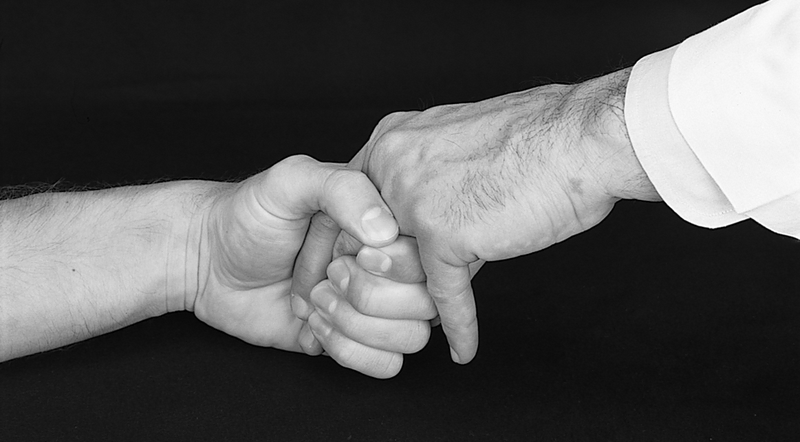
Grip strength
What to do: Ask the patient to squeeze your fingers as hard as possible.
Normal: Painless motion and symmetrical strength should be noted.
Interpretation: Power grip is primarily mediated by the ring and little fingers, as well as the intrinsic muscles of the hand. These are innervated by the ulnar nerve. Precision grip or pinch is mediated by the median nerve. Normal grip also requires good strength of the intrinsic muscles of the hand, which are also (for the most part) innervated by the ulnar nerve. Grip strength should be compared with the opposite side.
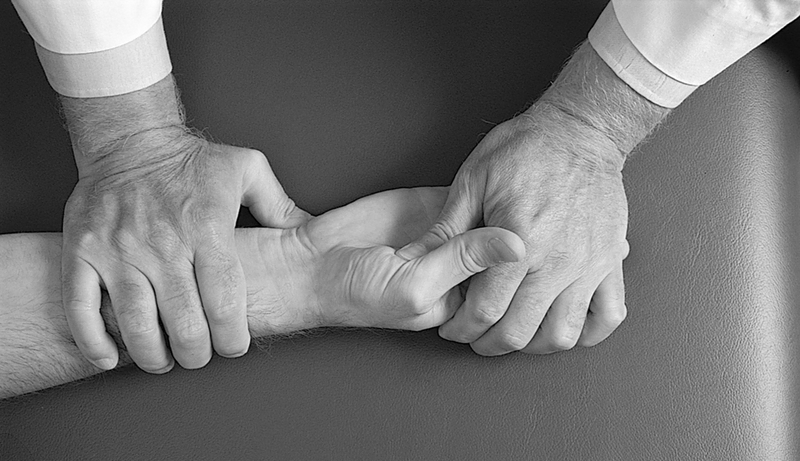
Palmar abduction strength
What to do: Ask the patient to raise the thumb from the plane of the palm. Resist the patient’s effort.
Normal: Good strength compared with the opposite side.
Interpretation: Poor strength usually indicates weakness of the abductor pollicis brevis. This is most commonly related to the motor nerve effects of carpal tunnel syndrome.
Comment: Atrophy of the thenar eminence may be present in severe carpal tunnel syndrome.
Special Tests

Phalen’s test
What it tests: Compression of the median nerve at the wrist (ie, carpal tunnel syndrome).
What to do: Ask the patient to sit comfortably or stand with the wrists flexed maximally for at least 60 seconds.
Normal: No symptoms produced in the fingers.
Interpretation: Paresthesias in the median nerve distribution suggest carpal tunnel syndrome.
Comment: This test should be combined with a positive history and other tests to confirm the diagnosis.
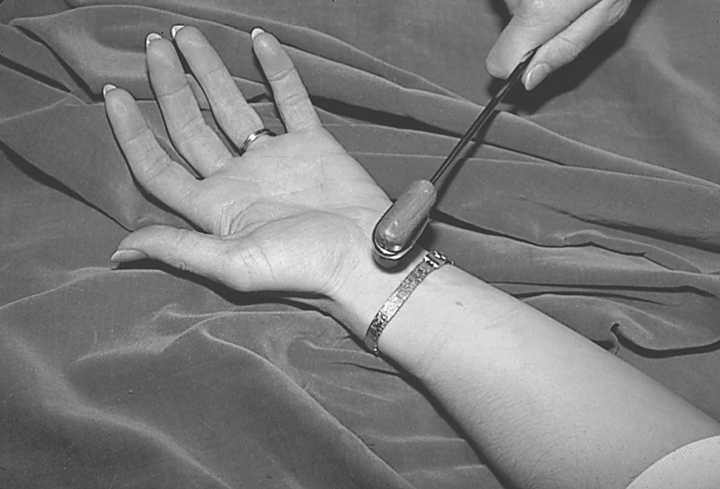
Carpal tunnel percussion (Tinel’s sign)
What it tests: Compression of the median nerve at the wrist (ie, carpal tunnel syndrome).
What to do: Place the patient’s hand on the table with the palm side up. Tap on the carpal tunnel using a reflex hammer or your index finger.
Normal: No symptoms produced in the fingers.
Interpretation: Paresthesias in the index and long fingers (and, less commonly, the thumb) suggest irritation of the median nerve at the carpal tunnel.
Comment: This test should be combined with a positive history and other tests to confirm the diagnosis. The presence of other signs and symptoms of carpal tunnel syndrome may help make the diagnosis.
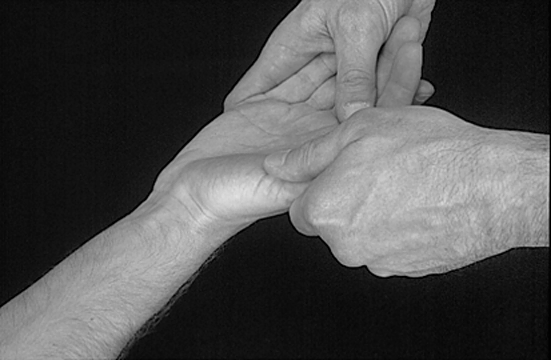
Thumb CMC stress test
What it tests: Arthritis at the CMC joint of the thumb.
What to do: Hold the thumb metacarpal. Place axial compression across the CMC joint and gently rotate the metacarpal to create a gentle grind.
Normal: Mild discomfort or no discomfort.
Interpretation: Pain at the base of the thumb suggests osteoarthritis.
Comment: The CMC joint of the thumb is the most common site of osteoarthritis in the hand.
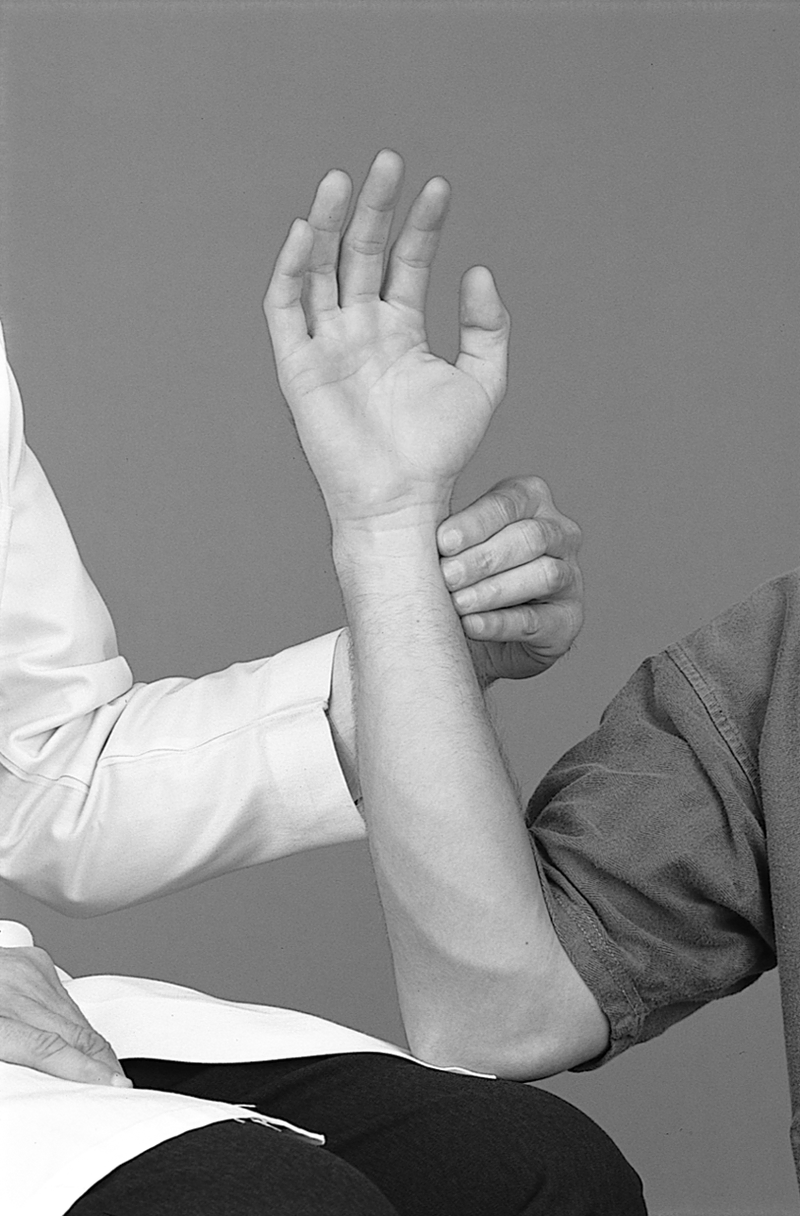
Allen’s test
What it tests: Circulation of the hand from both the radial and ulnar arteries.
What to do: Ask the patient to rapidly open and close the hand three times and then make a fist; this will exsanguinate the hand. Compress the radial and ulnar arteries by placing your fingers on their pulse. Release pressure on the ulnar artery, but maintain pressure on the radial artery. Observe return of normal perfusion (ie, color) to the hand. Repeat by releasing pressure on the radial artery and compressing the ulnar artery.
Normal: The hand should become pink, signifying adequate perfusion, even with one artery compressed by digital pressure.
Interpretation: This test helps determine if circulation in either artery is solely sufficient to perfuse the entire hand. If one artery is slow or sluggish in reperfusion the hand, it should be noted.
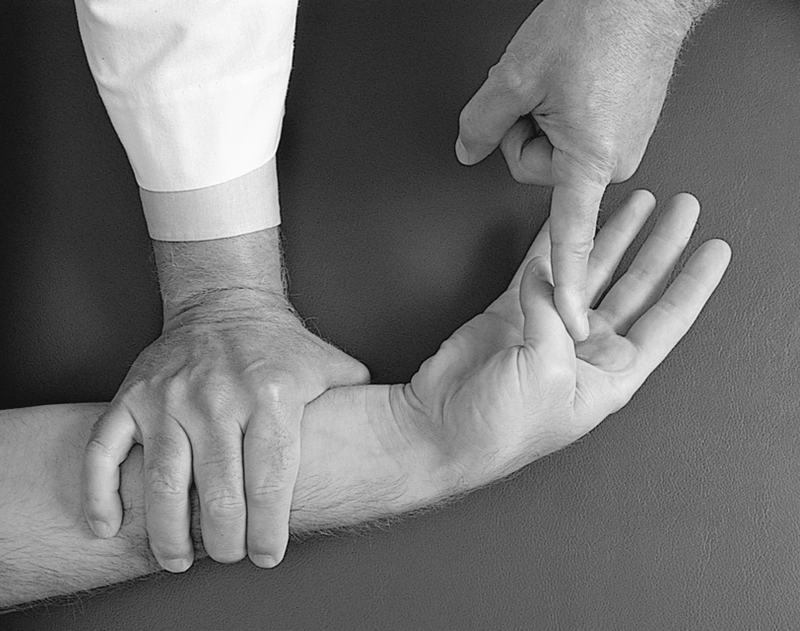
Finkelstein’s test
What it tests: Tenosynovitis of the abductor pollicis longus and extensor brevis tendons (located in the first dorsal compartment of the wrist).
What to do: Flex and ulnarly deviate the wrist, then push the thumb into flexion.
Normal: Mild discomfort.
Interpretation: Sharp pain on the radial border of the wrist suggests tenosynovitis of the abductor pollicis longus or extensor brevis tendons.
Comment: This test can be very painful in affected patients.
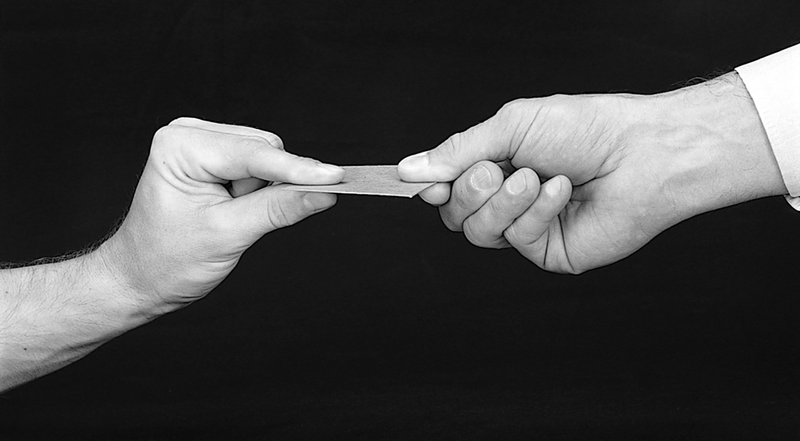
Froment’s test
What it tests: Function of the adductor pollicis (ie, the ulnar nerve to the thumb).
What to do: Ask the patient to pinch a piece of paper between the thumb and the tip of the index finger. Then attempt to pull the piece of paper from the patient.
Normal: The patient will be able to pinch the piece of paper with good strength and without
flexing the IP joint of the thumb.
Interpretation: Froment’s sign is flexion of the IP joint of the thumb while pinching. IP flexion is a motion that uses the median nerve; it occurs when there is weakness of the intrinsic adductors of the thumb, which is innervated by the ulnar nerve. Hyperflexion of the thumb IP joint indicates weakness of the adductor pollicis and first dorsal interosseous, which are innervated by distal branches of the ulnar nerve.
Hip and Thigh
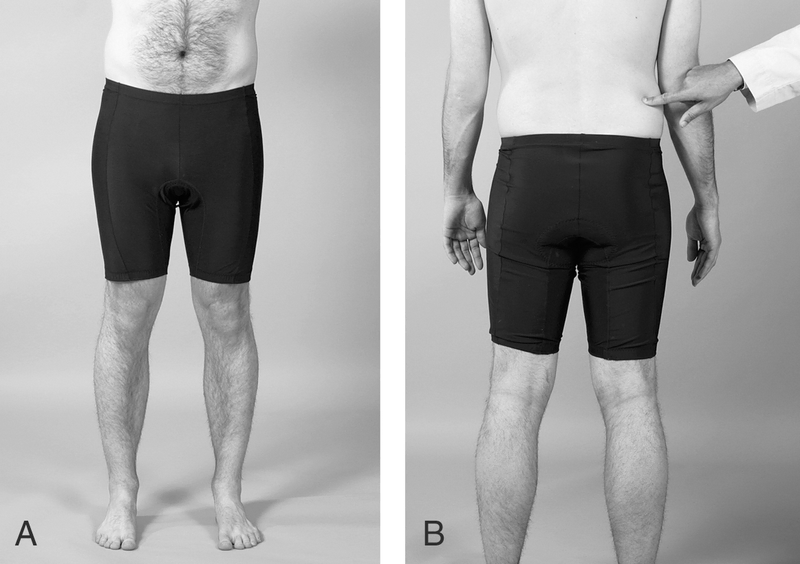
Inspection
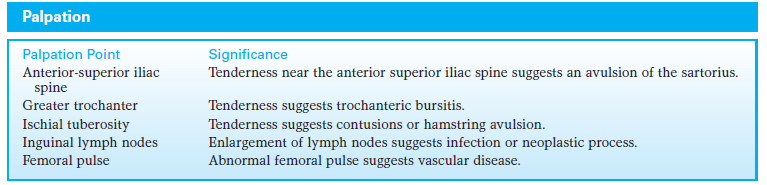
Look for atrophy of the muscles. Assess overall alignment of the limbs and tilt (obliquity) of the pelvis. The iliac crest (as shown in figure on the right) is a useful landmark for assessing pelvic tilt.
Hip flexion
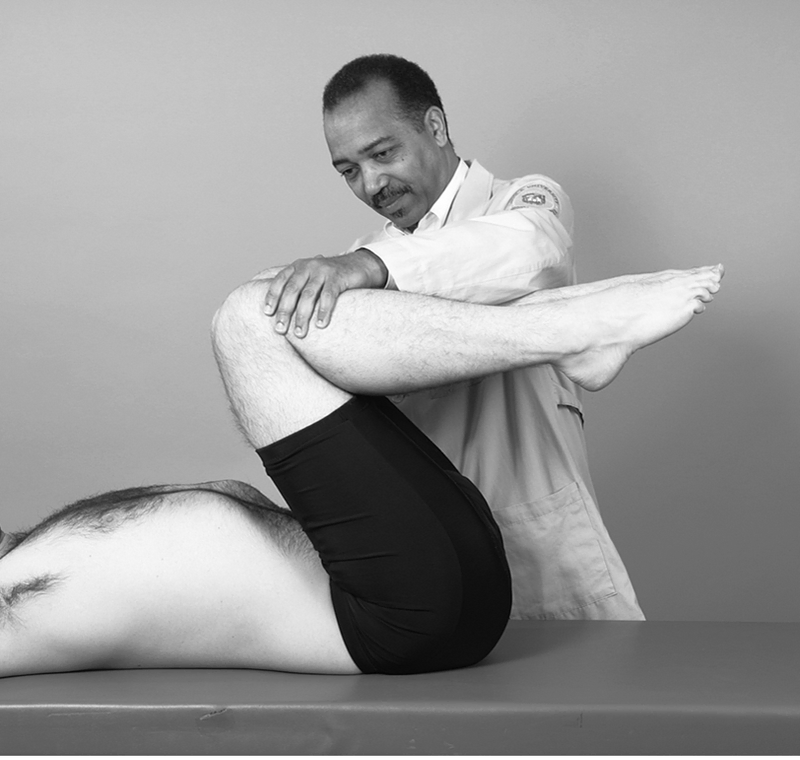
What to do: Hip flexion is assessed in the supine position. Passively flex the hip maximally toward the chest. Record the angle of the femur and horizontal line parallel to the examining table as the degree of hip flexion.
Normal: 110º to 130º.
Interpretation: Lack of normal hip flexion is most commonly secondary to osteoarthritis.
Hip abduction
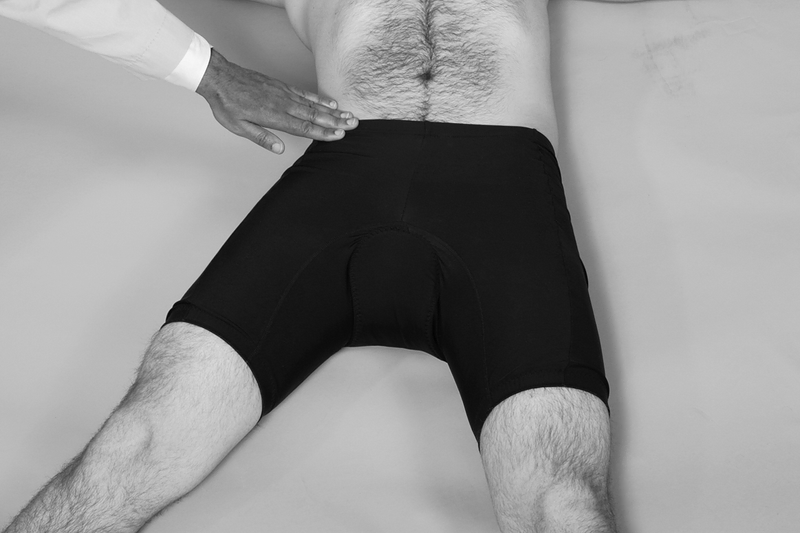
What to do: Hip abduction is assessed in the supine position. Stabilize the patient’s pelvis and ask the patient to abduct the affected extremity. Alternatively, with the patient’s perineum covered with an examination gown, ask the patient to separate the legs simultaneously and maximally (contralateral hip abduction simultaneously stabilizes the pelvis). Record the angle of abduction.
Normal: 45º to 50º.
Interpretation: Restricted abduction is a late manifestation of hip osteoarthritis.
Hip adduction
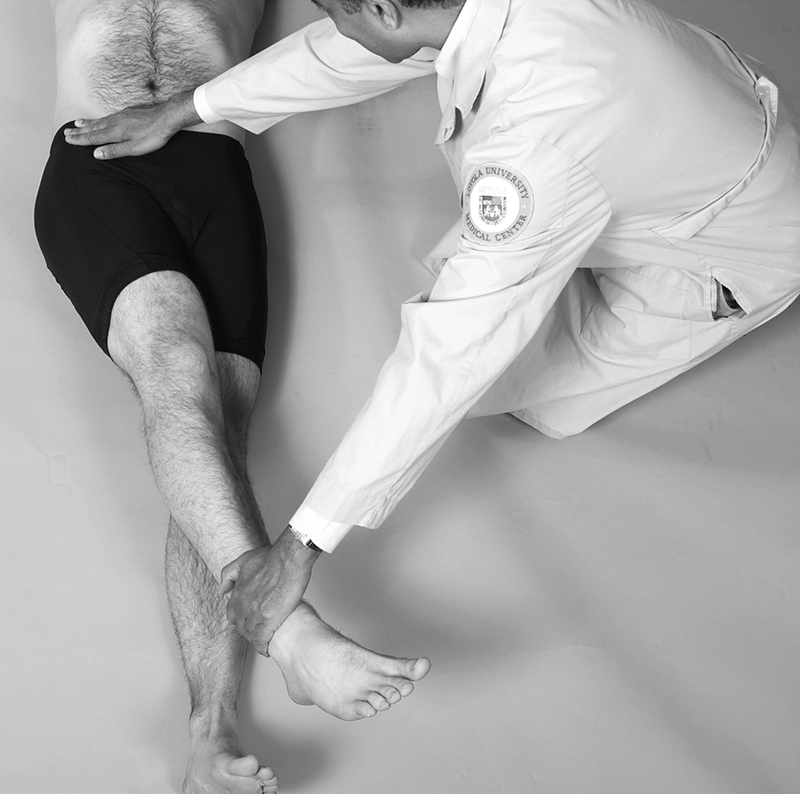
What to do: With the patient in the supine position, passively extend the entire leg across the midline. The contralateral extremity remains on the examination table while the tested extremity passes above the elevated extremity. Record the extent to which the extremity angularly crosses the midline.
Normal: 20º to 30º.
Interpretation: Restriction in adduction is a late manifestation of hip osteoarthritis.
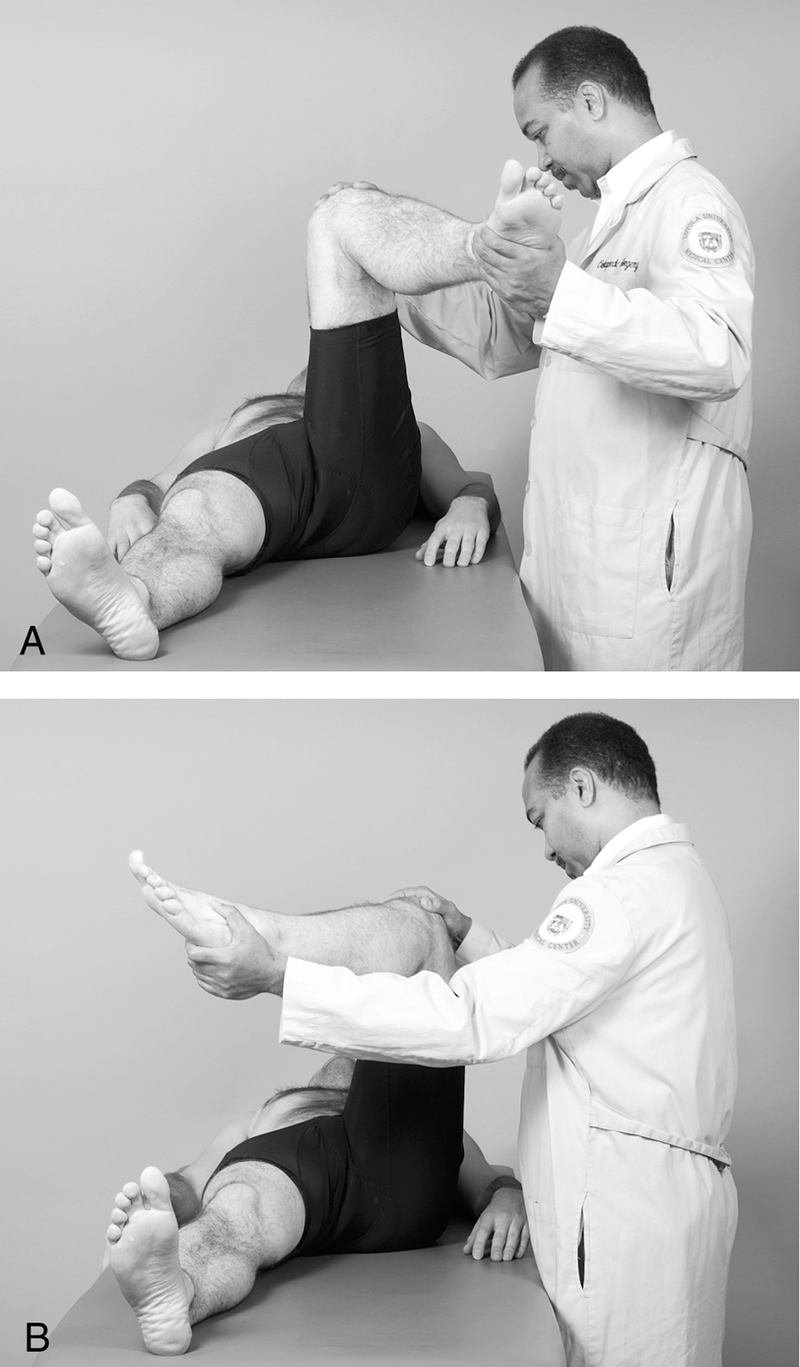
Internal and external rotation of the hip
What to do: With the patient in the supine position, flex the patient’s hip to 90º. Passively rotate the tibia away from the midline to assess internal rotation. Rotate the tibia towards the midline to assess external rotation.
Normal: 35º for internal rotation and 45º for external rotation.
Interpretation: Loss of hip rotation is commonly the first sign of early osteoarthritis.
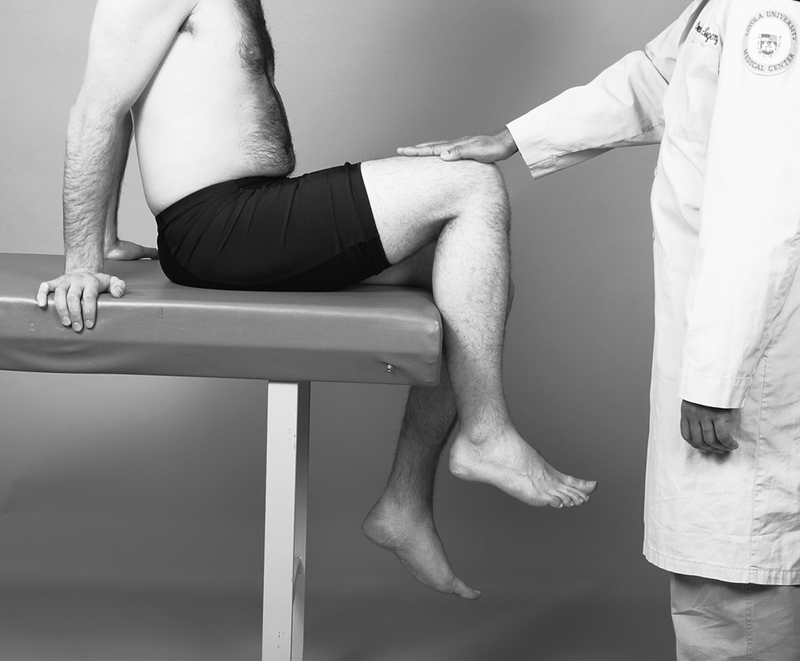
Hip flexion
What to do: With the patient in the seated position, place your hand on the thigh just above the knee. Ask the patient to flex the hip against resistance.
Normal: Normal muscle strength.
Interpretation: Absence of normal muscle strength may be secondary to pain or may indicate muscular or neurologic disease. Systemic processes near the iliopsoas and high in the pelvis may cause weakness of hip flexion.
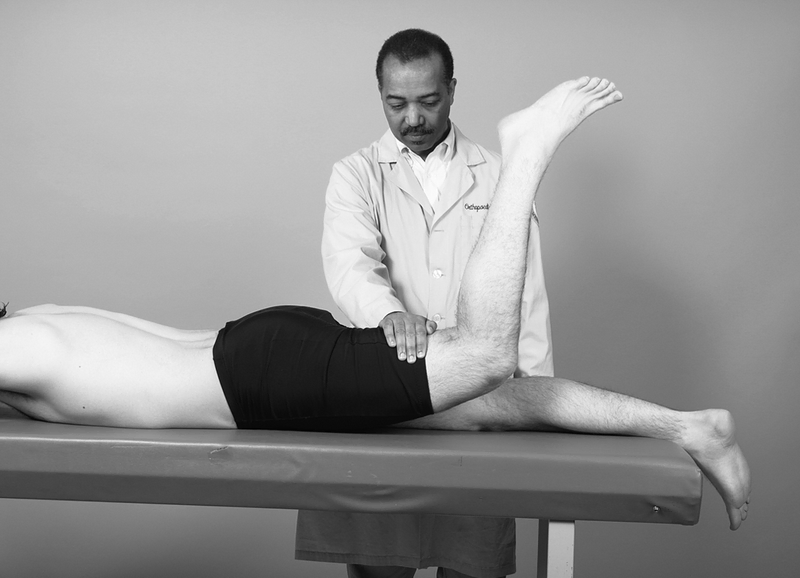
Hip extension
What to do: With the patient in the prone position, place the knee in 90º of flexion with your hand on the posterior thigh above the knee. Ask the patient to extend the hip against resistance.
Normal: Normal muscle strength.
Interpretation: Absence of normal muscle strength may be secondary to pain or may indicate muscular or neurologic disease.
Comment: A hip flexion contracture may limit the ability to test hip extension in this position; if this is the case, hip extension should be tested with the patient in the supine position.
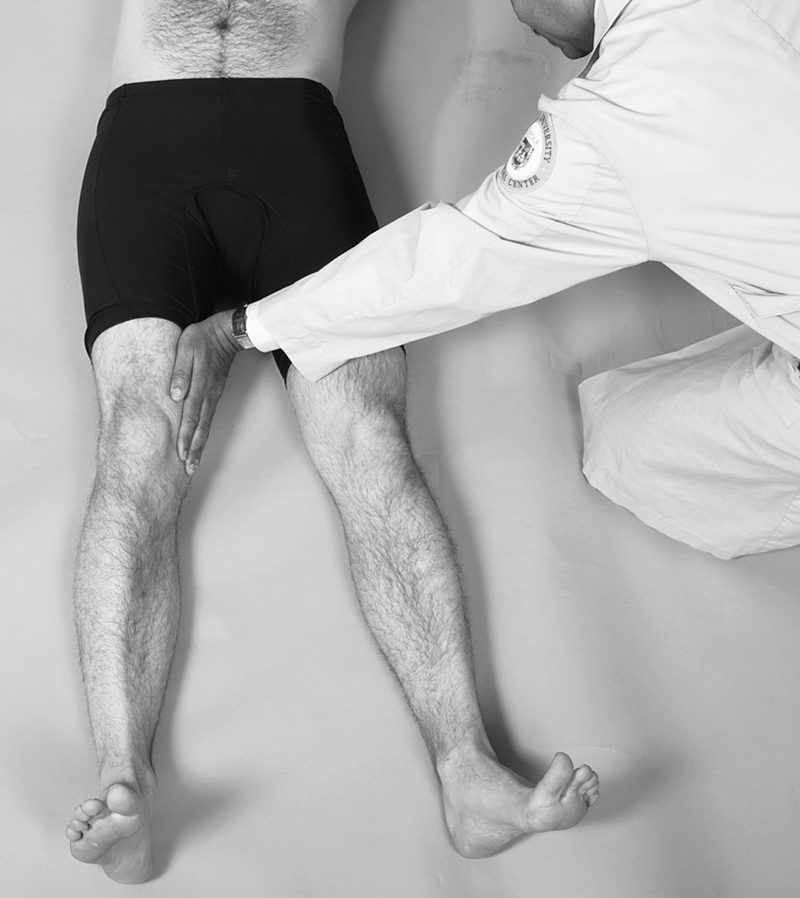
Hip adduction
What to do: With the patient in the supine position and the legs slightly apart, place one hand on the medial border of the thigh or leg and ask the patient to adduct the hip against manual resistance by bringing the legs together.
Normal: Normal muscle strength and absence of pain.
Interpretation: An adductor strain (also known as a pulled groin) causes pain-induced weakness.
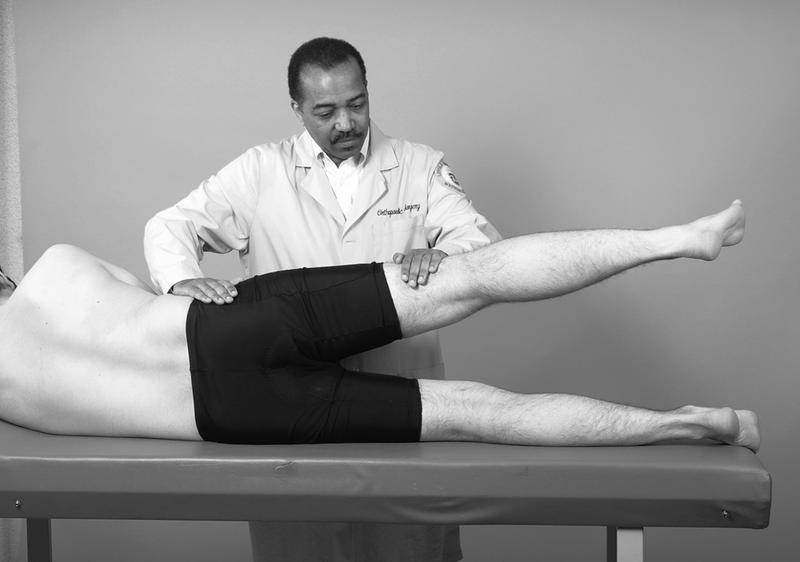
Hip abduction
What to do: With the patient lying on the unaffected side, place one hand on the lateral aspect of the thigh. Ask the patient to abduct the hip against resistance.
Normal: Normal muscle strength.
Interpretation: Absence of normal muscle strength may be secondary to pain or may indicate muscular or neurologic disease. Muscle atrophy and weakness commonly occurs with chronic hip diseases, such as osteoarthritis.
Comment: Hip abductor strength can also be assessed with the Trendelenburg test.
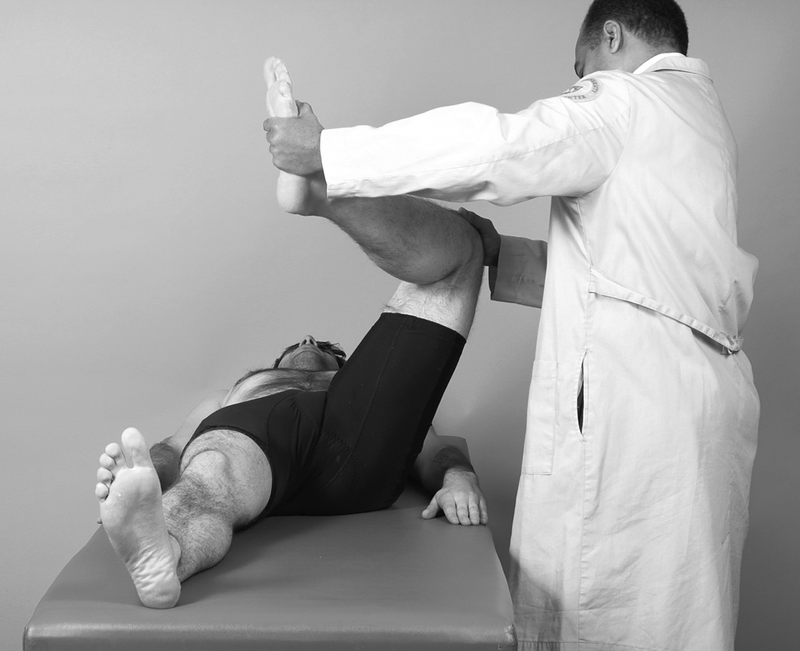
FABER test
What it tests: The FABER test (flexion-abduction-external rotation) is a stress maneuver to detect pathology at the sacroiliac joint.
What to do: With the patient in the supine position, place the patient’s affected hip in flexion, abduction, and external rotation.
Normal: Absence of pain.
Interpretation: If pain is produced, confirm that it emanates from the sacroiliac joint by palpating it.
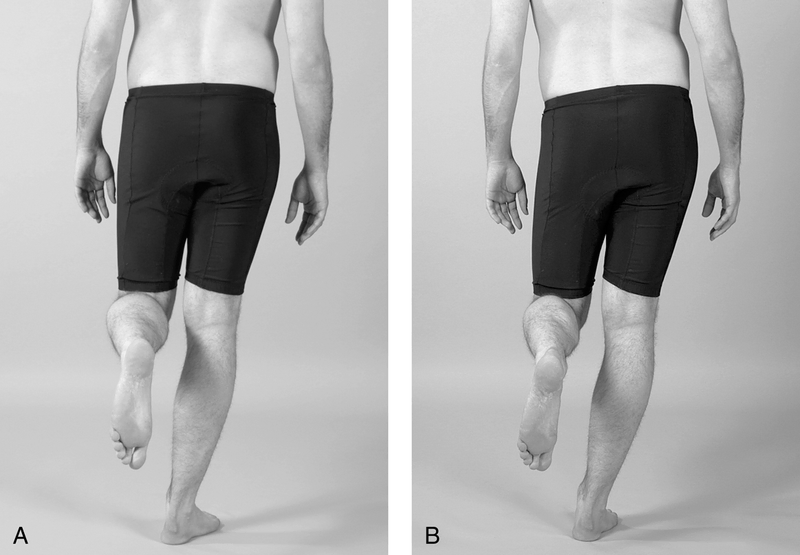
Trendelenburg test
What it tests: Abductor muscle strength of the hip.
What to do: With the patient standing, ask the patient to lift one foot off the ground and note whether the pelvis remains level or is slightly inclined toward the side of the supporting extremity.
Normal: Pelvis remains level.
Interpretation: If the pelvis dips toward the side of the foot being lifted off the ground and the trunk inclines toward the supporting side, the test result is positive. The abductor weakness is present on the side that supports the weight of the body. When the tendency to drop the pelvis toward the side of the foot being lifted is counteracted by normal strength in the abductor musculature, the test result is negative.
Comment: Positive test results can be noted in patients with hip pain because abductor muscle contraction creates compression of the hip joint (reactive joint force).
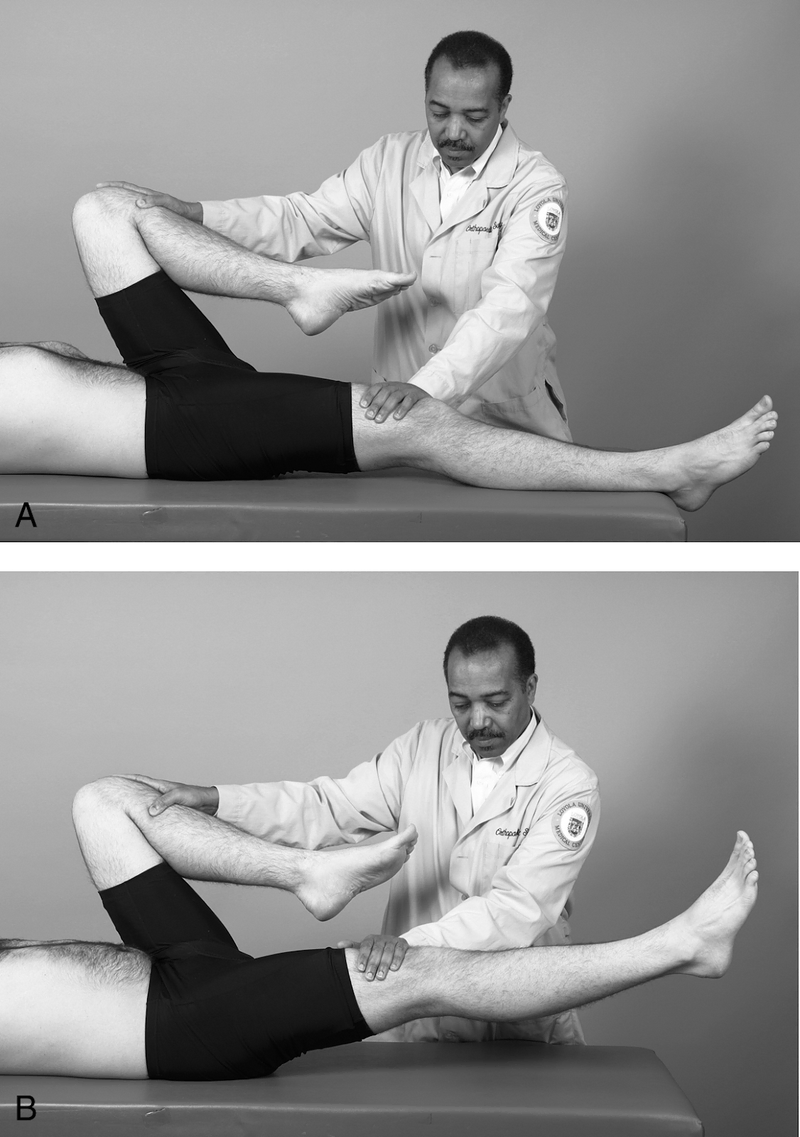
Thomas test
What it tests: Hip flexion contracture (lack of extension).
What to do: With the patient in the supine position, passively flex both of the patient’s hips into the chest. Then extend the affected hip while keeping the opposite hip in the flexed position.
Normal: The affected hip should extend completely to the examination table.
Interpretation: As this maneuver is being performed, the pelvis will be brought forward and flexion will occur at the lumbosacral articulations and eliminate lumbar lordosis. If the hip being tested cannot extend to the examination table, the test result is positive, in which case a fixed flexion contracture of the affected hip is diagnosed and measured.
Comment: Apparent “full extension” can be achieved even if there is a contracture (ie, false-negative test result) when the patient accentuates lumbar lordosis. By stabilizing the pelvis with the contralateral extremity flexed, the patient cannot compensate, and a true flexion contracture can be detected.
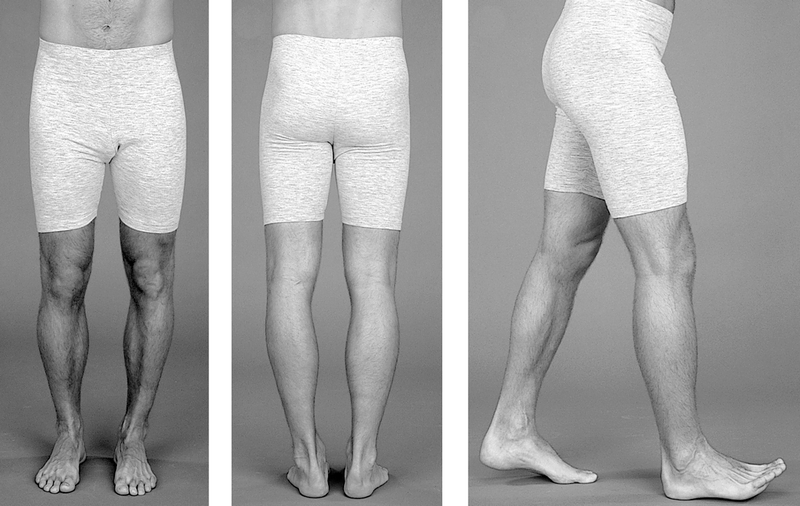
Inspection
Inspect the weight-bearing knees for overall alignment. The normal knee should be in slight valgus (knock-knees, or about 5º to 7º). Note any muscle atrophy, swelling, or malalignment, which are most evident on side-to-side inspection.
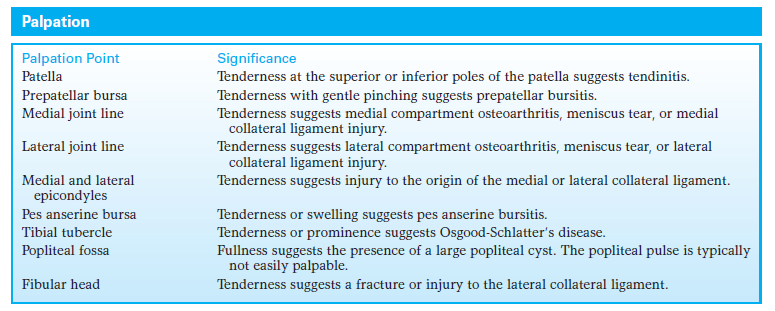
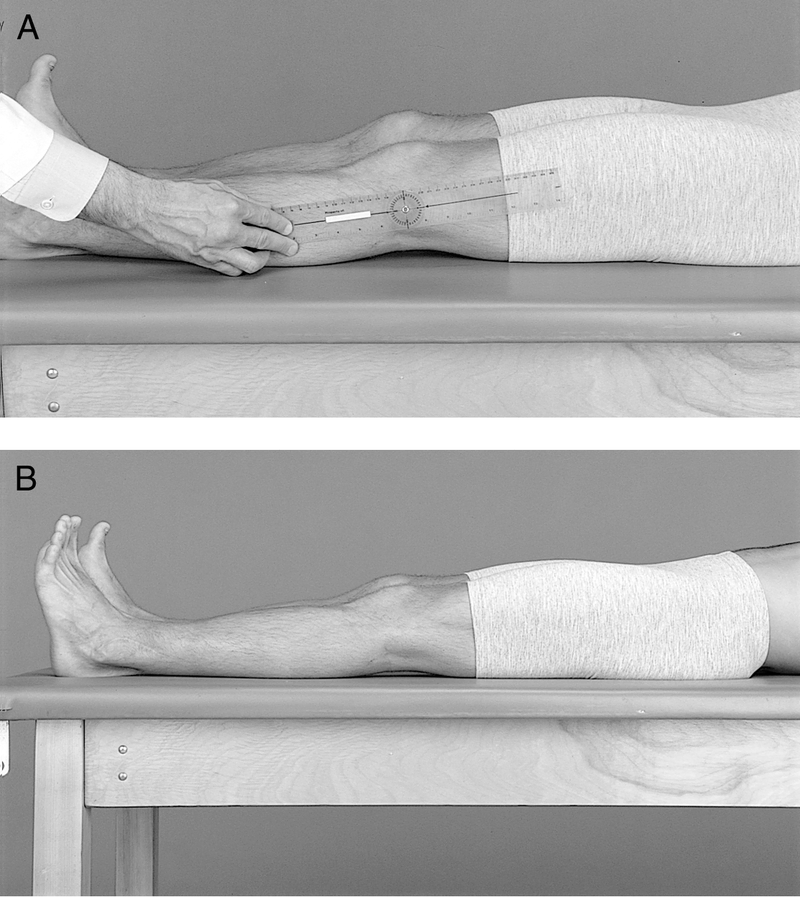
Knee flexion and extension
What to do: With the patient in the supine position, fully extend the knee by pulling the heel off of the examination table. Fully flex the knee by bringing the foot toward the buttock.
Normal: Extension to 0º and flexion to 135º.
Interpretation: Reduced range of motion suggests osteoarthritis, acute hemarthrosis, or capsular contracture (arthrofibrosis).
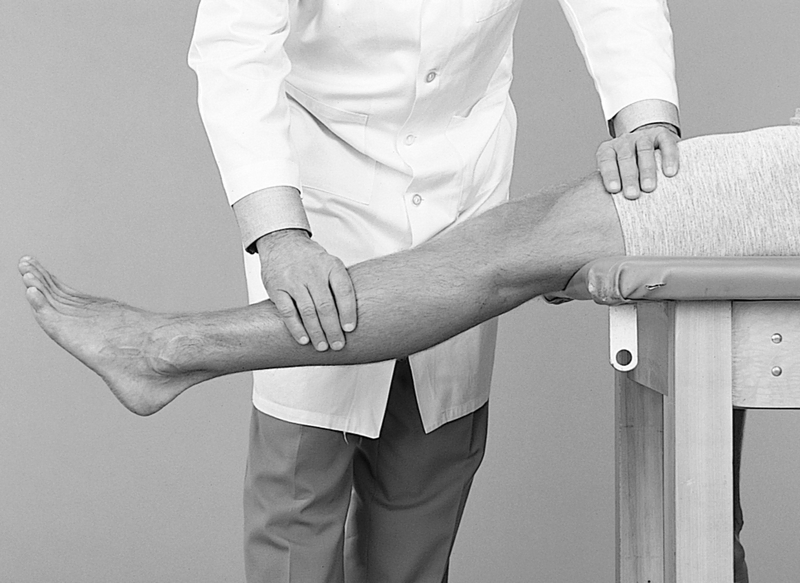
Quadriceps
What to do: With the patient in the seated position with the legs off of the examining table, ask the patient to extend the knee against resistance.
Normal: Good strength throughout a full range of motion (0° to 135°).
Interpretation: Complete inability to extend the knee indicates disruption of the extensor mechanism, including a possible quadriceps tendon tear, patellar tendon tear, or patella fracture. Weakness can be secondary to a muscular or neurologic cause. Chronic knee pain causes disuse atrophy of the quadriceps muscle, leading to subtle weakness.
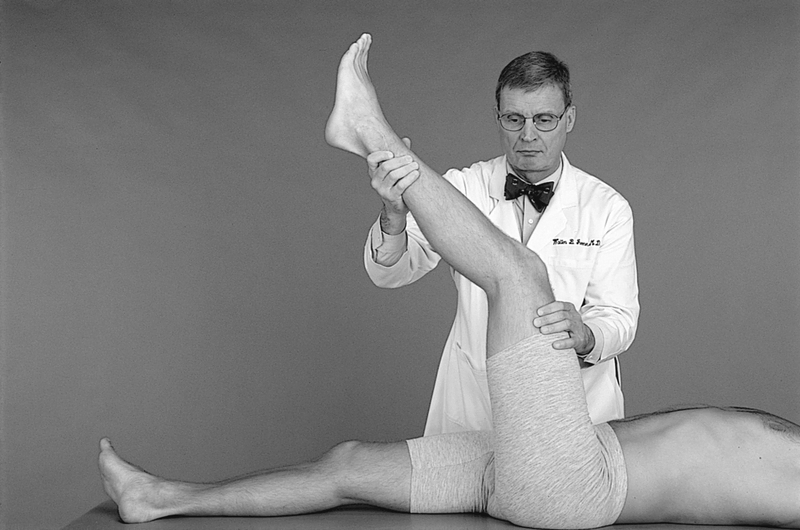
Hamstring
What to do: With the patient in the supine position with the hip flexed, bring the heel toward the buttock against resistance by placing the hand behind the ankle.
Normal: Good strength throughout a full range of motion.
Interpretation: Weakness can be secondary to pain or a muscular or neurologic cause (including disk herniation).
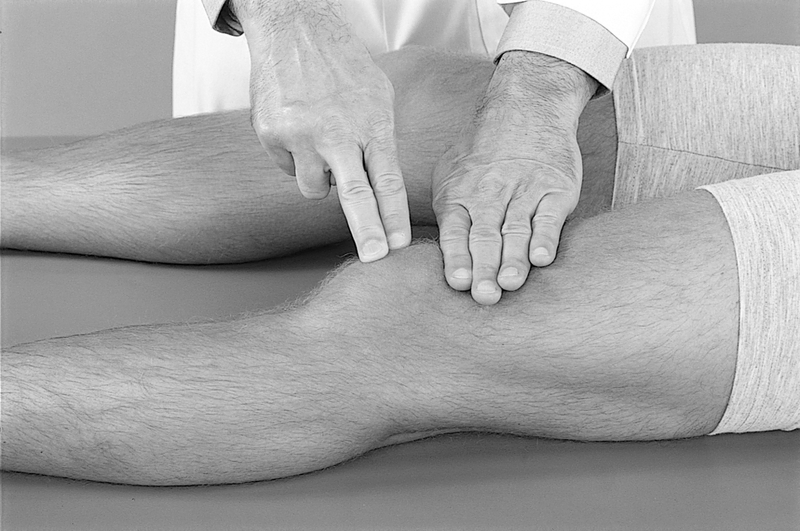
Patellar ballottement
What it tests: Effusions in the knee joint.
What to do: With the patient in the supine position, use one hand to compress the suprapatellar pouch, pushing whatever fluid may be in the pouch distally beneath the patella. Then use the other hand to tap the patella.
Normal: No effusions and the patella remains stable.
Interpretation: A positive result occurs when there is fluid in the knee joint that causes the patella to ballotte (bounce) as the fluid displaces with tapping. An effusion can be caused by acute trauma, inflammation, or infection.
Comment: The ballottement test may fail to detect small effusions if the fluid is not adequately compressed from the suprapatellar pouch.
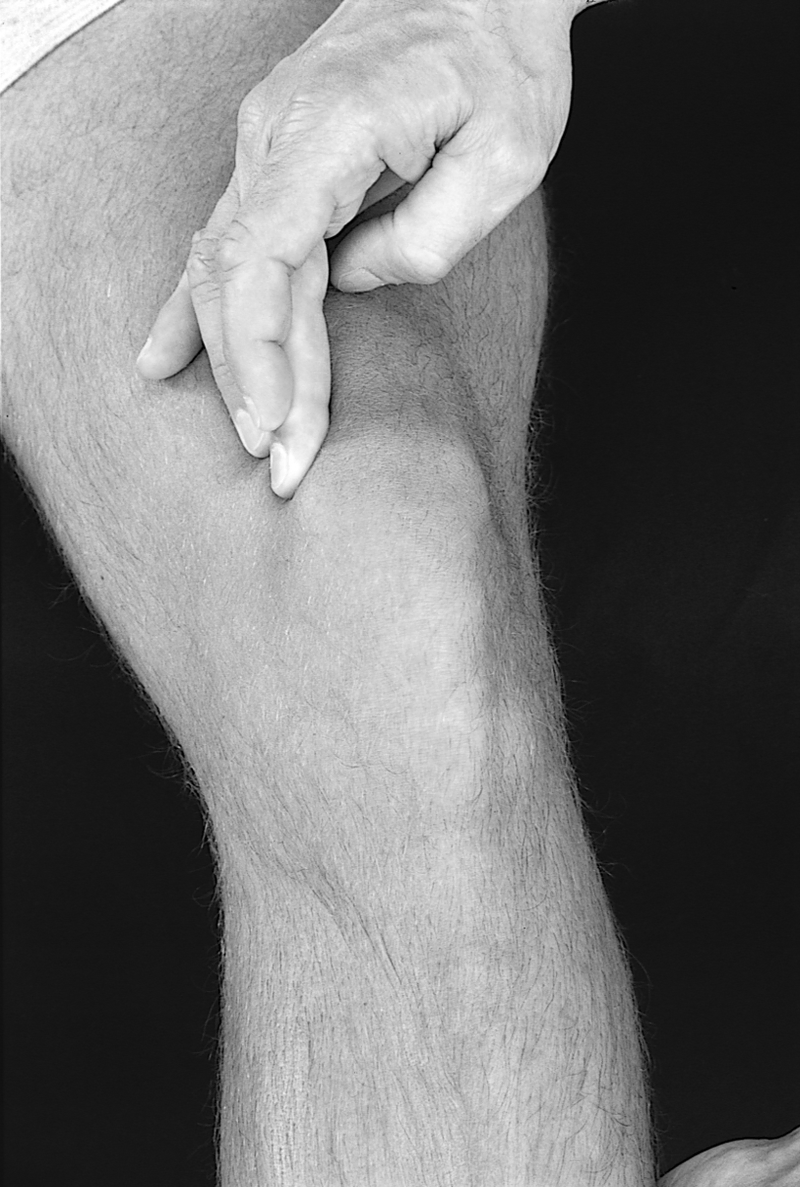
Patellar apprehension sign
What it tests: Patellar instability.
What to do: With the patient in the supine position, ask the patient to relax the quadriceps muscles. Attempt to laterally translate the patella by pushing on the medial aspect of the patella with a medial to lateral force, noting any apprehension or distress in the patient’s face.
Normal: No apprehension or distress by the patient.
Interpretation: A positive test result occurs when the patient reacts with apprehension or distress to the lateral translation of the patella. A patient with ligamentous laxity and instability may not react as dramatically as will a patient with traumatic dislocation.
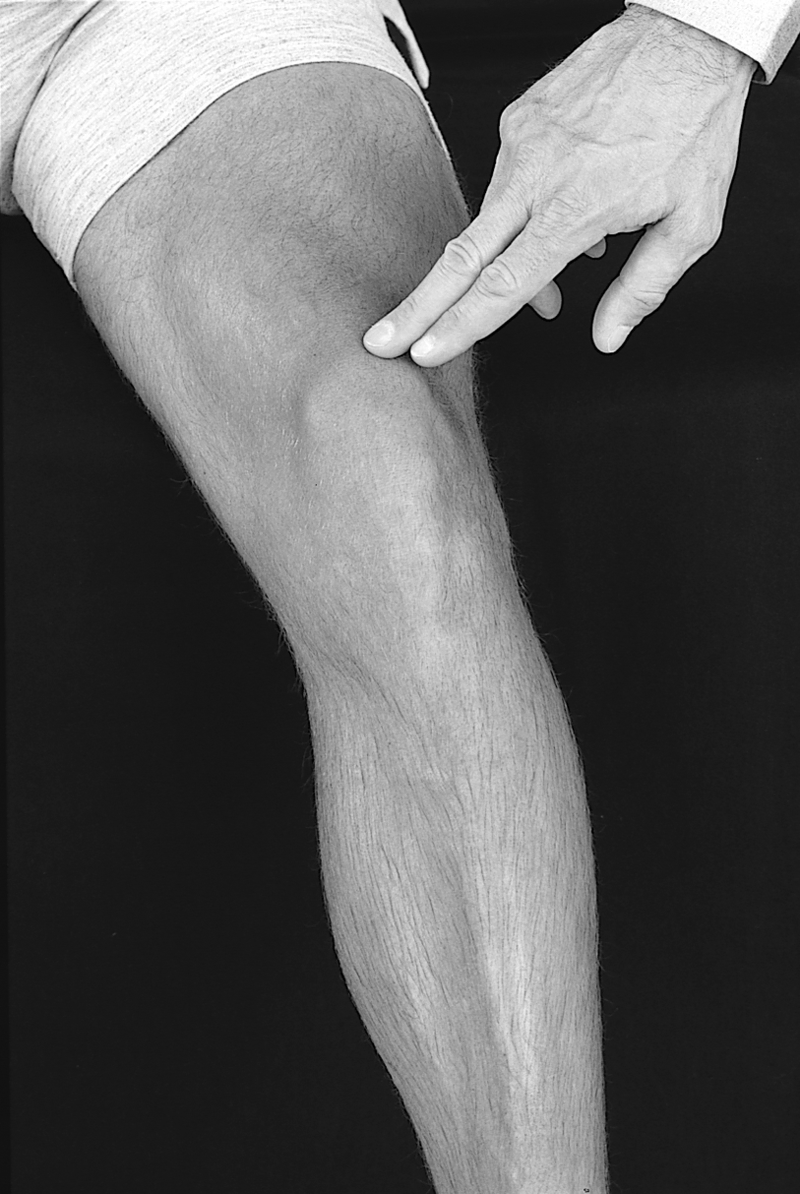
Patellar inhibition test
What it tests: Chondromalacia or osteoarthritis of the patellofemoral joint.
What to do: With the patient in the supine position, the quadriceps muscles relaxed, and the knee in extension, push the patella distally in the trochlear groove and then ask the patient to contract the quadriceps muscles. Apply resistance to the proximal excursion of the patella as the patient contracts the muscles.
Normal: No pain; patient is able to actively contract quadriceps.
Interpretation: Many patients will inhibit contraction of the quadriceps muscles to avoid pain. A positive test result usually indicates chondromalacia or osteoarthritis of the patellofemoral joint.
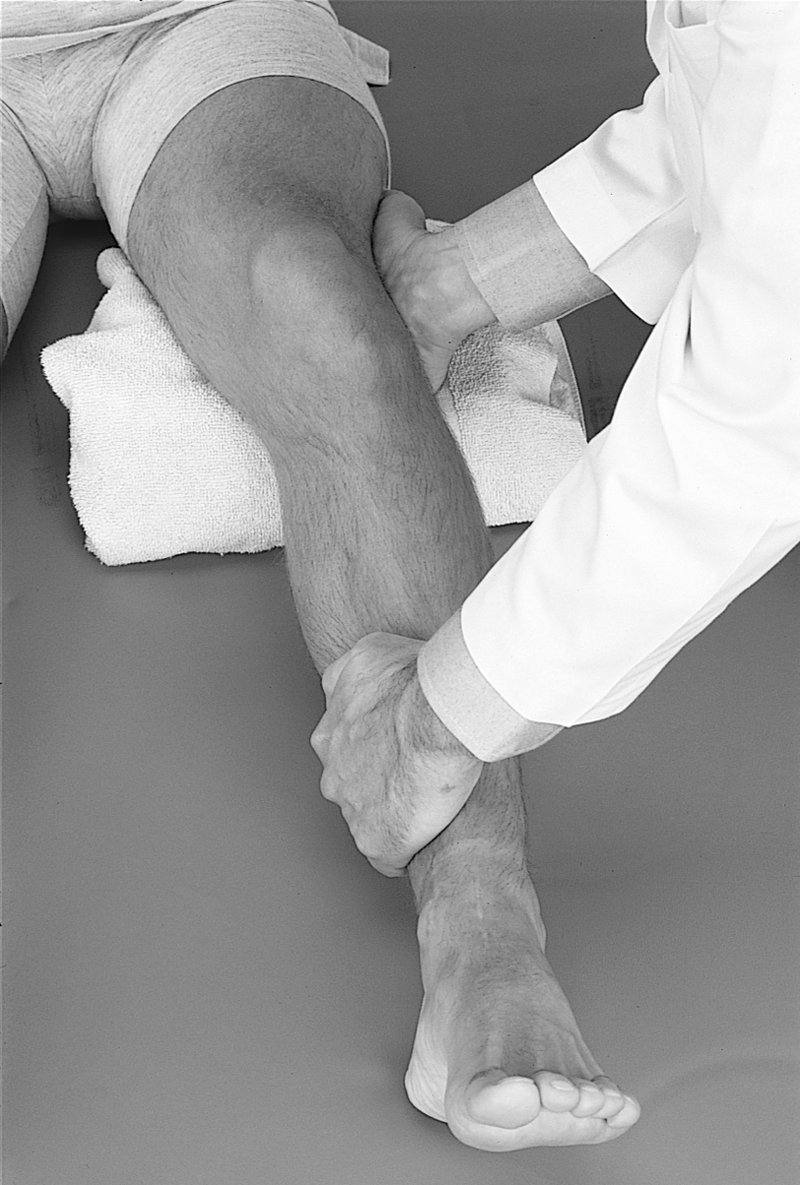
Valgus stress test (medial collateral ligament)
What it tests: Insufficiency of the medial collateral ligament.
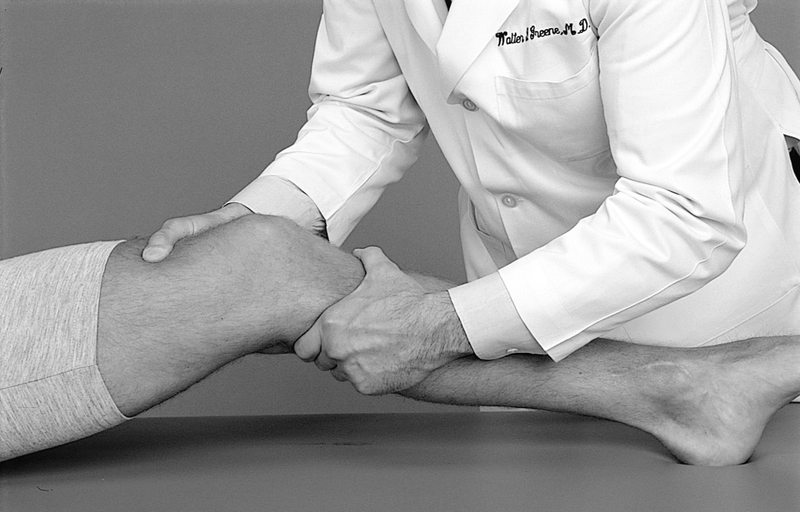
What to do: With the patient lying supine on the examination table, hold the leg in one hand while applying valgus stress to the knee with the other. Perform this test twice: first with the patient’s knee fully extended and again with the patient’s knee at 30º of flexion.
Normal: No significant opening (ie, ≤5º) of the medial joint space.
Interpretation: The test result is positive when there is more than 5º of opening of the medial joint space in response to the valgus stress. When the test result is positive with the knee at 30º of flexion but negative at 0º, isolated injury of the medial collateral ligament is suspected. When the test results are positive at both 0º and 30º, capsular damage is indicated in addition to a medial collateral ligament injury.
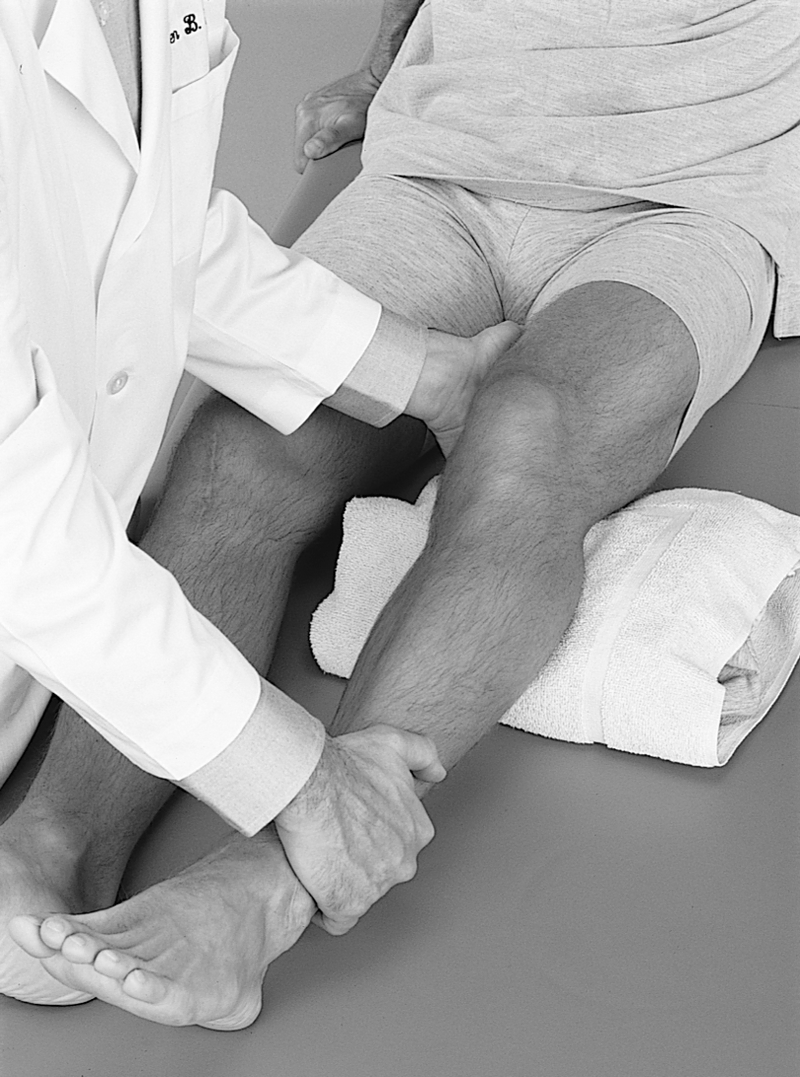
Varus stress test (lateral collateral ligament)
What it tests: Insufficiency of the lateral collateral ligament.
What to do: With the patient lying supine, hold the leg in one hand while applying varus stress to the knee with the other. As with the valgus stress test, perform this test twice: first with the patient’s knee fully extended (0º) and again with the patient’s knee at 30º of flexion.
Normal: No significant opening (ie, ≤7º) of the lateral joint space.
Interpretation: The test result is positive when there is more than 7º of opening of the lateral joint space in response to varus stress. When the test result is positive with the knee at 30º of flexion but negative at 0º, isolated injury to the lateral collateral ligament is suspected; however, when the test results are positive at both 0º and 30º, capsular damage is indicated in addition to a lateral collateral ligament injury.
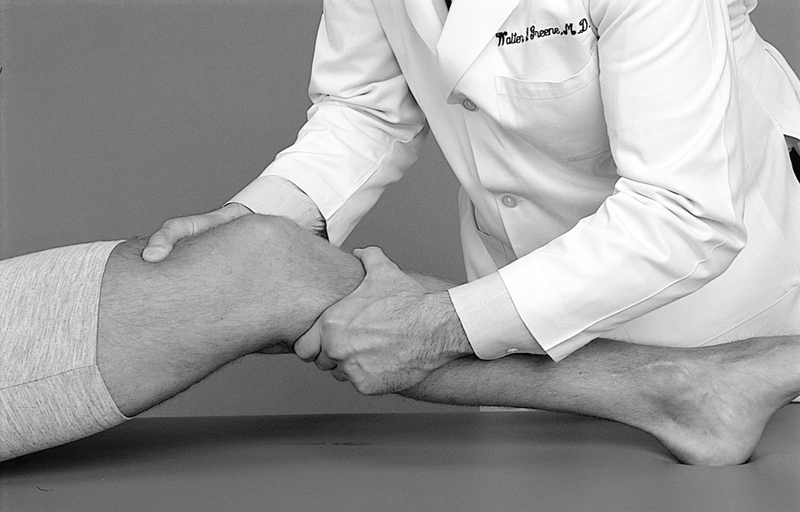
Lachman test
What it tests: ACL insufficiency.
What to do: With patient lying supine with the knee at 20º to 30º of flexion, stabilize the distal femur in one hand while grasping the proximal tibia with the other hand. The thumb of the hand grasping the tibia should be placed just below the joint line. Apply anterior force to the tibia. Grade the quality of the end point (taut versus soft) and the amount of anterior translation of the tibia on the femur compared with the normal side.
Normal: A firm end point implies continuity of the ACL.
Interpretation: Increased translation of the tibia on the femur with no end point indicates an ACL tear.
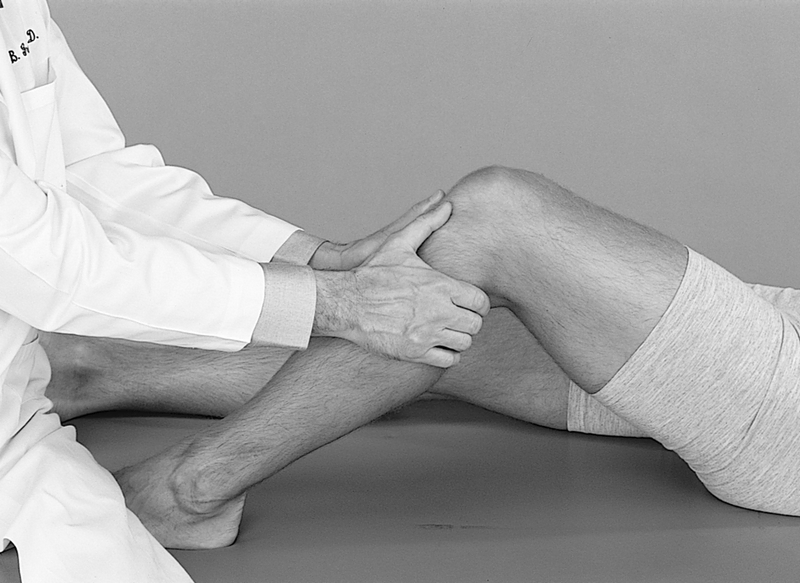
Anterior and posterior drawer test
What it tests: ACL and posterior cruciate ligament (PCL) insufficiency.
What to do: With the patient lying supine on the examination table, the knee flexed to 90º, and the hip flexed to 45º, rest your buttock on the patient’s foot to maintain the flexion and stabilize the leg. Then attempt to displace the tibial plateau anteriorly and posteriorly by pulling and pushing on the proximal tibia.
Normal: No excessive translation of the tibia on the femur; a firm end point is felt in each direction.
Interpretation: A positive test result consists of tibial plateau subluxation anteriorly relative to the femoral condyles. This is evident on visualization and palpation of the joint line as the force is applied. Excessive posterior translation is positive for a PCL injury.
Comment: The anterior drawer test is less accurate than the Lachman test in detecting ACL injury because some subluxation occurs even with an intact ACL. Nevertheless, the test has some utility when the patient’s body habitus or lack of relaxation makes it difficult to perform the Lachman test. If the test result is inconclusive and an effusion is present, aspiration may help make the diagnosis. The posterior drawer test is the most accurate test for detecting PCL injuries because the PCL is the tightest in 90° of knee flexion.
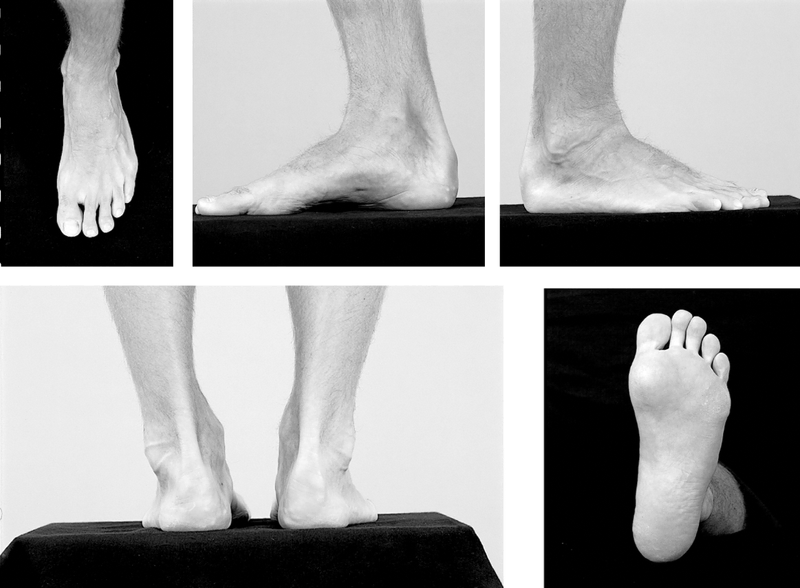
Inspection
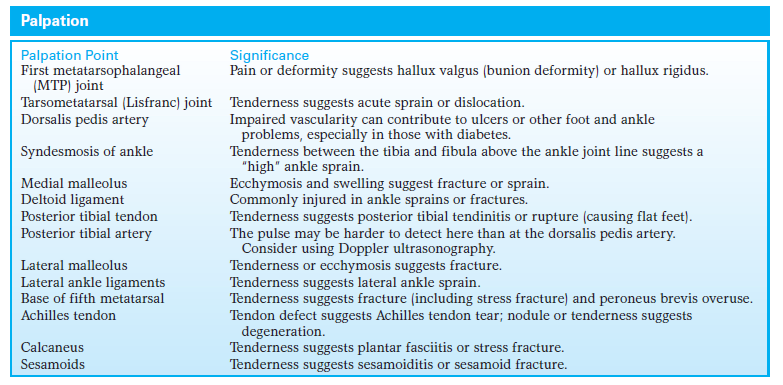
Inspect the feet and ankles using a combination of standing, ambulating, and non–weight-bearing positions. All surfaces of the foot and ankle should be inspected. Gait should also be inspected.
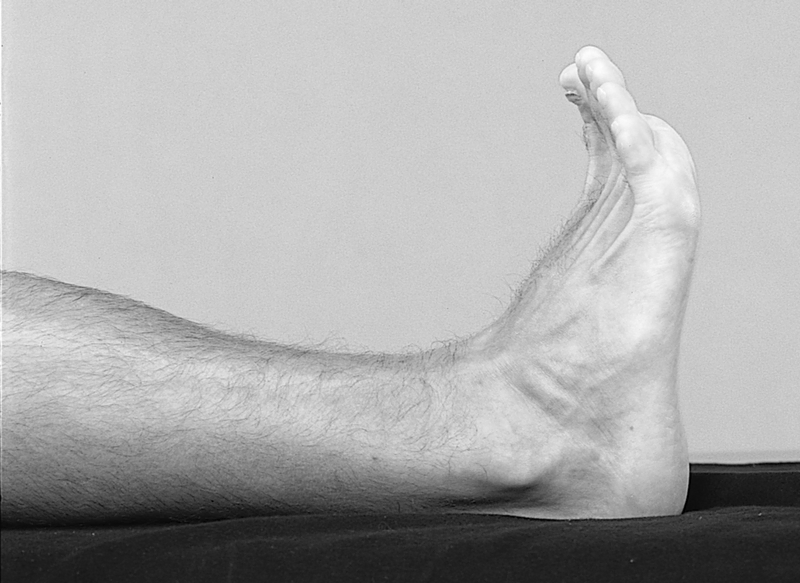
Ankle dorsiflexion and plantar flexion
What to do: With the patient seated and the heel stabilized, grasp the foot in the midfoot position and maximally dorsiflex and plantar flex the ankle joint.
Normal: Dorsiflexion of 10º to 20º and plantar flexion of 35º to 50º.
Interpretation: Loss of ankle range of motion is usually caused by arthritis or a capsular contracture.
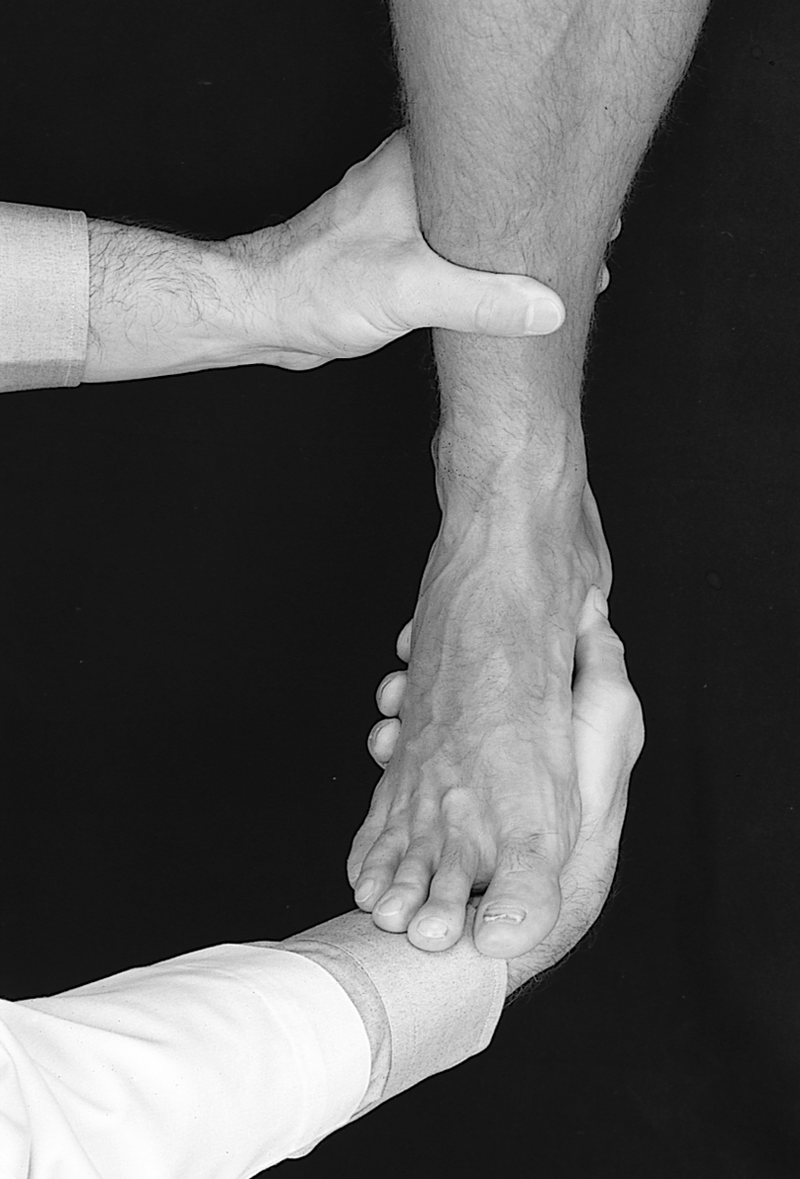
Subtalar inversion and eversion
What to do: With the patient seated, grasp the heel and apply gentle force in inversion (turn the heel in) and eversion (turn the heel out).
Normal: While considerable variability exists, average inversion is approximately 5º to 20º; average eversion is approximately 5º to 20º.
Interpretation: Restricted motion of the subtalar joint may be seen in patients with subtalar arthritis, end-stage posterior tibial tendon dysfunction, or tarsal coalition.
Comment: Pain resulting from a history of walking on uneven terrain suggests subtalar pathology.
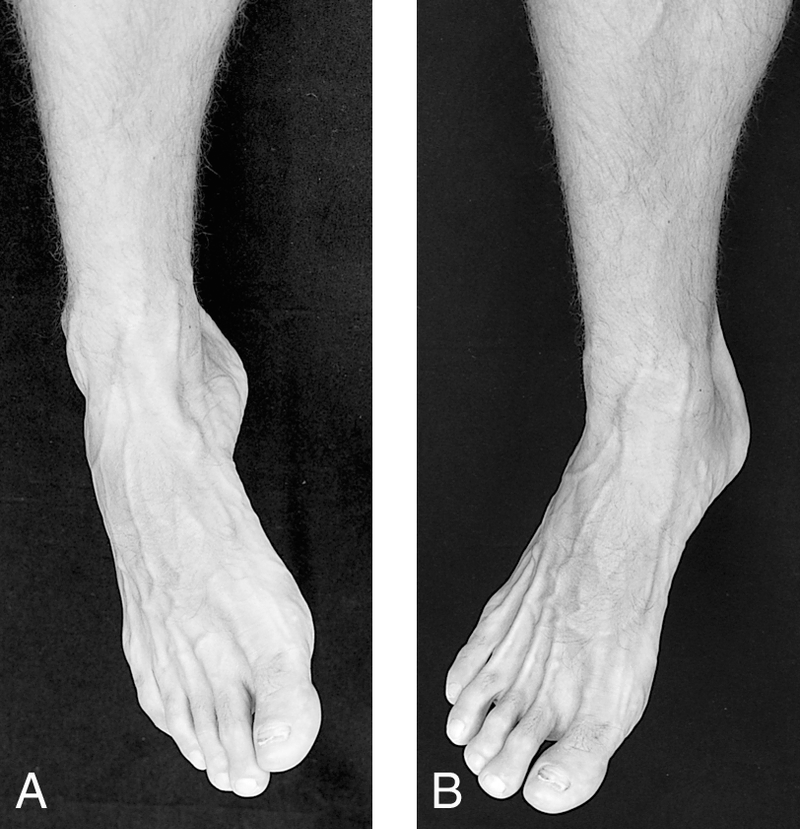
Supination and pronation
What to do: With the patient in the seated position, grasp the forefoot and rotate the foot in (supination) and out (pronation). Supination includes inversion of the heel, as well as adduction and plantar flexion of the midfoot. Pronation is the opposite motion and includes eversion of the heel and abduction and dorsiflexion of the midfoot.
Normal: Because the degree of supination and pronation is difficult to quantify, compare with the opposite side.
Interpretation: Restricted motion most commonly occurs secondary to midfoot arthritis; excess motion can be caused by injury to the ligaments of the midfoot joints.
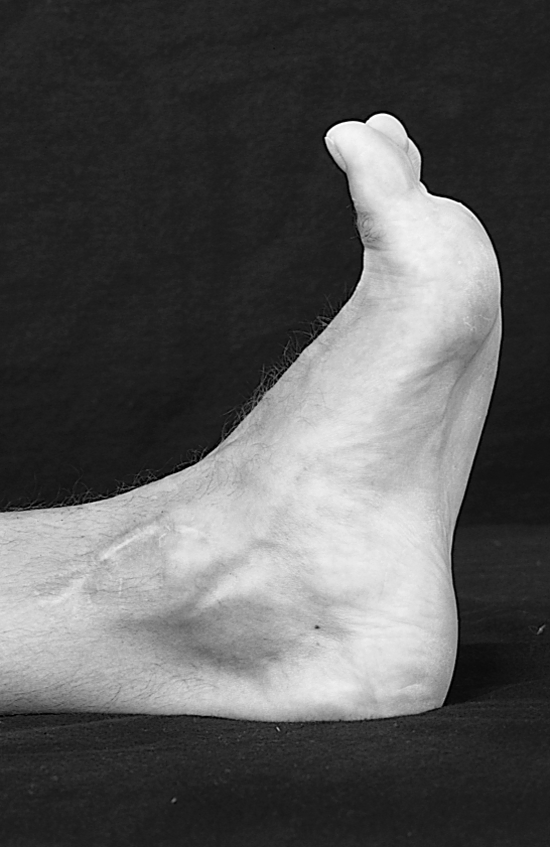
Great toe dorsiflexion and plantar flexion
What to do: Grasp the great toe at the interphalangeal joint and maximally dorsiflex and plantar flex the MTP joint while stabilizing the first metatarsal.
Normal: Passive extension to 70º, flexion to 45º.
Interpretation: Restricted motion, often associated with pain, is commonly associated with hallux rigidus or arthritic change in the MTP joint.
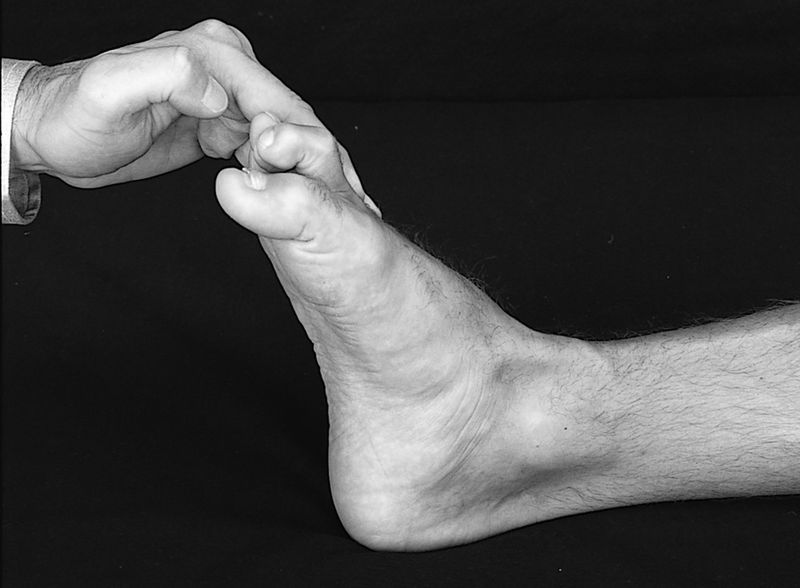
Tibialis anterior
What to do: With the patient in the supine position, ask the patient to maximally dorsiflex the ankle and maintain that position while you attempt to push the ankle into plantar flexion.
Normal: Normal strength against resistance (compare with contralateral side).
Interpretation: Weakness or loss of movement in the tibialis anterior leads to a “foot drop” during gait, which is commonly caused by peroneal nerve injury or less commonly by isolated L4 radiculopathy.
Comment: Because the extensor digitorum longus, extensor hallucis longus, and peroneus tertius are also ankle dorsiflexors, they may assist and mask isolated tibialis anterior weakness.
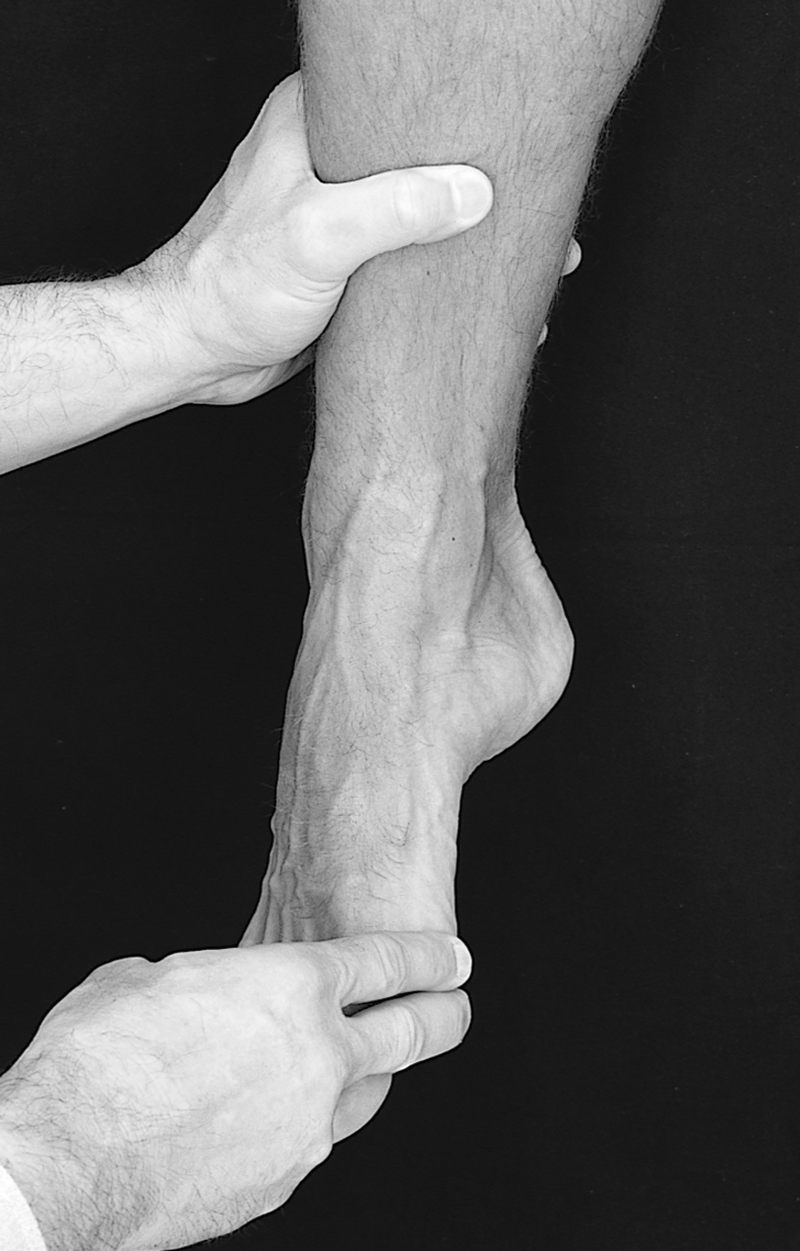
Tibialis posterior
What to do: Place the patient’s ankle in a plantar flexed and inverted position. Then ask the patient to resist your attempt at eversion.
Normal: Normal strength against resistance; the posterior tibialis tendon should visibly tighten.
Interpretation: Weakness can be associated with tendinitis or rupture and warrants further investigation, in which case, with the patient standing, you should evaluate the medial longitudinal arch for collapse and perform the single heel rise test.
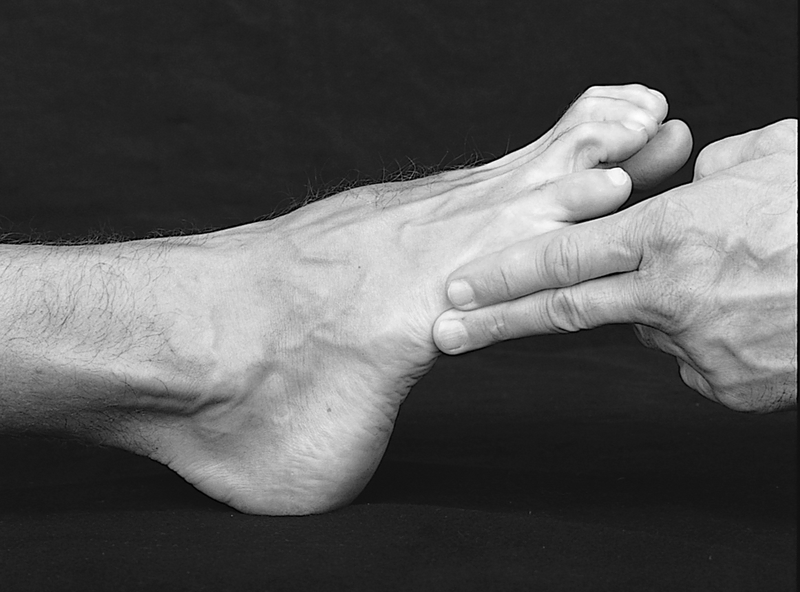
Peroneus longus and brevis
What to do: While facing the patient, grasp the foot and slightly plantar flex the ankle. After securing the distal tibia with the other hand, evert the foot. Then ask the patient to maintain this position as you attempt to invert the foot.
Normal: Normal strength against resistance
Interpretation: Inability to evert the foot and ankle may indicate tendinitis, instability of the peroneal tendons, Charcot-Marie-Tooth disease, superficial peroneal nerve palsy, or lumbosacral radiculopathy (S1).
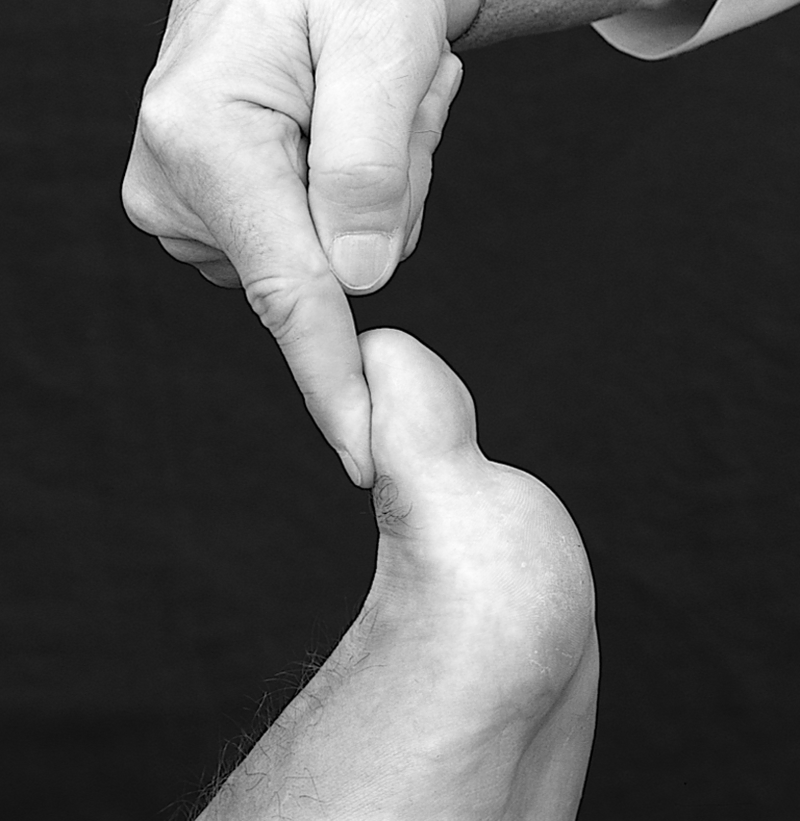
Extensor hallucis longus
What to do: While supporting the plantar forefoot, ask the patient to extend the great toe and resist your attempts to push the toe into flexion.
Normal: Normal strength against resistance.
Interpretation: Weakness or the inability to extend the great toe indicates injury to the extensor hallucis longus, the deep peroneal nerve, or, most commonly, the L5 nerve root.
Comment: Testing of the extensor digitorum longus muscle may be performed in an identical manner by isolating each of the remaining four toes.
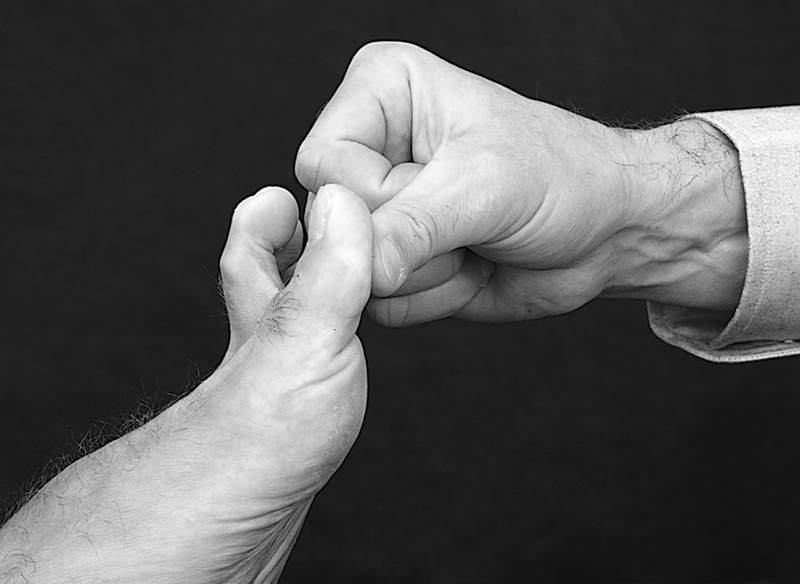
Flexor hallucis longus
What to do: With the patient’s ankle in the neutral position, ask the patient to flex the great toe against resistance to the distal phalanx.
Normal: Normal strength against resistance.
Interpretation: Weakness can indicate tendinitis or a tendon tear of the flexor hallucis longus. In addition, flexor hallucis longus weakness can indicate dysfunction of the S1 nerve root.
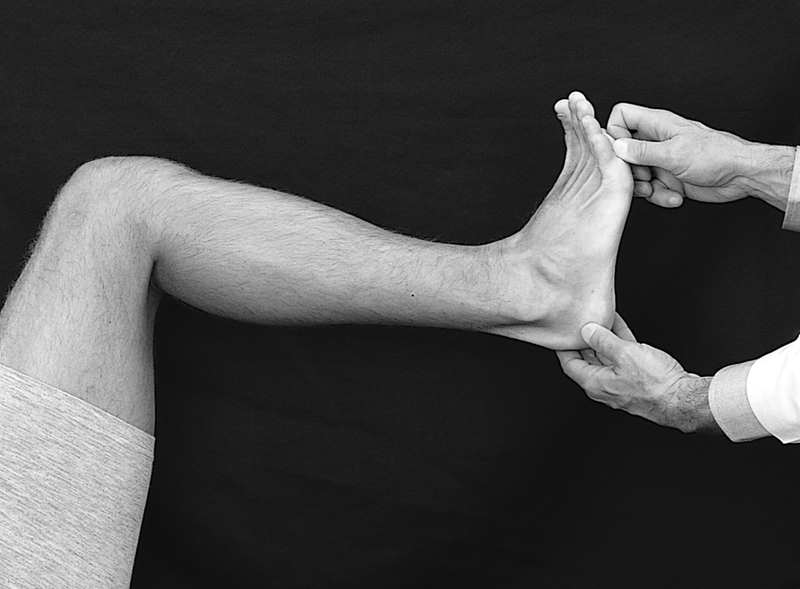
Gastrocnemius-soleus complex
What to do: Ask patient to plantar flex the ankle against resistance.
Normal: Full plantar flexion.
Interpretation: Weakness or the inability to plantar flex against resistance indicates possible Achilles tendon rupture, sciatic and tibial nerve injury, or lumbosacral radiculopathy (S1 and S2). The ability to plantar flex against resistance does not rule out a ruptured Achilles tendon (see Thompson test).
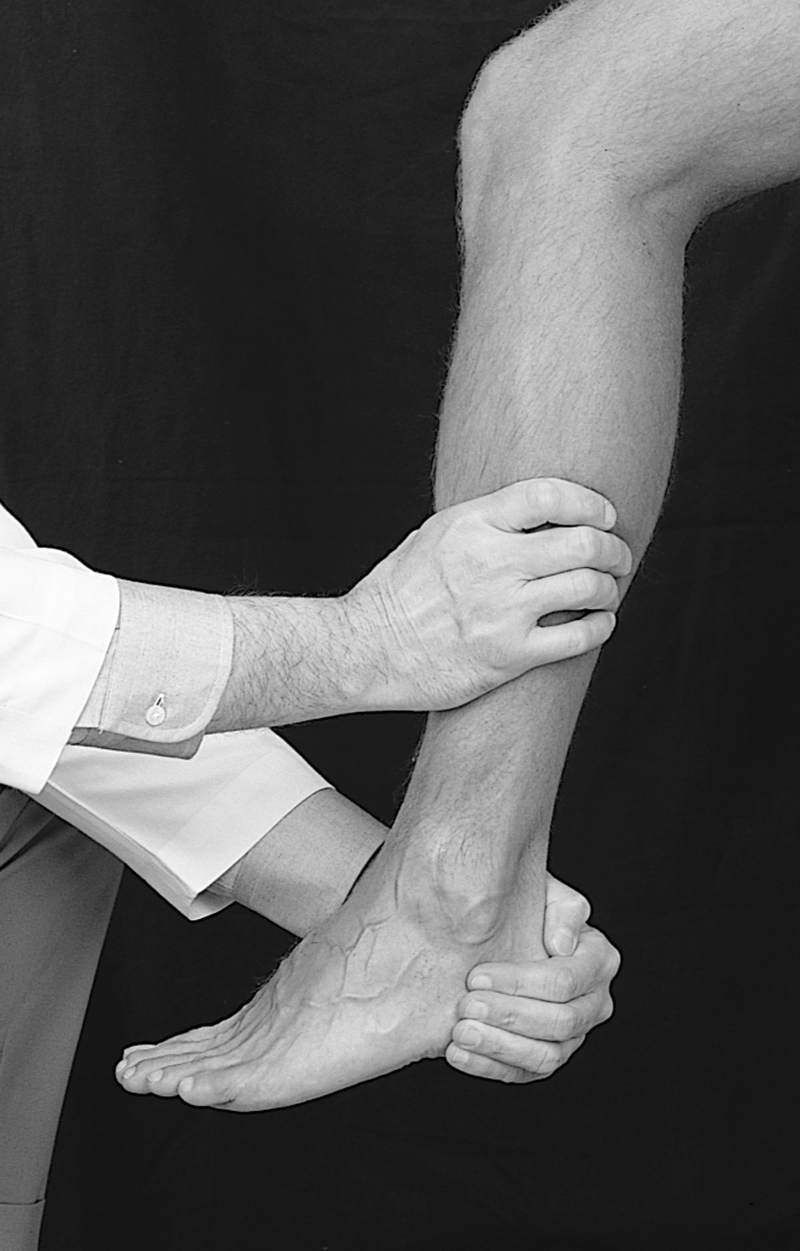
Anterior drawer test
What it tests: The anterior talofibular ligament in cases of ankle instability.
What to do: With the patient seated and the ankle slightly plantar flexed, stabilize the distal tibia with one hand and cup the heel in the other hand. Apply anterior force using the hand cupping the heel. Assess for anterior translation of the talus on the tibia.
Normal: 3 to 5 mm of anterior talus translation followed by a firm end point.
Interpretation: Translation of greater than 3 to 5 mm difference from the contralateral ankle or a “soft” or absent end point, suggests insufficiency (disruption) of the anterior talofibular ligament.
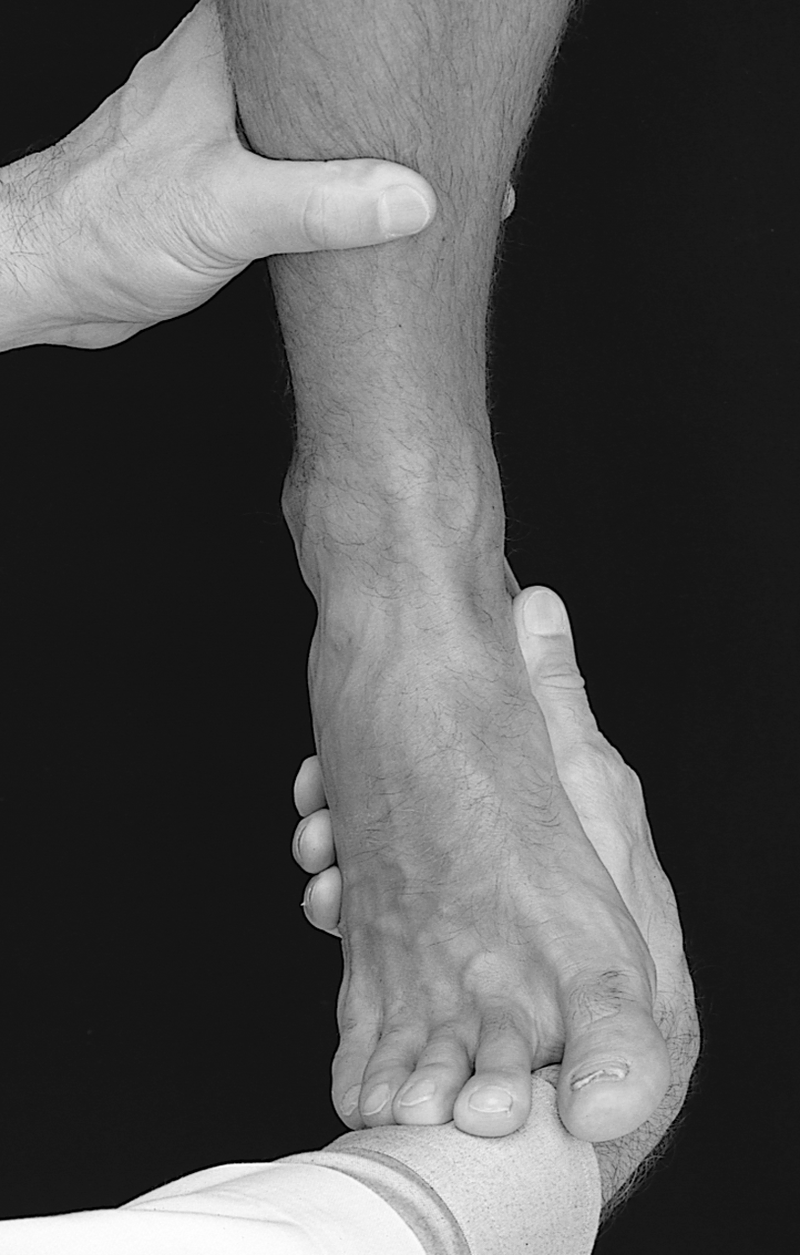
Inversion stress test
What it tests: The calcaneofibular ligament of the lateral ankle in cases of ankle instability.
What to do: With the patient seated, maximally dorsiflex the ankle by applying upward force on the forefoot. Then apply a varus movement to the ankle by cupping the heel medially and inverting it.
Normal: No significant motion of the talus.
Interpretation: With disruption of the calcaneofibular ligament, the talus can be felt rocking into inversion.
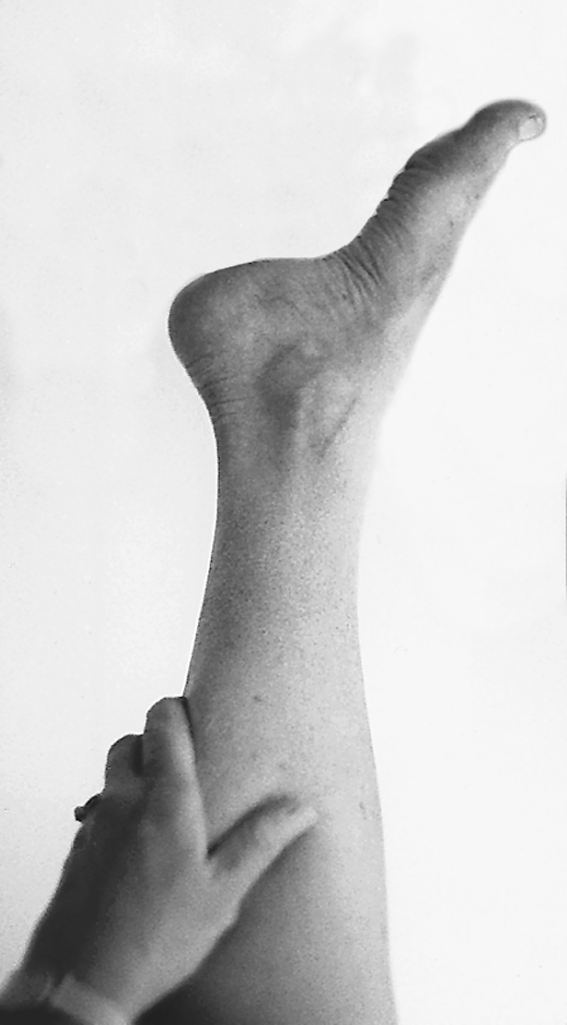
Thompson’s test
What it tests: Continuity of the gastrocnemius-soleus complex in cases of possible Achilles tendon rupture.
What to do: With the patient in the prone position, gently squeeze the calf using one or both hands.
Normal: Plantar flexion of the ankle as the calf is compressed.
Interpretation: With a fully ruptured Achilles tendon, there should be essentially no motion at the ankle. If there is only partial disruption of the Achilles tendon complex, slight plantar flexion may still occur.
Comment: Active plantar flexion does not rule out a torn Achilles tendon because the toe flexors and tibialis posterior can provide some plantar flexion strength; therefore, Thompson’s test is necessary in the assessment of the continuity of the gastrocnemius-soleus complex in cases of possible Achilles tendon rupture.

Single heel rise test
What it tests: Competence of the posterior tibial tendon.
What to do: Ask the patient to stand and face a wall using the hands for stabilization. Then ask the patient to lift the unaffected foot off the ground and stand up on the toes of the affected side. Observe the heel for movement.
Normal: Ability to stand up on toes; heel should tilt into an inverted (varus) position (medial side higher).
Interpretation: A patient with posterior tibial tendon dysfunction will not be able to perform the single heel rise and the heel will not move into the normal varus position. This can indicate posterior tibial tendinitis or a posterior tibial tendon tear.
Comment: It is crucial to begin the test with the unaffected leg off the ground. If the patient elevates onto the toes using both feet, the Achilles tendon can hold the heel in varus despite a dysfunctional posterior tibial tendon.
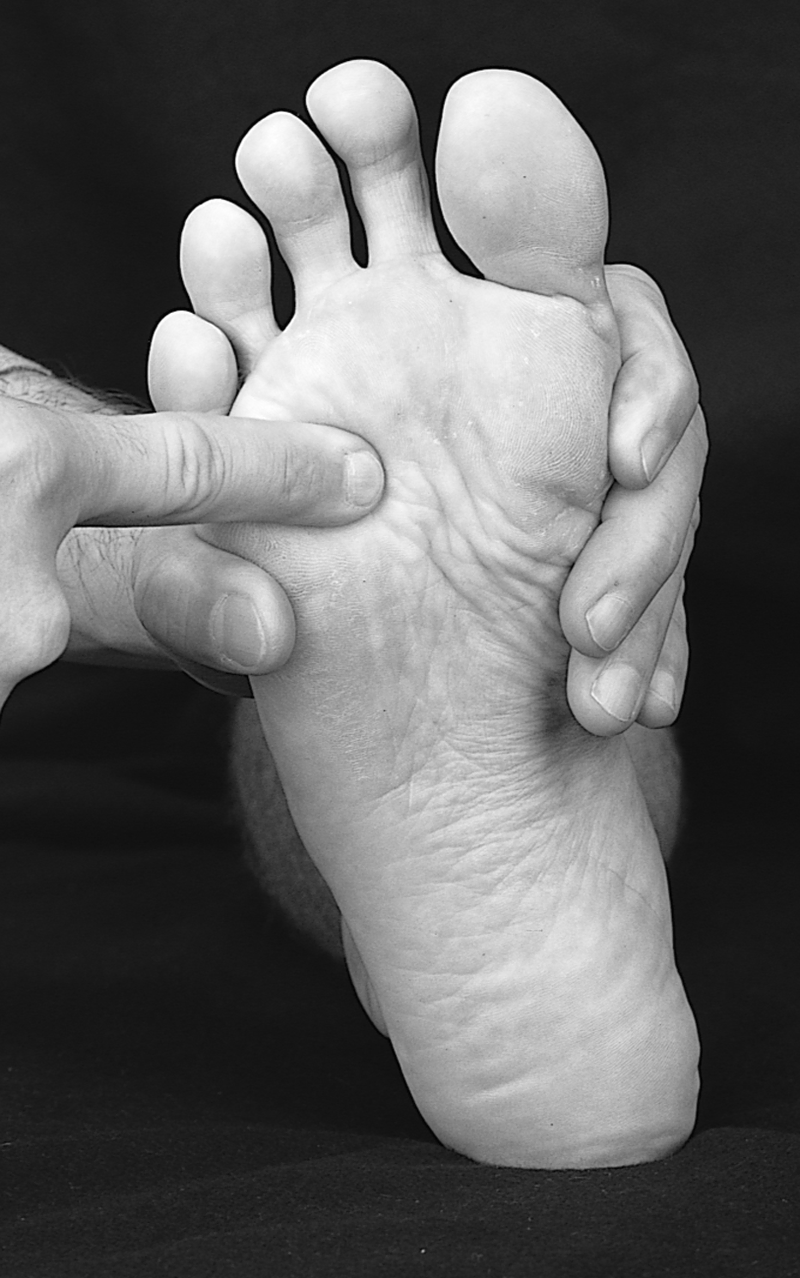
Interdigital neuroma (Morton’s) test
What it tests: The presence of interdigital neuroma as the source of web-space pain.
What to do: Grab the heads of the first and fifth metatarsals and squeeze them, capturing the other metatarsal heads between them.
Normal: Absence of pain.
Interpretation: The test result is positive when tenderness occurs with compression of interdigital neuromas between metatarsals. When a palpable click (Mulder’s click) is felt during compression, a large neuroma may extrude plantarly from between the metatarsal heads.
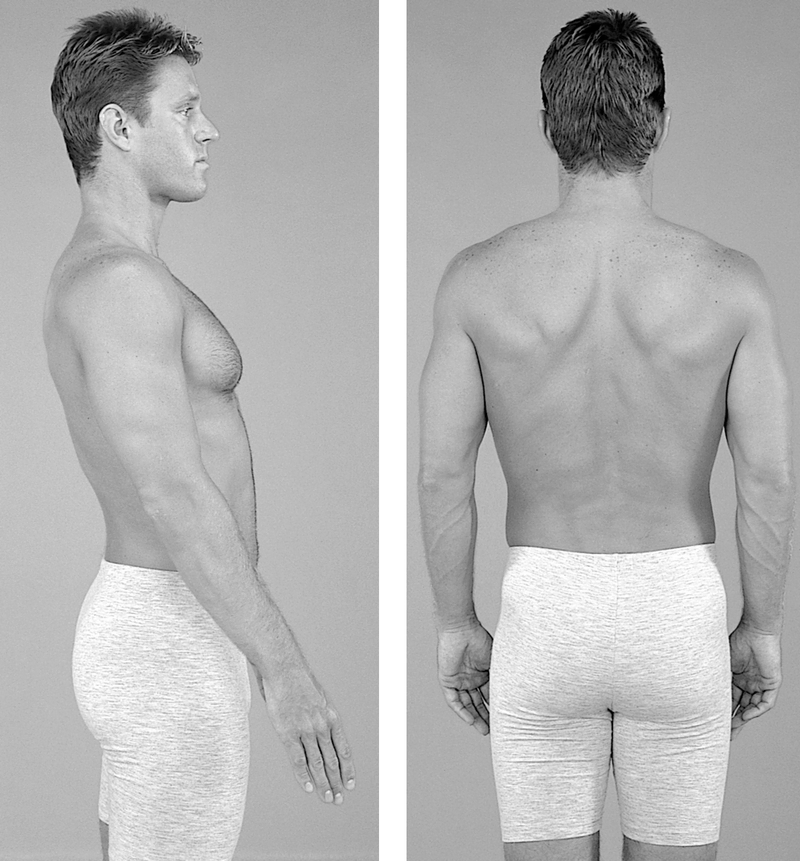
Lateral and posterior view of spine and pelvis ( E2, p. 526, Fig. 1; E2, p. 526, Fig 2[left])
With the patient standing, inspect for deviations in the normal spinal curves. In the lateral position, inspect for lordosis and kyphosis. Lordosis (a concave curve) should be apparent at the cervical and lumbar spine segments. Kyphosis (a mild convex curve) should be apparent in the thoracic spine. Deviation from these normal curves can occur with painful conditions such as acute sprains, fractures, infections, or neoplastic processes. Abnormalities also can be congenital. With the patient standing and facing away from you, view the alignment of the spine. Moderate to severe scoliosis (lateral “S” or “C” curvature) will be obvious, if present. A lumbar “list,” which causes the patient to lean to one side to alleviate nerve root compression, may also be present in association with a herniated disk or other conditions. Look for any atrophy of the gluteus muscles and posterior thigh musculature.
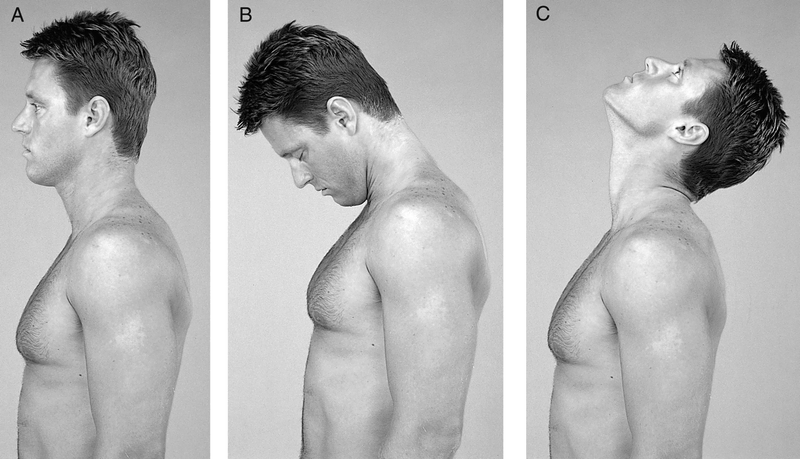
Neck flexion and extension
What to do: Beginning with the patient standing, align the neck with the trunk, and then stabilize the trunk so no motion occurs in the thoracic spine. Ask the patient to flex the neck by bending the head forward and touching the chin to the chest. Then ask the patient to extend the neck by looking up at the ceiling.
Normal: Flexion of the neck (able to touch the chin to the chest) and extension of the neck (able to look directly at the ceiling).
Interpretation: Limited range of motion or pain with this maneuver can indicate cervical spinal pathology, disk disease, or a muscle strain.

Lateral flexion of the neck
What to do: With the patient’s neck aligned with the trunk, ask the patient to touch the ear to one shoulder and then the other shoulder.
Normal: Able to bend to 45° to the shoulder.
Interpretation: Limited range of motion or pain with this maneuver can indicate cervical spinal pathology, disk disease, or a muscle strain.

Neck rotation
What to do: With the patient’s neck aligned with the trunk, ask the patient to turn the head to the right as far as possible. Then ask the patient to repeat this motion to the left.
Normal: Able to place the chin in line with each shoulder.
Interpretation: Limited range of motion or pain with this maneuver can indicate cervical spinal pathology, disk disease, or a muscle strain.
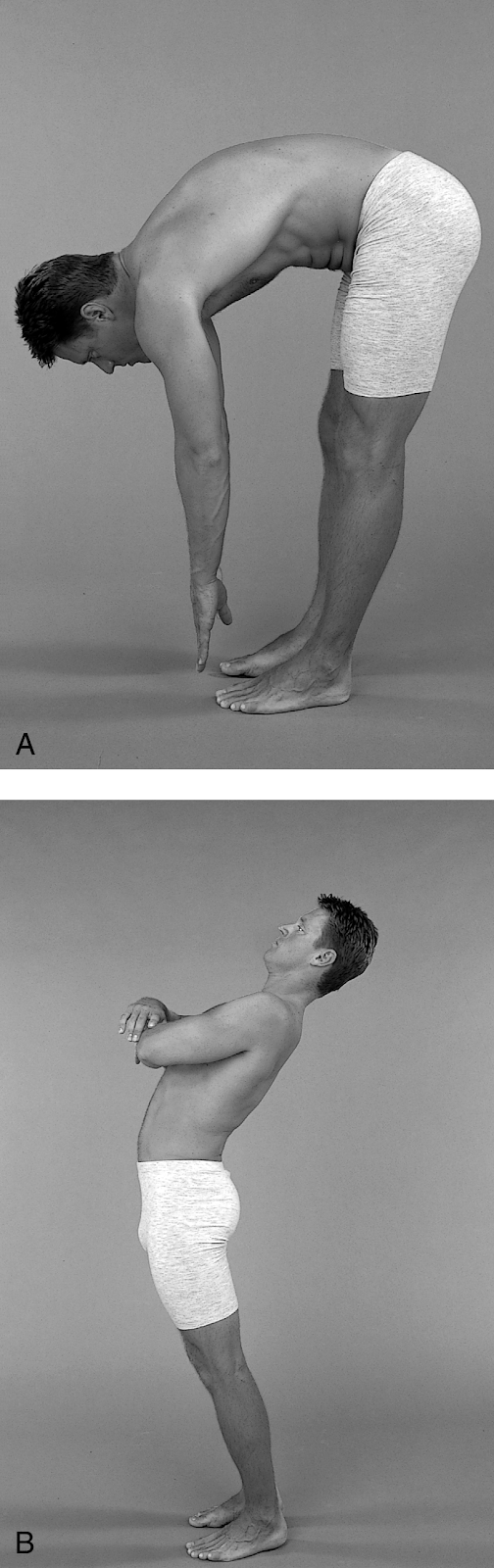
Lumbar flexion and extension
What to do: Ask the patient to stand straight with the feet comfortably apart for balance. Then ask the patient to flex the lower back by bending forward to touch the toes. Measure how close the fingers come to touching the floor. Ask the patient return to standing. Then ask the patient to extend the lower back by leaning backward as far as possible. Visually note the angle of extension during this test.
Normal: For normal lumbar flexion, the fingertips should reach within 10 cm of the floor. For normal lumbar extension, the patient should be able to lean backward 15º to 30º from standing straight.
Interpretation: If lumbar flexion is less than normal, lumbar radiculopathy or nonorganic pathology may be indicated. Pain with extension in young patients can be caused by spondylolysis.
Muscle Testing and Neurologic Examination of the Spine and Pelvis
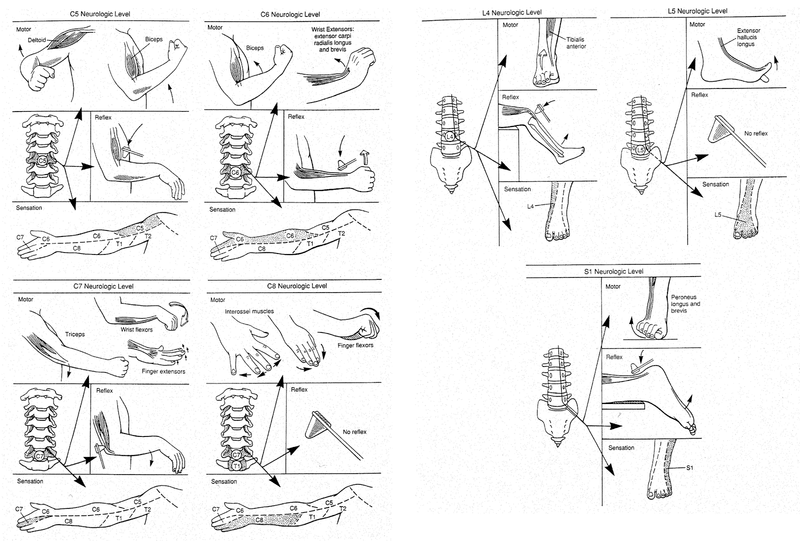
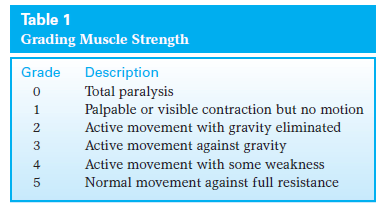
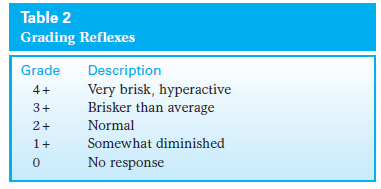
The spinal cord cannot be examined directly. Therefore, specific tests designed to assess the function of each nerve root can be used to determine whether a given nerve is intact. These functions include muscle strength, inducible reflexes, and sensation. For the purposes of conducting a thorough physical examination of the spine, these tests are grouped by the nerve root whose function they assess. Table 1 is a scale for grading muscle strength. Table 2 provides a grading system for reflexes.
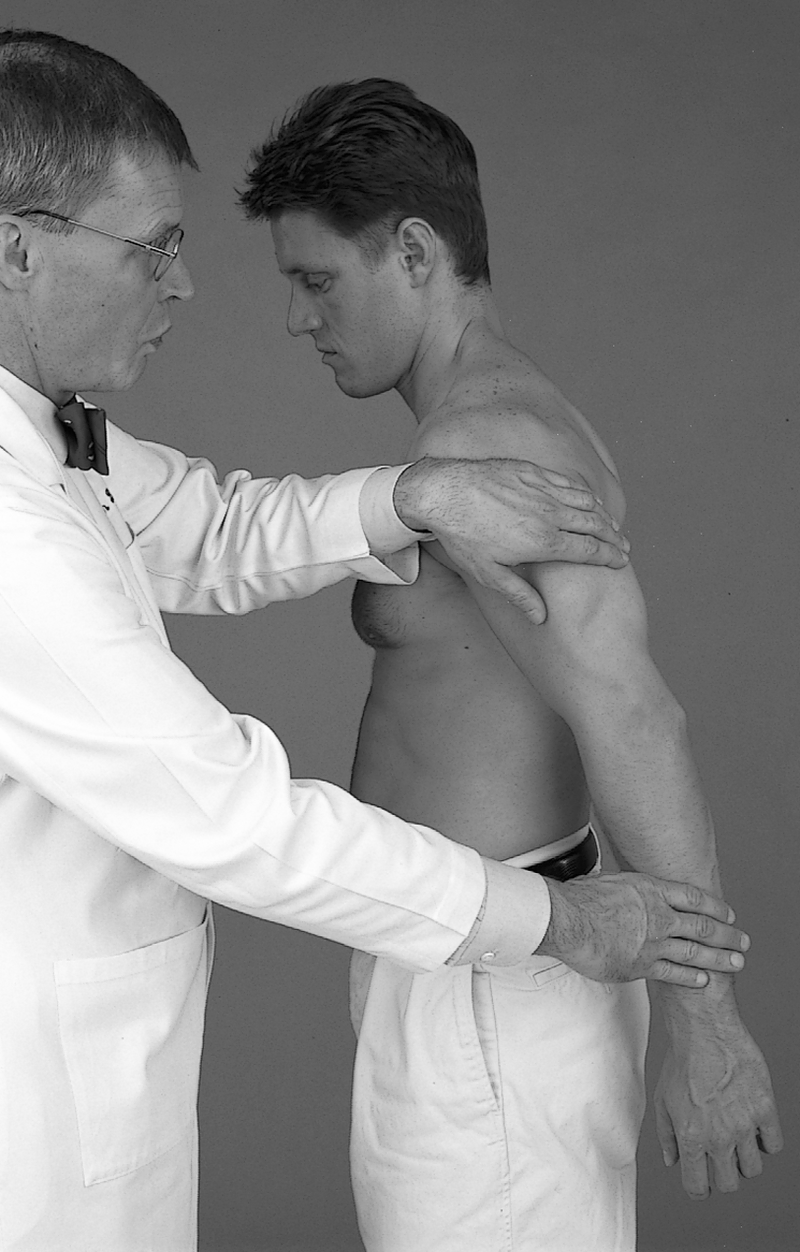
C5—Deltoid muscle
What to do: With the patient seated, abduct the shoulder to 90º. Push down on the arm to resist activity of the deltoid while the patient abducts the shoulder.
Normal: Grade 5 strength
Interpretation: Weakness indicates possible nerve compression at the spinal level. Complete absence of function is likely caused by peripheral nerve injury.
Comment: The deltoid muscle is innervated by the axillary nerve and is composed of C5 and C6 spinal cord segments.
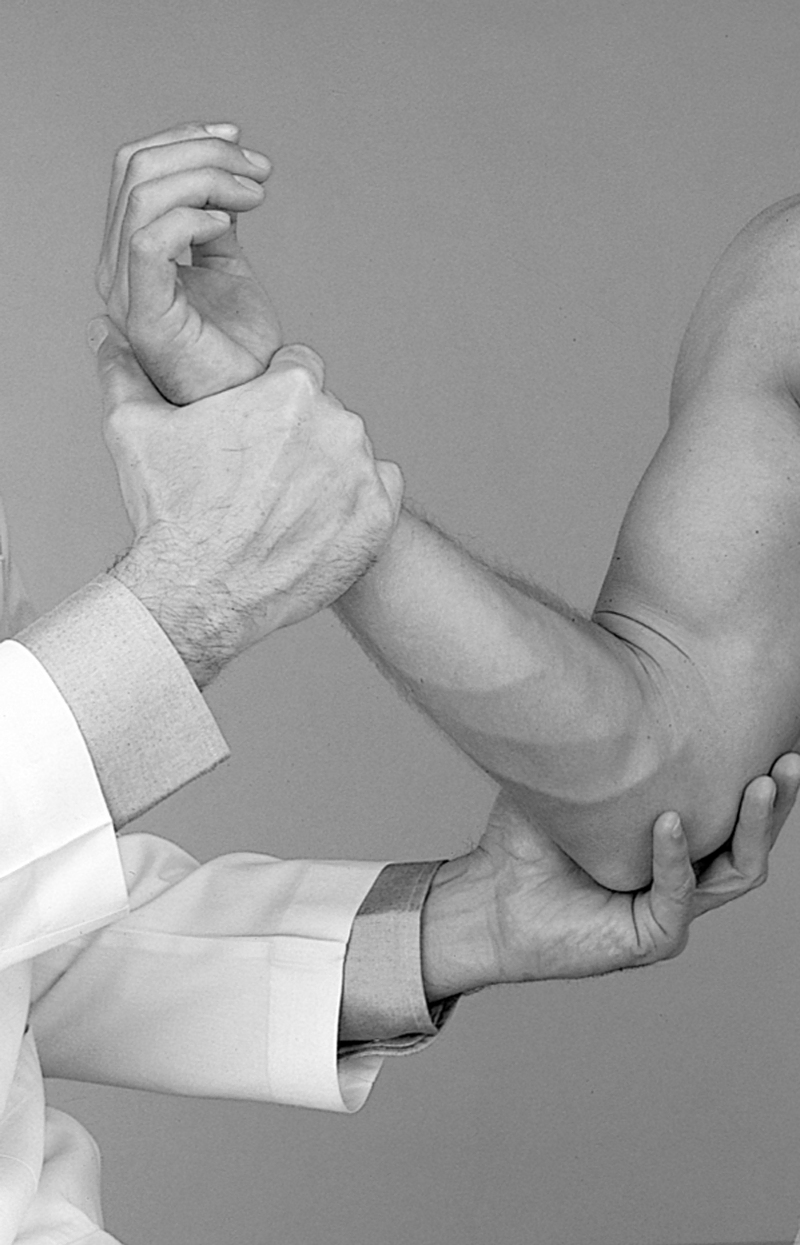
C5—Biceps
What to do: With the patient seated, ask the patient to “make a muscle” with the arm. To accomplish this, the patient must flex the elbow in a supinated position as you apply resistance.
Normal: Grade 5 strength
Interpretation: Although partially innervated by C6, if C5 is intact, biceps strength should be at least grade 3.
Comment: The biceps muscle is innervated by the musculocutaneous nerve and is composed of C5 and C6 spinal cord segments.
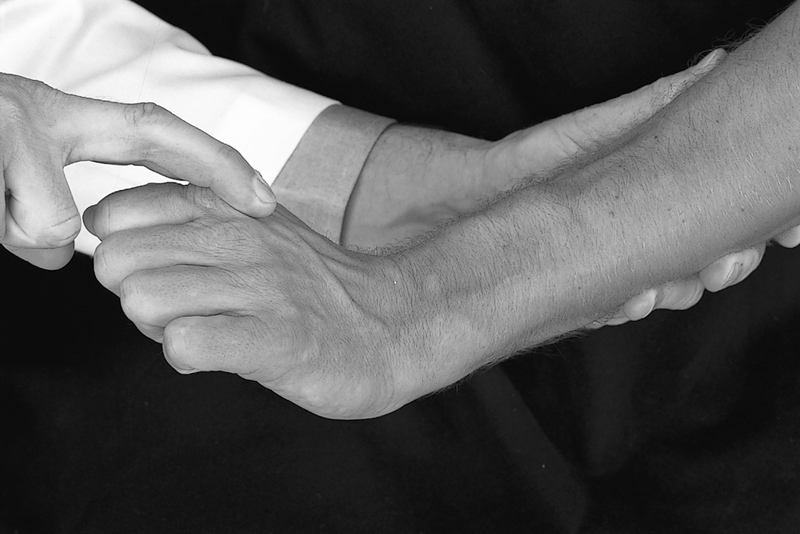
C6—Radial wrist extensors
What to do: Begin with the patient’s fingers flexed to eliminate wrist extension activity by the finger extensor muscles. With the forearm pronated, ask the patient to extend the wrist in an upward direction as you apply resistance.
Normal: Grade 5 strength
Interpretation: Weakness indicates possible nerve compression at the spinal level. Complete absence of function is likely caused by peripheral nerve injury.
Comment: The radial wrist extensors include the extensor carpi radialis longus and brevis muscles. They are innervated by the radial nerve from the C6 and C7 spinal cord segments.
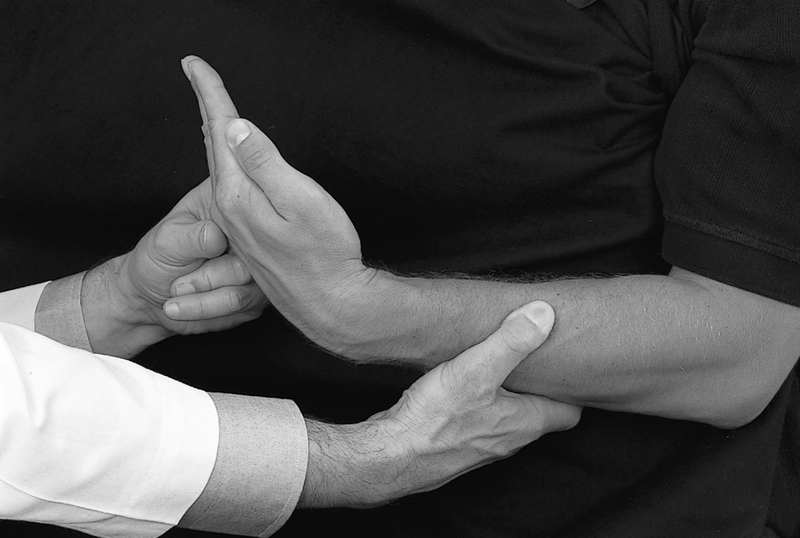
C7—Triceps
What to do: Ask the patient to extend the elbow as you apply resistance.
Normal: Grade 5 strength
Interpretation: Weakness indicates possible nerve compression at the spinal level. Complete absence of function is likely caused by peripheral nerve injury.
Comment: The triceps muscle is innervated by the radial nerve and is composed of C6, C7, and C8 spinal cord segments.
C7—Flexor carpi radialis
What to do: With the patient seated, place the patient’s fingers in extension to eliminate wrist flexor activity by the finger flexor muscles. Ask the patient to flex the wrist in the radial direction as you apply resistance.
Normal: Grade 5 strength
Interpretation: Weakness indicates possible nerve compression at the spinal level. Complete absence of function is likely caused by peripheral nerve injury.
Comment: The flexor carpi radialis muscle is innervated by the median nerve and is composed of C6 and C7 spinal cord segments.
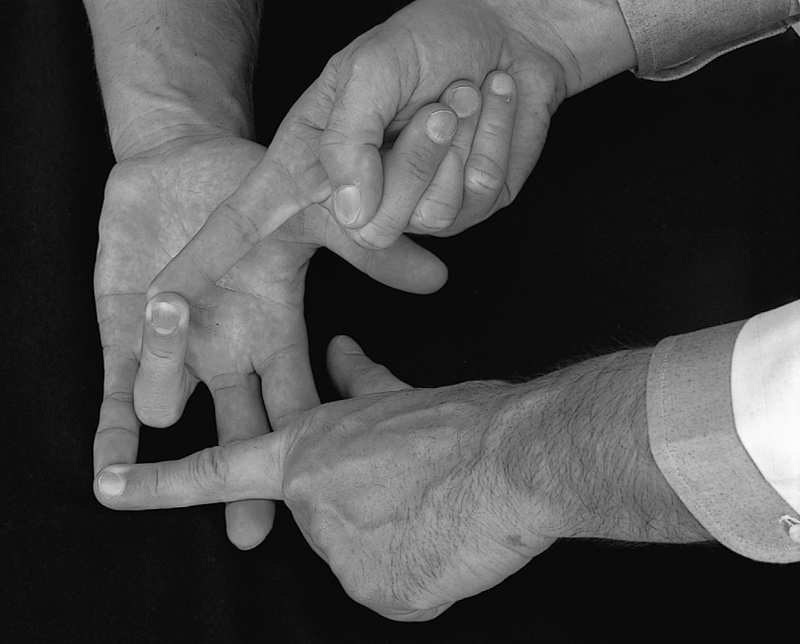
C8—Flexor digitorum superficialis
What to do: While stabilizing the long, index, and little fingers in extension, ask the patient to flex the fingers as you apply resistance.
Normal: Grade 5 strength
Interpretation: Weakness indicates possible nerve compression at the spinal level. Complete absence of function is likely caused by peripheral nerve injury.
Comment: The flexor digitorum superficialis muscle is innervated by the median nerve and is composed of C7, C8, and T1 spinal cord segments.
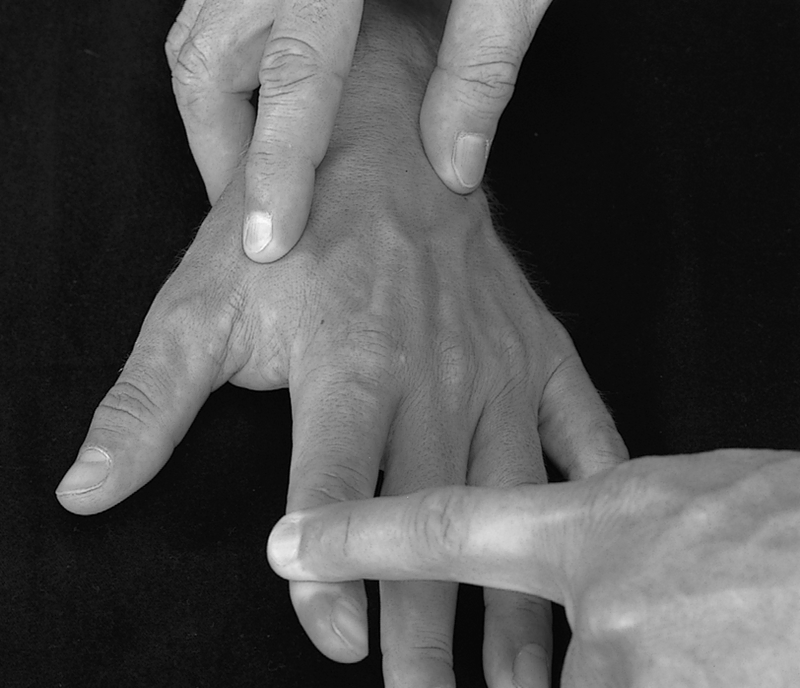
T1—First dorsal interossei
What to do: Ask the patient to abduct the index finger as you apply resistance. Palpate the muscle belly of the first dorsal interossei to confirm activity of the muscle.
Normal: Grade 5 strength
Interpretation: Weakness indicates possible nerve compression at the spinal level. Complete absence of function is likely caused by peripheral nerve injury.
Comment: The dorsal interossei muscles are innervated by the deep ulnar nerve and are composed of C8 and T1 spinal cord segments.
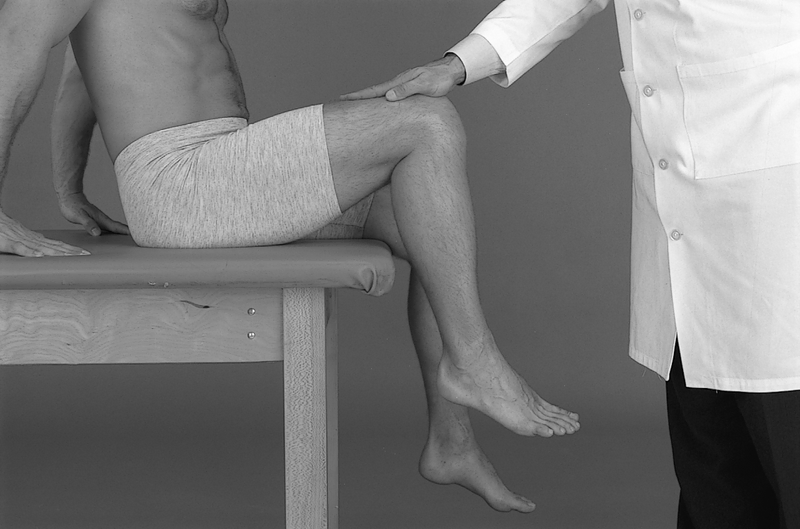
L1—Hip flexors
What to do: With the patient seated, ask the patient to flex the hip as you apply resistance.
Normal: Grade 5 strength
Interpretation: Weakness indicates possible nerve compression at the spinal level. Complete absence of function is likely caused by peripheral nerve injury.
Comment: Although many muscles aid in the flexion of the hip, the iliopsoas muscle is the predominant muscle. It is innervated in part by the femoral nerve and is composed of L1, L2, and L3 spinal cord segments. It is the only hip flexor with an L1 component.
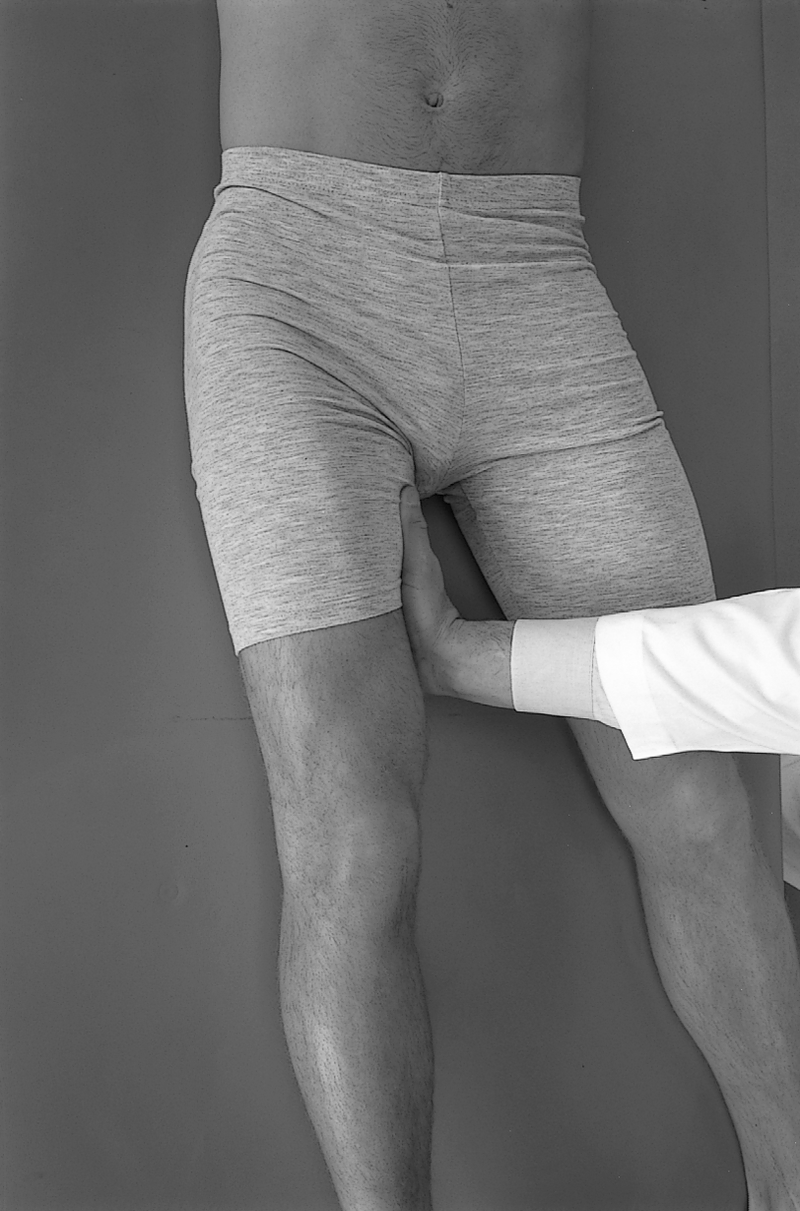
L2—Hip adductors
What to do: With the patient supine, ask the patient to adduct the thigh as you apply resistance.
Normal: Grade 5 strength
Interpretation: Weakness indicates possible nerve compression at the spinal level. Complete absence of function is likely caused by peripheral nerve injury.
Comment: Multiple muscles act to adduct the thigh, but the major innervation to these muscles is the obturator nerve. This nerve is composed of L2, L3, and L4 spinal cord segments.
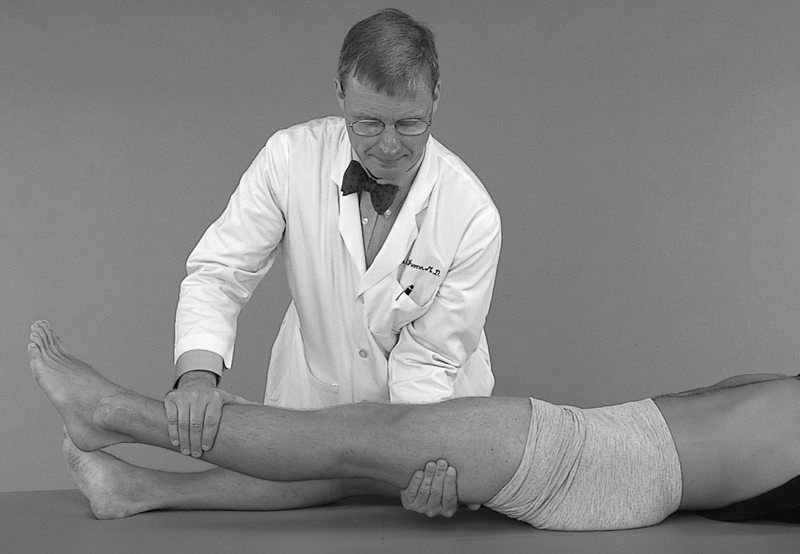
L3—Quadriceps
What to do: With the patient supine, ask the patient to extend the knee as you apply resistance.
Normal: Grade 5 strength
Interpretation: Weakness indicates possible nerve compression at the spinal level. Complete absence of function is likely caused by peripheral nerve injury.
Comment: The quadriceps consists of the rectus femoris, vastus lateralis, vastus medialis, and vastus intermedius muscles. They are innervated by the femoral nerve, which is composed of L2, L3, and L4 spinal cord segments.
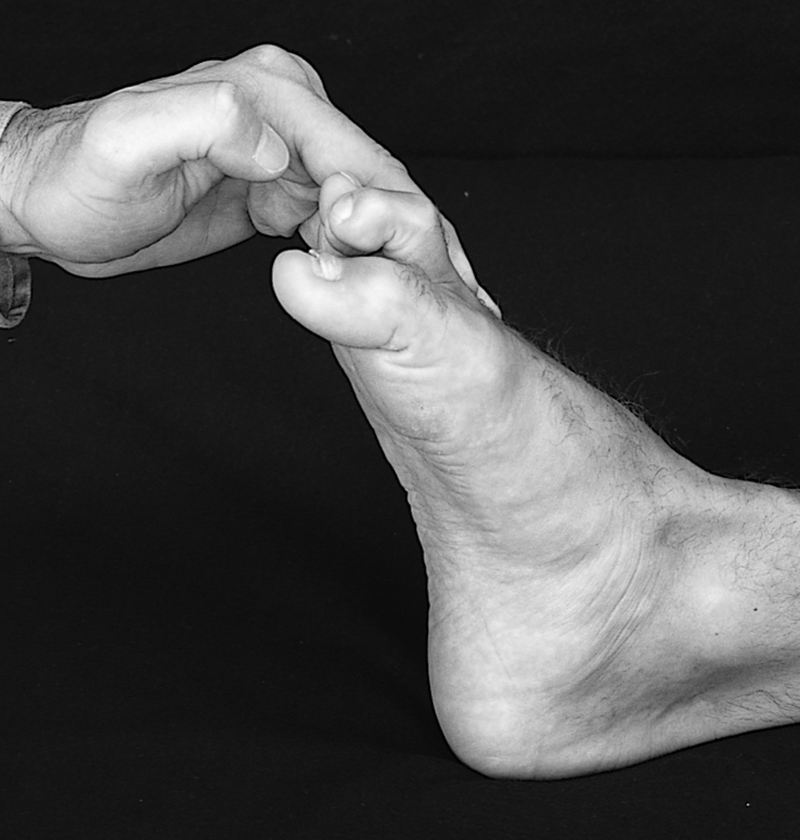
L4—Tibialis anterior
What to do: With the patient seated, ask the patient to flex the toes to eliminate dorsiflexor activity by the toe extensor muscles. Then ask the patient to dorsiflex the ankle as you apply resistance.
Normal: Grade 5 strength
Interpretation: Weakness indicates possible nerve compression at the spinal level. Complete absence of function is likely caused by peripheral nerve injury.
Comment: The tibialis anterior is innervated by the deep peroneal nerve and is composed of L4, L5, and S1 spinal cord segments.
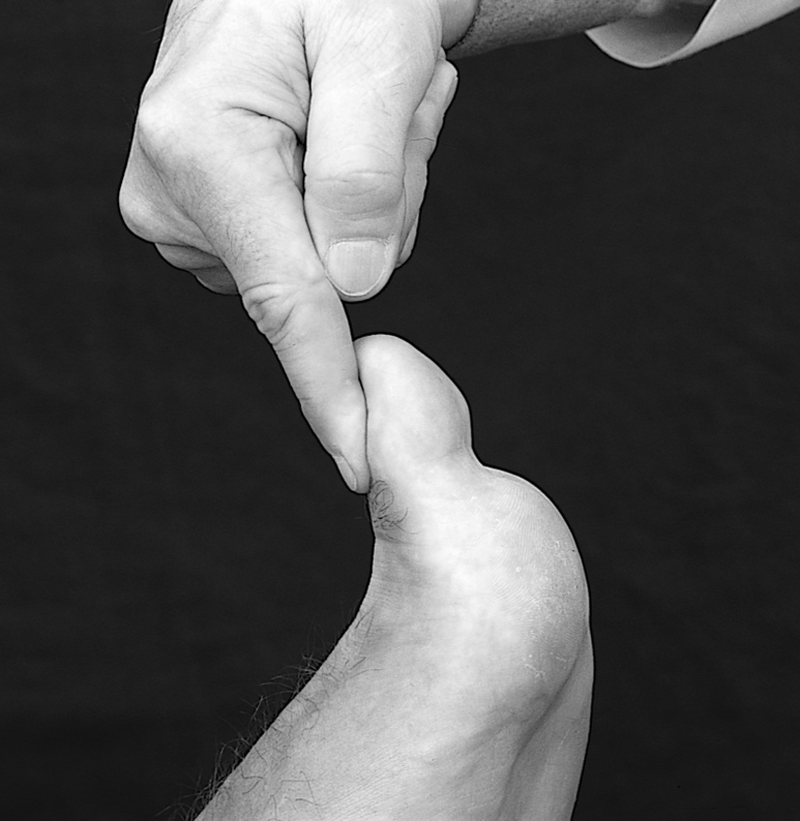
L5—Extensor hallucis longus
What to do: With the patient supine or seated, stabilize the foot in a neutral position with one hand and ask the patient to extend the great toe as you apply resistance.
Normal: Grade 5 strength
Interpretation: Weakness indicates possible nerve compression at the spinal level. Complete absence of function is likely caused by peripheral nerve injury.
Comment: The extensor hallucis longus muscle is innervated by the deep peroneal nerve and is composed of L4, L5, and S1 spinal cord segments.
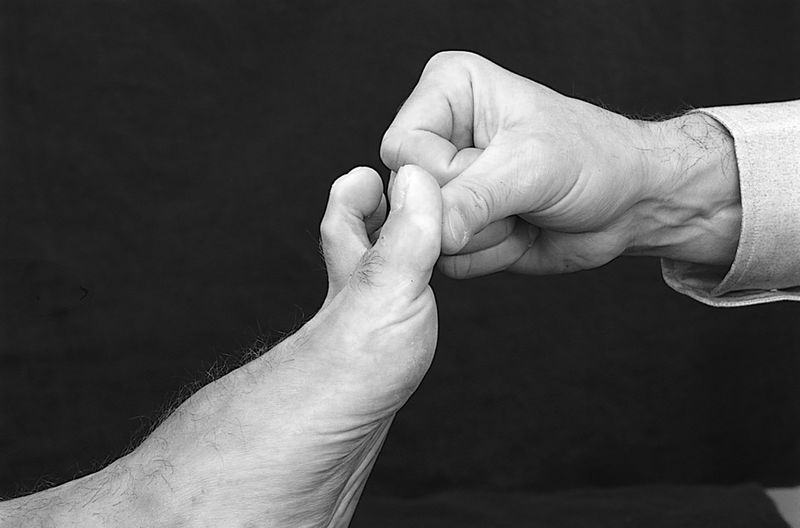
S1—Flexor hallucis longus
What to do: With the patient supine or seated, stabilize the foot in a neutral position with one hand and ask the patient to flex the great toe as you apply resistance.
Normal: Grade 5 strength
Interpretation: Weakness indicates possible nerve compression at the spinal level. Complete absence of function is likely caused by peripheral nerve injury.
Comment: The flexor hallucis longus muscle is innervated by the tibial nerve and is composed of L5, S1, and S2 spinal cord segments.
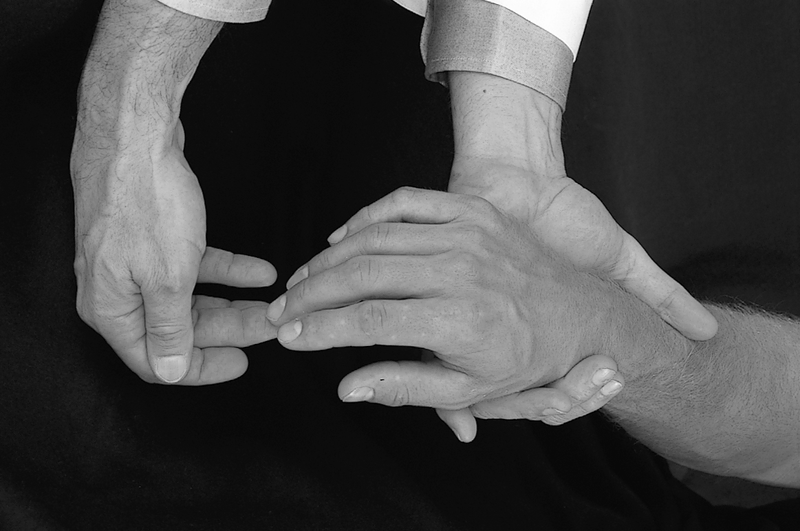
Hoffmann reflex [PRODUCTION NOTE NEW ART:
What it tests: Cervical myelopathy.
What to do: With the patient seated and the patient’s relaxed hand cradled in yours, repeatedly flick the long fingernail.
Normal: No flexion of the index finger and thumb.
Interpretation: Flexion of the index finger and thumb is a sign of long-tract spinal cord involvement.
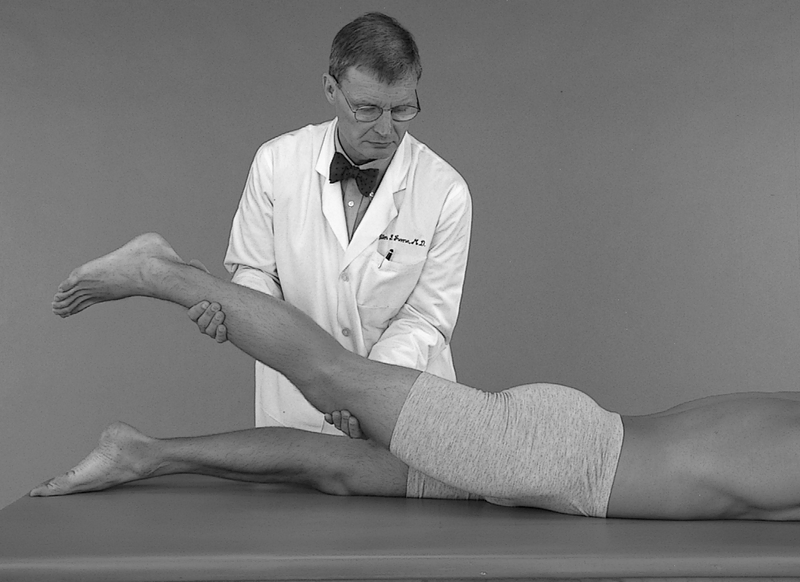
Reverse straight-leg raising
What it tests: L1-L4 nerve root impingement.
What to do: With the patient in the prone position, lift the hip into extension while keeping the knee straight.
Normal: No pain.
Interpretation: Pain with this maneuver suggests compression of the upper lumbar nerve roots.
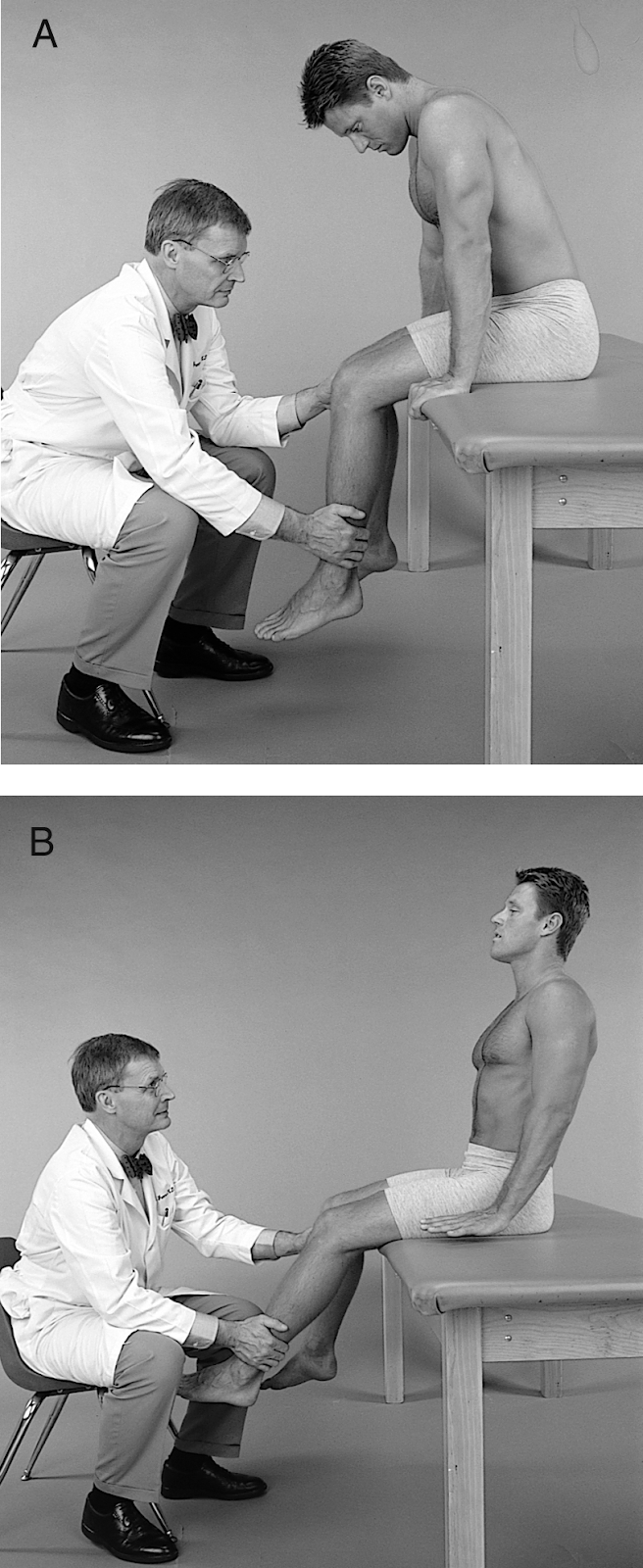
Flip sign
What it tests: Lumbar nerve root impingement
What to do: With the patient seated and hands resting on the edge of the examination table, examine the patient’s reflexes, extensor hallucis longus, and quadriceps strength. Next, distract the patient by asking about knee symptoms. During the distraction, dorsiflex the ankle and extend the knee, noting the degree of knee flexion when back pain occurs.
Normal: No back pain with knee extension.
Interpretation: This test correlates with the straight-leg raise in the supine position. Patients with sciatic tension will have significant pain with extension of the knee and may “flip” backward to avoid further extension of the knee.
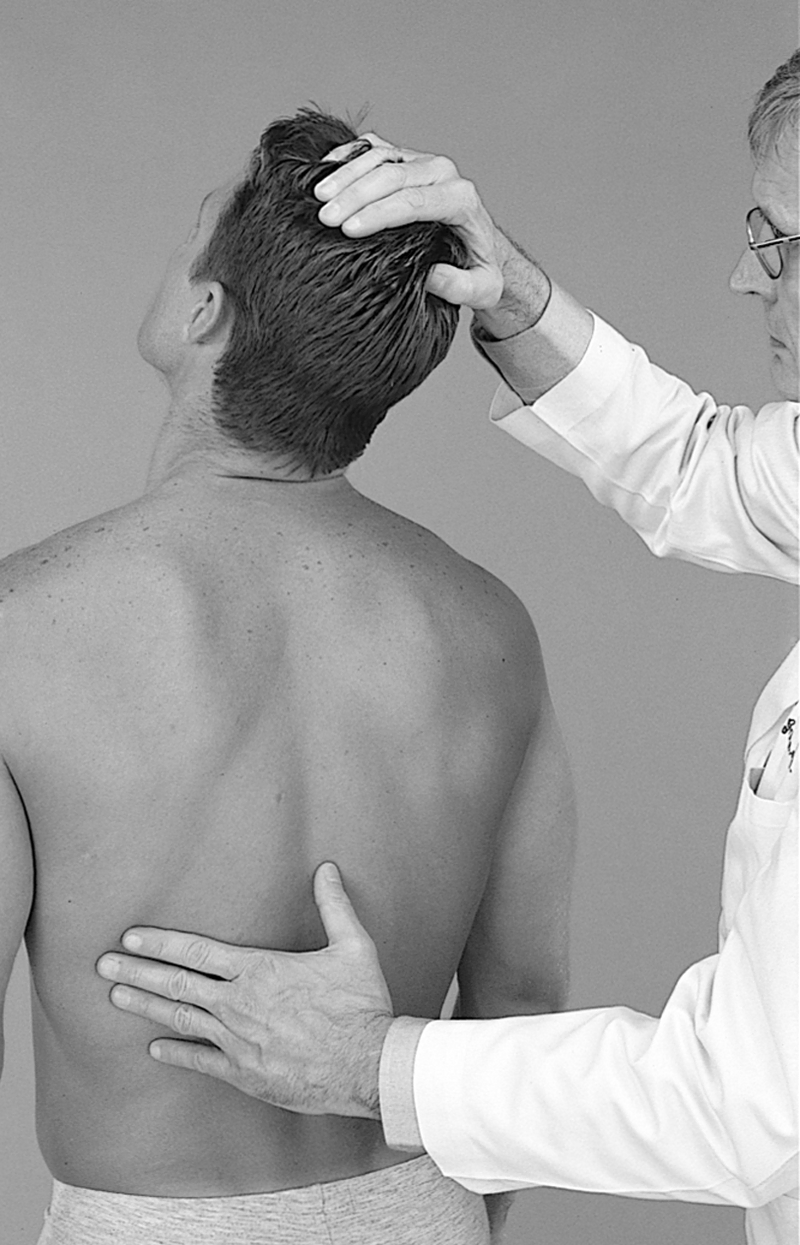
Spurling test
What it tests: Cervical spinal and cervical disk pathology.
What to do: Ask the patient to extend the neck while you passively tilt the head to one side with approximately 5 lb of pressure and hold for 10 to 30 seconds.
Normal: No radicular pain or paresthesias.
Interpretation: This maneuver narrows the neural foramen and will increase or reproduce radicular arm pain associated with cervical disk herniations or cervical spondylosis.
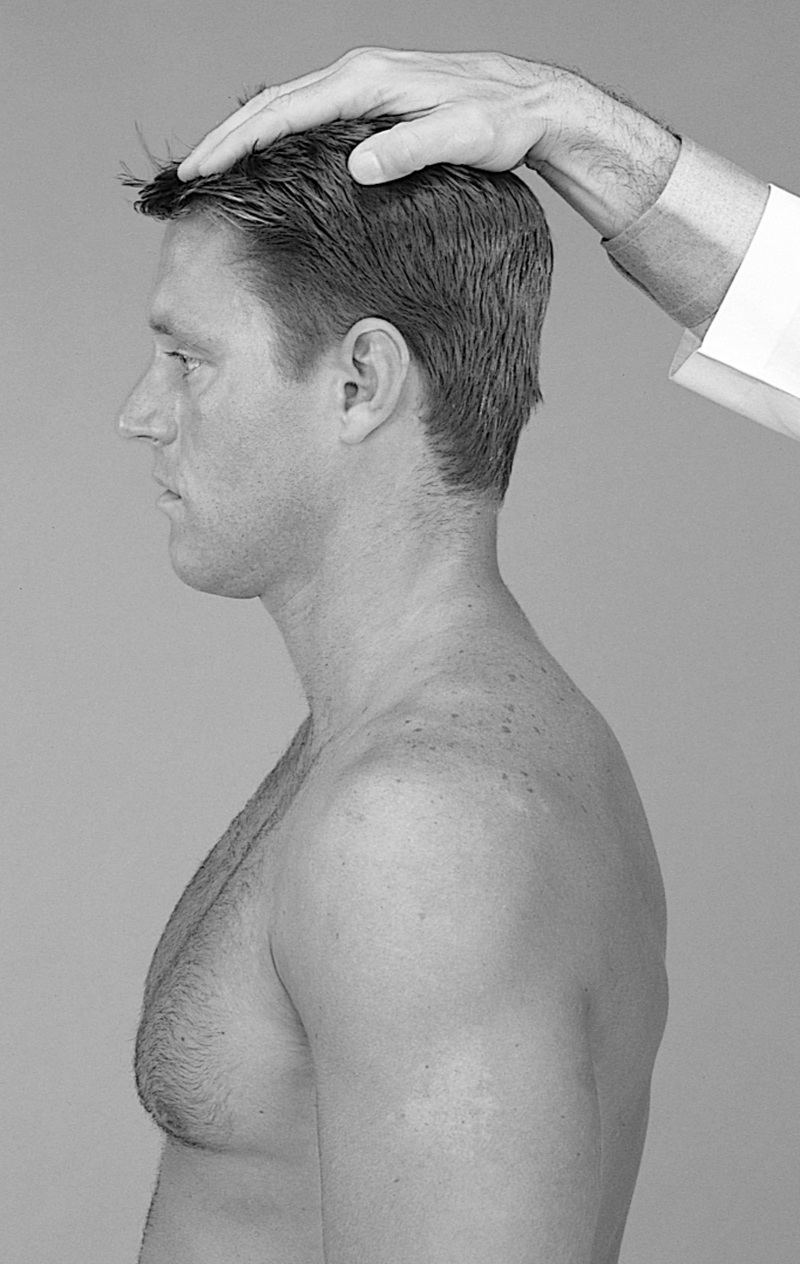
Axial loading
What it tests: Cervical disk pathology.
What to do: With the patient standing, push down on the patient’s head.
Normal: No pain.
Interpretation: This maneuver may elicit neck pain in some patients with disk pathology. Increased low back pain is usually a nonorganic finding.
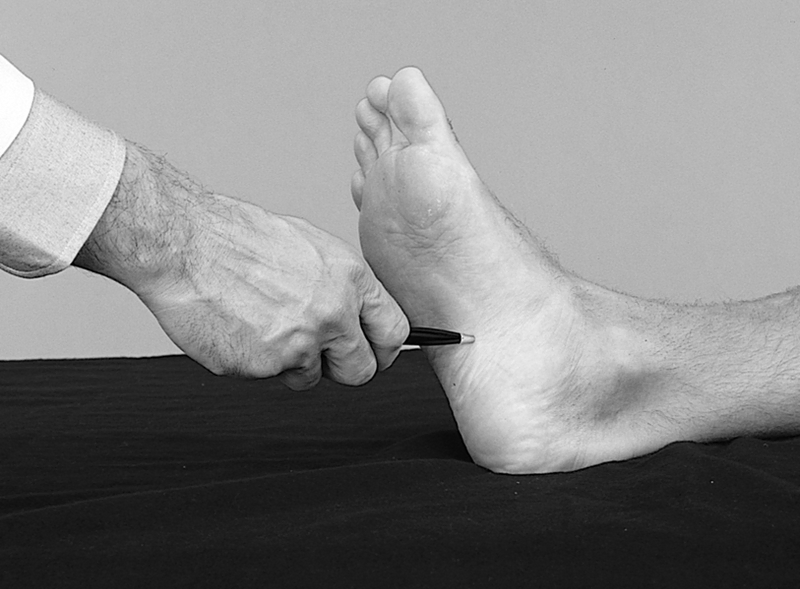
Babinski sign
What it tests: Upper motor neuron disease caused by spinal cord injury to the lower back; also called the flexor plantar response.
What to do: With the patient supine, stroke lightly upward on the plantar surface of the foot and look for great toe extension (withdrawal response) and fanning of the lesser toes.
Normal: A neurologically intact person will flex the toes or have no reaction at all.
Interpretation: Fanning of the toes is a positive test result and indicates long-tract spinal cord involvement.
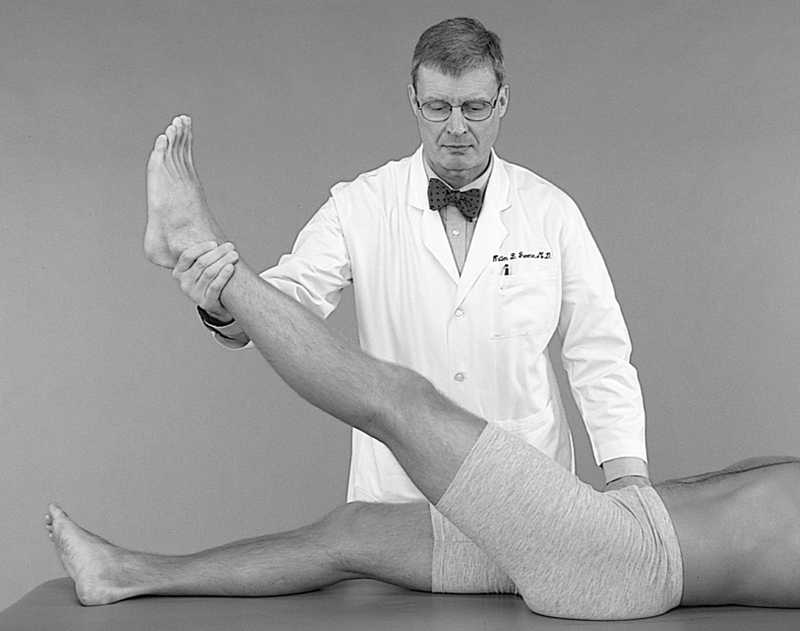
Straight-leg raising
What it tests: The L5 and S1 nerve roots.
What to do: With the patient in the supine position and relaxed, elevate the leg by flexing the hip until either the knee begins to bend or the patient reports severe pain in the buttock or back. Record the degree of elevation at which pain occurs. Then dorsiflex the ankle to determine whether this motion increases pain (ankle dorsiflexion further stretches the L5 and S1 nerve roots).
Normal: No pain radiating down the leg.
Interpretation: Radicular pain down the back of the leg produced by this maneuver is evidence of L5 or S1 nerve root irritation, usually resulting from a herniated disk. Pain in the lower back with this maneuver is common with lumbar muscle strain; pain radiation is essential for a test result to be considered positive. Repeating this test with the patient seated may increase the specificity.
