

Many musculoskeletal conditions can be treated nonsurgically. In most instances, surgical treatment is reserved for conditions that do not respond to nonsurgical measures. However, some conditions, such as open fractures, demand urgent surgical attention. The principal goals of surgical treatment may include the restoration of normal anatomic relationships and functions, the promotion of healing, the correction of deformity, the removal of abnormal tissue, or the replacement of structures that cannot be repaired.
Conditions
Infection
In musculoskeletal medicine, three forms of infection are encountered: soft-tissue infection, joint infection (septic arthritis), and bone infection (osteomyelitis). Many soft-tissue infections do not require surgical treatment. When the body’s defenses are overwhelmed, however, removal of the infected tissue, often devitalized and necrotic, is necessary to restore homeostasis and allow healthy granulation tissue to form.
An infection within a joint usually requires some type of surgical treatment because the joint space is, to some extent, inaccessible to the circulatory system. Surgical drainage is also used to preempt the body’s own response because the cellular machinery built to fight infection can also destroy articular cartilage. It is imperative, therefore, to treat the infection before this response is mounted.
Surgical drainage of a joint infection does not always have to be performed in an operating room with the patient under anesthesia. Aspiration of many superficial joints, such as the knee, can be performed with a needle at the bedside. Aspiration of deeper joints, such as the hip, may require at least radiographic guidance.
Lavage, also known as irrigation, is another surgical procedure that is used to treat infected joints. Lavage is often done with an arthroscope, especially when treating infections in the large joints. In this procedure, the joint is thoroughly washed with a high-volume saline solution flush to remove the offending organism and prevent the host response to it. For example, articular cartilage is extremely sensitive to the degradative enzymes that are released by white blood cells to combat bacteria. Thus, the response to the bacteria may result in a Pyrrhic victory because the body will win the battle against the bacteria but lose the war in that the articular surface will be destroyed in the process.1,2 In this example, lavage removes bacteria but helps preserve joint surfaces.
Because the deep core of the bone is relatively inaccessible to circulating antibiotics, infected bone is typically treated with surgical drainage as well. Moreover, bone responds to infection by forming new bone called the involucrum that creates a barrier around the infected nidus. The infected area isolated by the involucrum is called the sequestrum. To drain the sequestrum surgically, the surrounding involucrum must be removed.3 Bone drainage procedures are often performed in combination with soft-tissue coverage operations, such as skin grafts and muscle flaps. This is because soft-tissue defects are commonly seen in conjunction with osteomyelitis and because both can be caused by an open fracture.
Fractures
Although many fractures that are treated surgically would heal without surgical intervention, surgery may nevertheless be needed to preserve the anatomic alignment of the bone or to allow the bone to heal without excessive immobilization. In addition, surgical treatment is sometimes needed for fractures that would not heal well otherwise. Open fractures, for example, require wound débridement and restoration of the soft-tissue envelope. Such a fracture may also need to have additional blood supply brought to it in the form of a vascularized muscle flap, a procedure called revascularization. Additionally, some fractures associated with great bone loss require bone grafting to augment healing.
Surgical treatment of fractures can lead to either primary or secondary bone healing. Primary bone healing occurs when the bone ends are anatomically opposed and held together rigidly. This is similar to the healing seen in sutured skin, but no scar is formed in bone. Primary healing occurs only when there is no motion between the fracture ends. In that case, the bone heals by direct formation of new bone, and no fracture callus is formed. Primary bone healing is also known as osteonal healing because osteons cut across the fracture site to allow the formation of new bone in the gap. Secondary bone healing is characterized by the formation of fracture callus. A fracture callus is initially formed from the hematoma that develops from the bleeding edges of bone. This callus then forms a cartilage mass that is remodeled into mature bone.4,5
Types of Surgery
Open Reduction and Internal Fixation
Open reduction and internal fixation, often abbreviated as ORIF, is a procedure that involves incising the skin and soft tissue to repair a fracture under direct visualization. Once the incision is made, the fracture fragments are placed into anatomic alignment (hence, open reduction) and rigidly held in this position by means of screws, plates, or wires (internal fixation).
Open reduction and internal fixation is typically used to mend fractures for which perfect anatomic alignment is necessary. Typically, these fractures involve or are in close proximity to the joint line (Fig. 1
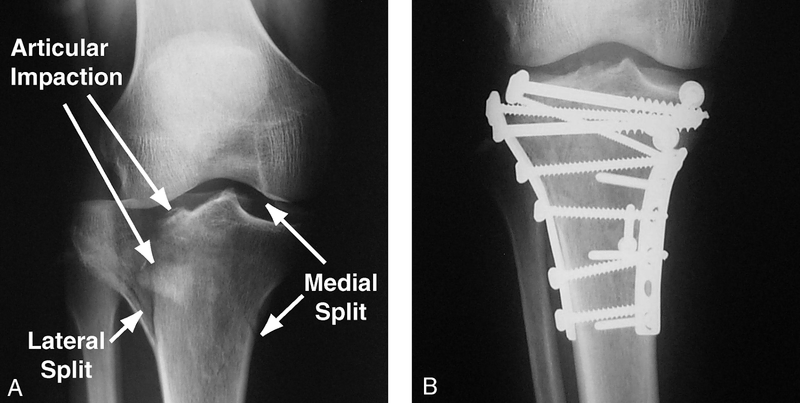
Figure 1A, Radiograph of an extensively comminuted fracture of the tibial plateau with disruption of the joint surface. B, Radiograph showing restitution of the joint achieved with open reduction and internal fixation using medial and lateral plates and interfragmentary (free) screws.
(Reproduced from Lang GJ: Knee and leg: Bone trauma, in Koval KJ (ed): Orthopaedic Knowledge Update 7. Rosemont, IL, American Academy of Orthopaedic Surgeons, 2002, pp 479-488.)
). An advantage of this surgical approach is that anatomic alignment can be restored; however, a disadvantage is that it requires surgical dissection near the site of the fracture, which disrupts the biologic envelope (ie, the surrounding soft tissue and periosteal sleeve). This disruption increases the risk of infection and may also increase the risk of fracture nonunion.6
Open reduction and internal fixation can fail if there is too much motion at the fracture site, which can occur when the hardware itself fails or when the screws pull out of the bone. In both situations, another surgical procedure would be required to repair the problems.
Intramedullary Nailing
Another method of surgical fixation of fractures is intramedullary nailing or rodding. (The terms are interchangeable.) This method is best employed for diaphyseal (shaft) fractures of the long bones. This is deemed to be an indirect method of fixation because the fracture site itself is not surgically exposed; rather, a rod is inserted into the intramedullary canal of the bone at one of its two ends (Fig. 2
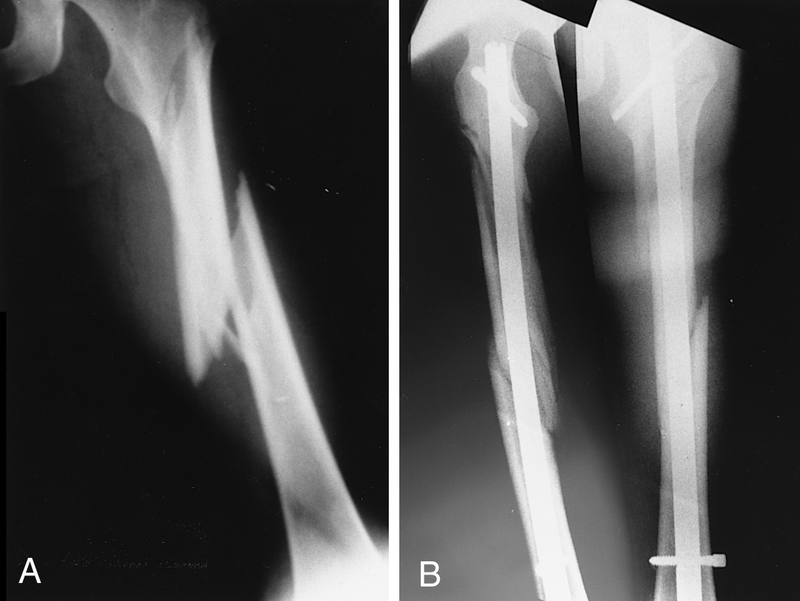
Figure 2A, Midshaft femur fracture with comminution. B, AP and lateral view of this femur after fixation with a locked intramedullary nail. Note that the fracture fragments are not perfectly interdigitated and will unite only if callus forms across this gap.
(Reproduced from Johnson KD: Femur trauma, in Poss R, Bucholz RW, Frymoyer JW, Gelberman RH, Hensinger RN, Morrey BF (eds): Orthopaedic Knowledge Update 3. Rosemont, IL, American Academy of Orthopaedic Surgeons, 1990, pp 513-527.)
). For example, an intramedullary nail can be inserted into the tibia through a hole made near the tibial tubercle, and the femoral shaft can accept an intramedullary rod either through the hip or the knee.
An intramedullary nail functions as an internal splint to stabilize a fracture. Even when the proximal and distal ends of the nail are secured to the bone with screws, there is some small degree of motion at the fracture site. This leads to secondary bone healing through callus formation. The proximal and distal locking screws provide rotational stability to the fracture site, which allows for early mobilization of the fractured limb and possibly early weight bearing. This method also allows motion of the joint above and below the fracture site. By way of contrast, it should be noted that the cast needed to control rotation of a tibial fracture spans from foot to groin and may produce knee or ankle stiffness.
Intramedullary rods have a number of advantages and disadvantages. Compared with plating, intramedullary fixation does not require any stripping of the soft tissue or periosteum near the fracture site. Also, the length of incision typically needed to insert the rod is considerably smaller than that needed to expose a fracture site. However, there is a risk of fat embolism associated with placing a rod in the intramedullary canal.7,8 Intramedullary nailing does not allow for as precise an anatomic alignment as that achieved with a plate and, of course, cannot be used for articular fractures.
One special case for which intramedullary nailing is particularly well suited is in the treatment of an impending pathologic fracture, in which a metastatic lesion within a long bone weakens the bone and predisposes it to fracture. In many instances, pain develops in a long bone in which there is a metastatic lesion, even though the bone has not yet fractured. For patients with metastatic bone lesions, a true fracture is avoided and much of their pain alleviated when the “intact†bone receives an intramedullary nail.9-11 By spanning the pathologic site, the intramedullary nail is able to accept some of the forces of weight bearing and prevent the bone from breaking.
External Fixation
External fixation is a method of immobilization that uses pins inserted through the skin to attach fragments of fractured bone to external stabilizing frames (Fig. 3
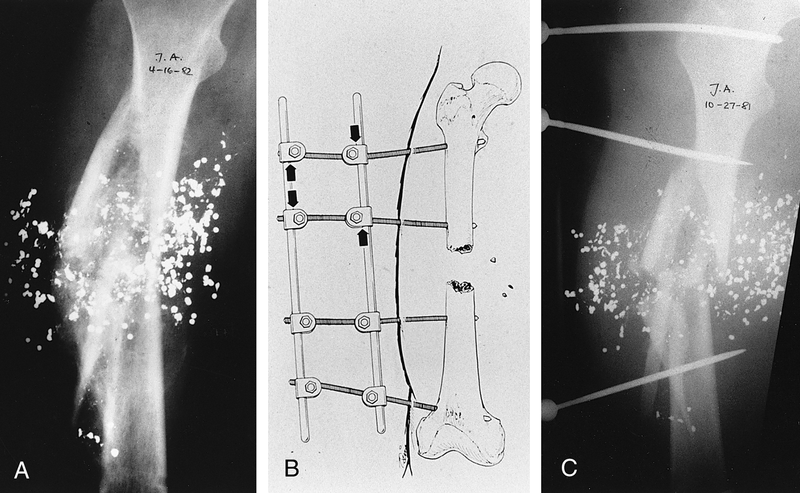
Figure 3A, Highly comminuted femur fracture caused by a shotgun blast inflicted at close range. There was extensive soft-tissue damage as well. B, Schematic representation of external fixation for this fracture pattern. C, Radiograph of this fracture after the application of the fixator.
(Reproduced from Johnson KD: Femur trauma, in Poss R, Bucholz RW, Frymoyer JW, Gelberman RH, Hensinger RN, Morrey BF (eds): Orthopaedic Knowledge Update 3. Rosemont, IL, American Academy of Orthopaedic Surgeons, 1990, pp 513-527.)
). These frames are placed outside the body at a distance from the zone of injury. Malgaine used the first external fixation device in 1853 when he placed a claw-like clamp through the skin to compress and immobilize a fractured patella. Fixation devices historically have spanned at least one joint, but some of the newer models use wires inserted at the ends of the bone such that the fixator does not cross the adjacent joints. This can help preserve the motion of these joints.
Several situations call for the use of external fixation devices. Highly comminuted (shattered) fractures, for example, frequently cannot be treated with plates and screws because there is simply not enough solid bone left to accept the screws. Open fractures with severe soft-tissue injury may be best treated with devices that can temporarily stabilize the bone as the soft-tissue envelope and blood supply are being restored.12
External fixation is now also used for limb lengthening. In the Ilizarov technique, an external fixation device is placed across a bone, which is then cut transversely.13 Gradual tension across this man-made fracture site allows for gradual lengthening of the bone—a process called distraction osteogenesis. Such an approach is also useful to correct angular deformities.
The major limitation of external fixation is that it requires an open channel of communication to the outside world in the form of pin tracts, which are subject to infection. What may begin as a superficial pin tract infection can actually extend deep into the bone, causing osteomyelitis. Therefore, it is not unusual for an external fixation device to be exchanged for another means of immobilization once the specific goals of external fixation are accomplished. For example, once the skin wound of an open fracture heals, the fixator may be replaced with a rod or cast.
Total Joint Arthroplasty
The mainstay of surgical treatment for arthritis of the hip and knee is joint replacement, a procedure known as arthroplasty. The goal of arthroplasty is to replace a destroyed, painful joint with an artificial joint that is functional and pain free. During the procedure, the diseased ends of the bone with their irregular articular surfaces are removed and replaced with man-made materials.
When both sides of a joint are replaced, the procedure is known as a total joint replacement. When only one side is replaced, the procedure is called a partial joint replacement, or hemiarthroplasty. Hemiarthroplasty is most often used in the hip to treat a fracture that is unlikely to heal (Fig. 4
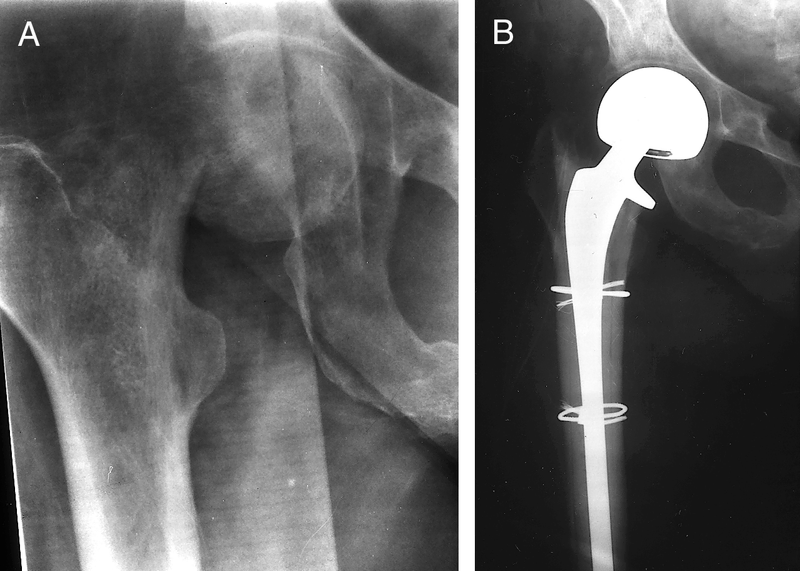
Figure 4A, Preoperative AP view of the right hip demonstrating a femoral neck fracture caused by tumor metastasis. B, Postoperative AP view of a partial hip replacement (hemiarthroplasty) in which the femoral head and neck were removed and long-stem femoral components were placed. The “ball†of this joint sits in the native acetabulum.
(Reproduced from Damron TA, Sim FH: Surgical treatment for metastatic disease of the pelvis and the proximal end of the femur. Instr Course Lect 2000;49:461-470.)
). In this procedure, the femoral head is removed and an artificial one is placed on a stem that extends into the shaft of the femur. This artificial head can then articulate with the native acetabulum. In a total hip replacement, there is an acetabular component added as well. With a total knee replacement, both sides of all three compartments (medial, lateral, and patellofemoral) are replaced. A partial knee replacement, also called a unicompartmental arthroplasty, involves the replacement of only one compartment, typically on the medial side.
Arthroplasty is major surgery. Thus, there is a measurable risk of perioperative complications. Beyond the medical risks associated with major surgery in general, with joint replacement there is a specific risk for deep venous thrombosis and subsequent pulmonary embolism; however, with the use of chemical or mechanical prophylaxis, the risk of deep venous thrombosis is reduced.14 Other risks include infection or dislocation of the prosthesis. Finally, even if these complications are avoided, there is the risk of mechanical (aseptic) loosening of the prosthesis.15 Aseptic loosening refers to a process that exceeds the normal wear and tear of the prosthesis. It is a biologic process in which small particles from the plastic surface of the artificial joint are generated from motion and incite an inflammatory response. This inflammation ultimately loosens the prosthesis. Because of these limitations, joint replacement is a less appealing alternative for young people; it is likely that they will outlive their prosthetic joints and thus require one or more revision surgeries, each with a diminishing chance of good results.
Despite its limitations, total joint arthroplasty is an extremely effective operation. It has nearly obliterated the word “cripple†from the English language. However, it is hoped that arthroplasty will be replaced by more biologically oriented procedures in the future.
Resection Arthroplasty
An arthritic joint can be treated with other surgical approaches as well. Some joints are amenable to removal, or resection arthroplasty. A resection arthroplasty involves simply cutting out the surfaces of the diseased joint and allowing a fibrocartilage scar to grow in its place. Resection arthroplasty is often the best initial surgical option for joints that have little function. For example, surgical treatment of a painful acromioclavicular joint can be successful by simply removing the contacting surfaces of the clavicle and acromion. Even major joints can be treated with resection arthroplasty, although this is rarely a first-choice solution. Resection arthroplasty of the hip was originally developed to treat tuberculosis. In this operation, the bones of the hip joint are removed so that a fibrous union can form between the pelvis and lower extremity. Although this shortens the leg considerably and produces a floppy joint, this is the ideal operation for some patients because it alleviates joint pain.
Arthrodesis
A painless joint also can be achieved by arthrodesis, or fusion. With arthrodesis, the painful edges of the joint are removed, and the two ends of raw bone are allowed to unite as if they were the edges of a fracture (Fig. 5
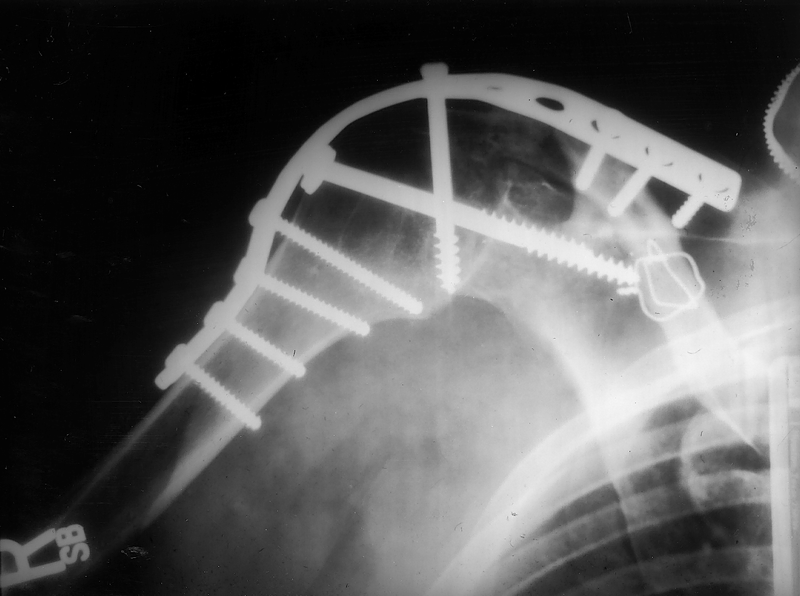
Figure 5 Radiograph of fusion of the glenohumeral joint using a plate that spans from the humeral shaft to the scapula. A separate long screw was used to compress the humerus into the glenoid socket.
(Reproduced from Bennett JB, Allan CH: Tendon transfers about the shoulder and elbow in obstetrical brachial plexus palsy. Instr Course Lect 2000;49:319-332.)
). This radical operation is used only when other options are not feasible. For example, a joint that has been destroyed by infection may require fusion and not replacement when there is suspicion that some of the infection still lingers. With fusion, all motion across the joint is eliminated. This typically eliminates pain permanently, but motion is likewise permanently lost. This loss of motion may limit function substantially. The glenohumeral joint of the shoulder tolerates fusion better than many other major joints because the nearby scapulothoracic joint can substitute some of the lost motion. When the nearby joint is not able to provide replacement motion, great stresses are placed on it. This, in turn, places adjacent joints at increased risk for early arthritis.
Arthroscopy
Arthroscopy is a form of minimally invasive surgery in which a fiberoptic camera, the arthroscope, is introduced into a joint through a small incision. This allows the surgeon to observe the inner environment of the joint without making large incisions and disrupting the normal soft tissue surrounding it.
Arthroscopy was originally used as a diagnostic tool. Although MRI has obviated the need for many diagnostic surgeries, arthroscopy still has some role in making diagnoses. For the most part, though, arthroscopy is used as a therapeutic tool. By making additional small incisions, the surgeon can introduce specially designed surgical instruments that allow for removal or repair of abnormal tissue. Common arthroscopic procedures include the removal of a torn meniscus (partial meniscectomy); the flattening of a bone spur extending from the acromion (acromioplasty); and various surgical repairs and reconstructions, including meniscal repair (Fig. 6
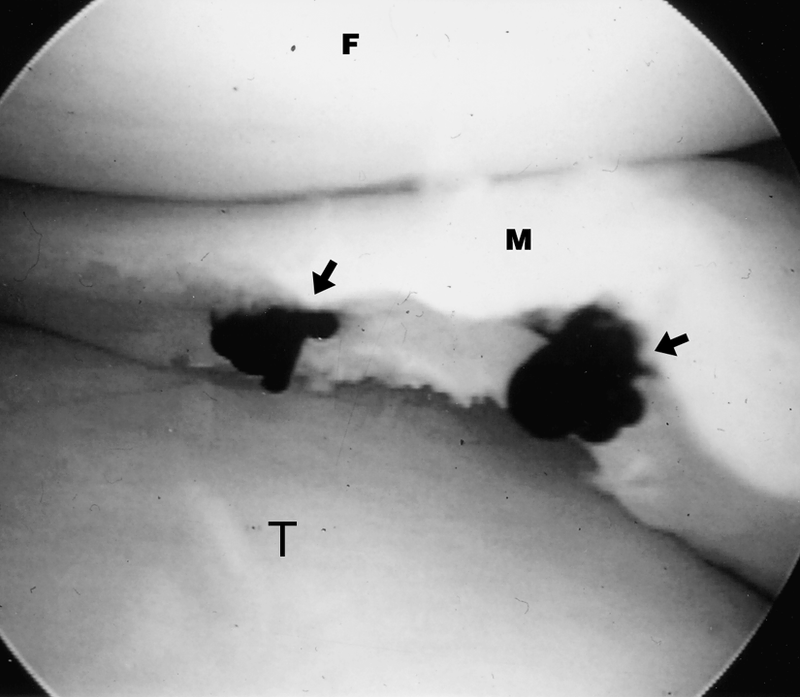
Figure 6 Arthroscopic view of the knee joint demonstrates meniscal repair. Note the two suture knots in the meniscus (arrows). The femur (F) is above the meniscus (M). The tibial plateau (T) is below.
(Reproduced from Rodeo S: Arthroscopic meniscal repair with use of the outside-in technique. Instr Course Lect 2000;49:195-206.)
), anterior cruciate ligament reconstruction, and rotator cuff repair.16-18
As surgeons’ arthroscopic skills have improved over the years, the number of conditions now amenable to arthroscopic treatment has increased. Arthroscopy of the wrist, elbow, and ankle has now become routine. The major limitation of arthroscopy is that it can address only surface phenomena in the joint; diseases within the soft tissue or the bone are beyond its reach. In addition, arthroscopy can be used only in joints that have enough room for the arthroscopic equipment to function without hitting (and possibly damaging) the articular surfaces.
Surgical Decompression
When clinical symptoms result from pressure on vital structures, surgical treatment may consist of simply eliminating the pressure by removing the offending tissue. This is a broad category of procedures that include carpal tunnel release, in which the transverse carpal ligament of the hand is simply cut to allow more space in a crowded carpal tunnel; laminectomy and diskectomy, in which the bone and disk pressing on a nerve root in the spine are removed (Fig. 7
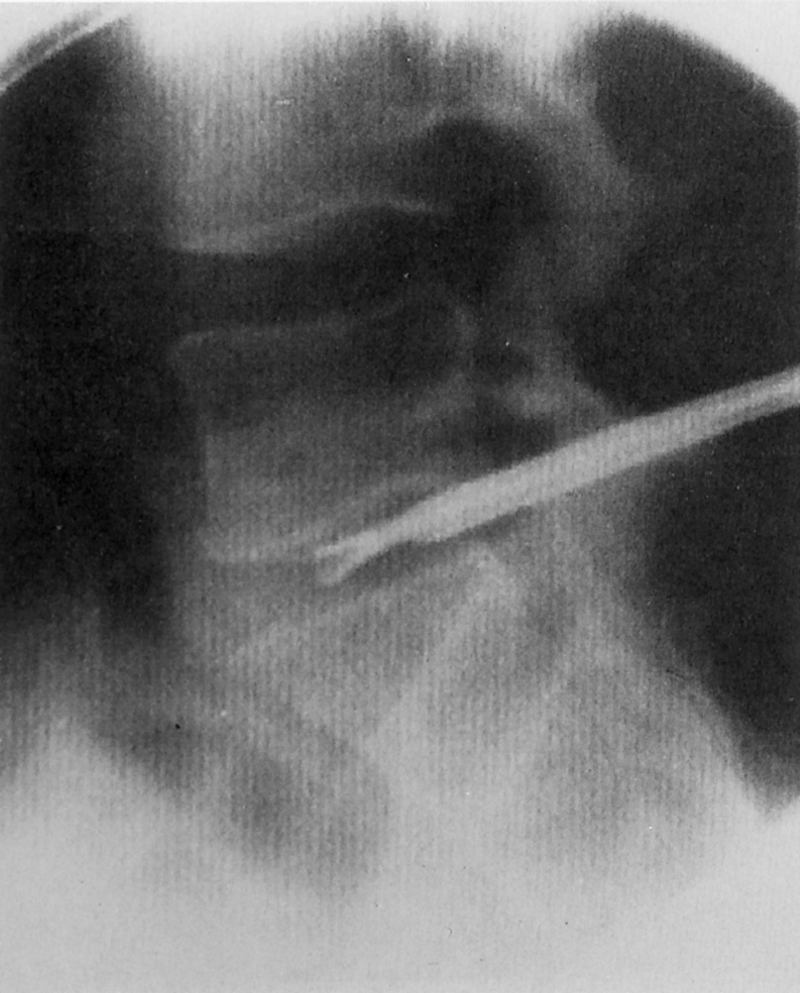
Figure 7 Intraoperative radiograph showing forceps in the L5-S1 disk space removing a herniated spinal disk.
(Reproduced with permission from Kambin P, Schaffer JL: Percutaneous lumbar discectomy: Review of 100 patients and current practice. Clin Orthop 1989;238:24-34.)
); and acromioplasty, in which a bone spur extending from the acromion and pressing on the rotator cuff is flattened.
The common theme of these operations is a controlled injury: without precision control, tissues may be damaged or an exuberant healing response may be induced such that even greater compression results.
Amputation
The goal of surgery on the musculoskeletal system is to restore function. In some cases, however, a better outcome can be achieved with amputation, the surgical removal of a damaged limb, as opposed to repeated surgical attempts to fix a problem that may not be fixable. For example, if a patient has an open fracture of the leg that would require extensive vascular and nerve repair, multiple débridements, and a muscle flap for soft-tissue coverage, it may be better to simply amputate distal to the injury and fit the patient with a prosthesis.19 This is often a complex and difficult decision; however, it should be noted that there have been patients with above-knee amputations who were able to compete successfully in marathon races.
Amputation can be used to address traumatic injuries or it can be performed as a planned treatment for pathologic conditions, such as vascular insufficiency, life-threatening infections, malignant tumors, or severe degenerative or acquired deformities. Traumatic amputations can be complete or partial. Complete amputation can result from sharp transection (eg, from saw blades or knives), crushing injuries (eg, from hydraulic presses), or avulsion injuries (eg, from motor vehicle accidents). The amputated part is often too severely damaged to attempt replantation, in which case the remaining stump is treated with débridement of severely contaminated tissue and closure of the wound after appropriate decontamination. The remaining bone ends may require shortening to obtain adequate soft-tissue and/or skin coverage for the remaining stump. Skin grafts and soft-tissue flaps also may be used to maintain the length of the amputated limb. Preservation of limb length is important because it allows for a more efficient prosthetic or artificial limb fitting and function.
Replantation
Traumatic amputation that results from a clean transection of the limb or body part without a large zone of crush injury is generally amenable to attempted replantation. Replantation is often a lengthy and tedious surgical procedure for which the skill of the surgical team and the age and overall health status of the patient must be considered. For example, an elderly man who has severe coronary artery disease and cardiac insufficiency may suffer grave complications during an extended replantation procedure; therefore, he may not be a good candidate because the risks outweigh the benefits. Severely contaminated or damaged partial amputations or injuries with a large zone of devastating damage to the nerves, blood vessels, bone, and soft tissues are also frequently treated by amputation. This is known as completion amputation. Microsurgical techniques have been developed that allow surgeons to anastamose (reconnect) arteries, veins, and nerves in conjunction with repair of the tendons and muscles. Microsurgical techniques have also been used in conjunction with fracture fixation and soft-tissue débridement and coverage to enable surgeons to reattach fingers, hands, arms, feet, and even legs under certain circumstances. For example, the great toe may be attached to the hand to establish a functioning thumb after traumatic loss of the thumb.
Key Terms
Acromioplasty A surgical decompression procedure in which a bone spur extending from the acromion and pressing on the rotator cuff is removed
Arthrodesis A procedure in which the edges of a joint are removed and the two ends of raw bone are allowed to unite as if they were the edges of a fracture; also known as joint fusion
Arthroplasty A procedure in which the diseased ends of bone with their irregular articular surfaces are removed and replaced with man-made materials or scar tissue
Arthroscopy A form of minimally invasive surgery in which a fiberoptic camera, the arthroscope, is introduced into a joint through a small incision
Aspiration Removal of fluids from a body cavity; often done to obtain specimens for analysis
Diskectomy A surgical decompression procedure in which an intervertebral disk is removed
External fixation A method of immobilization that uses pins inserted through the skin to attach fragments of fractured bone to external stabilizing frames
Fracture callus Structure developed after a fracture; initially formed from a hematoma at the bleeding edges of bone, it eventually forms a cartilage mass that is remodeled into mature bone
Intramedullary nailing or rodding A procedure for the fixation of fractures in which a nail or rod is inserted into the intramedullary canal of the bone at one of its two ends
Involucrum In osteomyelitis, the barrier of new bone formed around an infested nidius (ie, the sequestrum)
Laminectomy A surgical decompression procedure in which part of the posterior arch of a vertebra is removed; allows access to the disk
Lavage The irrigation or thorough washing of an infected joint with high-volume saline solution
Open reduction and internal fixation Often abbreviated ORIF, a procedure that involves incising the skin and soft tissue to repair a fracture under direct visualization
Primary bone healing The end-to-end repair process that occurs when the bone ends are anatomically opposed and held together rigidly; no callus forms
Resection arthroplasty A procedure in which the surfaces of diseased bone are excised and fibrocartilage is allowed to grow in its place
Revascularization A procedure to provide an additional blood supply to fractured bone
Secondary bone healing The repair process that is characterized by the formation of fracture callus, which then remodels to form new bone
Sequestrum The infected area of bone that is walled off by the involucrum
Surgical drainage A procedure in which fluid is removed from an infected body part, often to treat infection
References
1. Goldenberg DL: Septic arthritis. Lancet 1998;351:197-202.
2. Deng GM, Nilsson IM, Verdrengh M, et al: Intra-articularly localized bacterial DNA containing CpG motifs induces arthritis. Nat Med 1999;5:702-705.
3. Mader JT, Calhoun J: Osteomyelitis, in Mandell GL, Bennett JE, Dolin R (eds): Mandell, Douglas and Bennett’s Principles and Practice of Infectious Diseases, ed 4. New York, NY, Churchill Livingstone, 1995, pp 1039-1051.
4. McKibbin B: The biology of fracture healing in long bones. J Bone Joint Surg Br 1978;60:150-162.
5. Brighton CT: Principles of fracture healing: Part I. The biology of fracture repair. Instr Course Lect 1984;33:60-82.
6. Leunig M, Hertel R, Siebenrock KA, et al: Clin Orthop 2000;375:7-14.
7. Wenda K, Runkel M, Degreif J, et al: Pathogenesis and clinical relevance of bone marrow embolism in medullary nailing: Demonstrated by intraoperative echocardiography. Injury 1993;24(suppl 3):S73-S81.
8. Kropfl A, Berger U, Neureiter H, et al: Intramedullary pressure and bone marrow fat intravasation in unreamed femoral nailing. J Trauma 1997;42:946-954.
9. Harrington KD: Orthopedic surgical management of skeletal complications of malignancy. Cancer 1997;80(suppl 8):1614-1627.
10. van der Hulst RR, van den Wildenberg FA, Vroemen JP, et al: Intramedullary nailing of (impending) pathologic fractures. J Trauma 1994;36:211-215.
11 Ryan JR, Rowe DE, Salciccioli GG: Prophylactic internal fixation of the femur for neoplastic lesions. J Bone Joint Surg Am 1976;58:1071-1074.
12. Browner BD, Alberta FG, Mastella DJ: A new era in orthopedic trauma care. Surg Clin North Am 1999;79:1431-1448.
13. Shtarker H, Volpin G, Lerner A, et al: Ilizarov reconstructive surgery: A solution for complex problems of the musculoskeletal system. Harefuah 1999;136:182-256.
14. Geerts WH, Heit JA, Clagett GP, et al: Prevention of venous thromboembolism. Chest 2001;119(suppl 1):S132-S175.
15. Goldstein J, Zuckerman JD: Selected orthopedic problems in the elderly. Rheum Dis Clin North Am 2000;26:593-616.
16. McGinity JB, Geuss LF, Marvin RA: Partial or total meniscectomy: A comparative analysis. J Bone Joint Surg Am 1977;59:763-766.
17. DeHaven KE: Meniscus repair. Am J Sports Med 1999;27:242-250.
18. Gartsman GM: All arthroscopic rotator cuff repairs. Orthop Clin North Am 2001;32:501-510.
19. Sudkamp N, Haas N, Flory PJ, et al: Criteria for amputation, reconstruction and replantation of extremities in multiple trauma patients. Chirurg 1989;60:774-781.
