
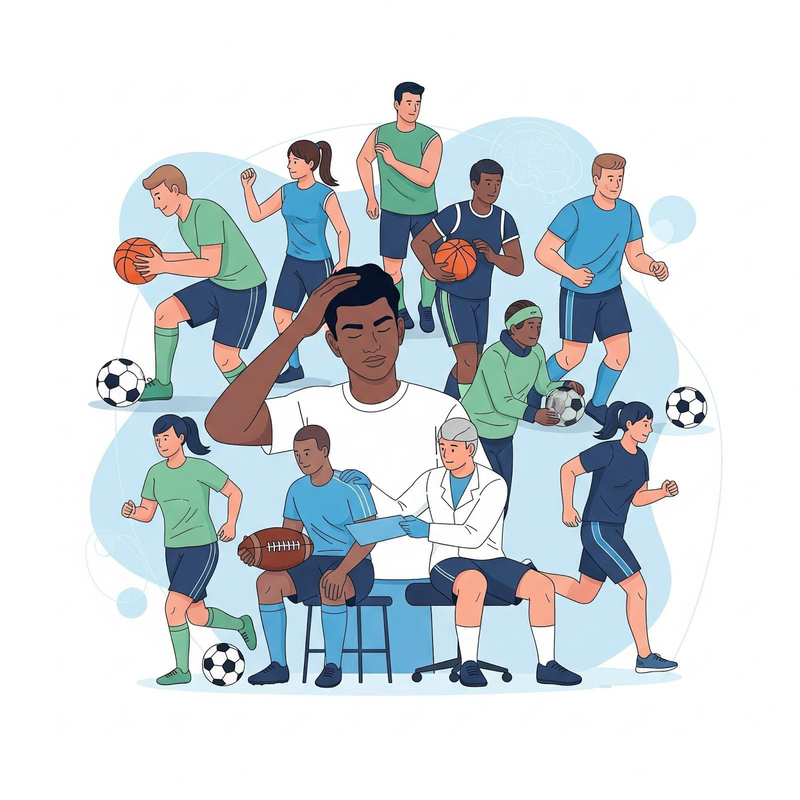
Concussion in Athletes: Diagnosis, Management, and Long-Term Effects
Concussions are a common injury in athletes, particularly those participating in contact sports 1. This article summarizes current guidelines for the diagnosis and management of concussions in athletes, discusses the importance of a graded return-to-play (RTP) protocol, and explores the long-term effects of repeated concussions.
Methodology
This article was developed based on a comprehensive review of current guidelines and research on concussion in athletes. Reputable sources, including sports medicine organizations, research papers, and articles, were consulted to gather information on concussion diagnosis, management, and long-term effects. The research process involved the following steps:
- Identifying current guidelines for concussion diagnosis and management in athletes from reputable sports medicine organizations.
- Finding research papers and articles on graded return-to-play protocols for athletes with concussions.
- Finding research papers and articles on the long-term effects of repeated concussions in athletes.
- Summarizing the key points from the guidelines, research papers, and articles.
- Highlighting the importance of a graded return-to-play protocol in preventing further injury and long-term complications.
- Discussing the potential long-term effects of repeated concussions, including cognitive impairment, mental health issues, and neurodegenerative diseases.
Diagnosis of Concussion in Athletes
A concussion is a type of traumatic brain injury caused by a bump, blow, or jolt to the head or body that causes the head and brain to move rapidly back and forth 2. This sudden movement can cause injury to the brain, even if the head is not directly impacted 3. Forces transmitted to the head can also result in a concussion. While a direct blow to the head is a common cause, it is not necessary for a concussion to occur 2.
Before an athlete enters a new level of participation, a complete pre-participation physical evaluation (PPE) should be performed. This is also recommended when changes in the athlete's status may warrant a new exam 1. The PPE helps identify potential risk factors and establish a baseline for comparison.
Recognizing the Signs and Symptoms
Concussion symptoms can be subtle and may not be immediately apparent. Some symptoms may appear right away, while others may not be noticed for days or even weeks after the injury 4. It is crucial to recognize the various physical, cognitive, emotional, and sleep-related symptoms that may indicate a concussion:
Physical Symptoms:
- Headache
- Nausea or vomiting
- Balance problems or dizziness
- Double or blurry vision
- Sensitivity to light or noise
- Ringing in the ears 5
Cognitive Symptoms:
- Feeling mentally slow or "foggy"
- Difficulty concentrating
- Difficulty remembering
- Amnesia, especially surrounding the time of the injury 5
Emotional Symptoms:
- Irritability
- Sadness
- Nervousness
- More emotional than usual
Sleep-Related Symptoms:
- Sleeping more or less than usual
- Drowsiness
- Trouble falling asleep
"Red Flags" Requiring Immediate Medical Attention
Certain symptoms warrant immediate medical attention. These may indicate a more serious brain injury 2. If any of the following symptoms are present, seek emergency care immediately:
- Increasing confusion or headache
- Seizures
- Looks less alert
- Cannot be awakened
- Repeated vomiting
- Slurred speech
- Cannot recognize people or places
- Increasing confusion or irritability
- Loss of consciousness
- Weakness or numbness in arms or legs
- Unusual behavioral change 2
Evaluation and Diagnosis
If a concussion is suspected, the athlete must be removed from play immediately and evaluated by a healthcare professional experienced in concussion management 3. This evaluation typically includes:
- A detailed medical history: This includes questions about the athlete's symptoms, any previous concussions, and any relevant medical conditions. It is important to include concussion-specific questions in this evaluation, as many athletes may not recognize or recall past concussions 8.
- A physical examination: This may include a neurological examination to assess the athlete's reflexes, coordination, and balance.
- Cognitive testing: This may involve tests of memory, concentration, and reaction time.
- Balance testing: Tools like the Balance Error Scoring System (BESS) can be used to assess balance and coordination 9.
- Symptom assessment: Standardized tools like the Standardized Assessment of Concussion (SAC) and the Sport Concussion Assessment Tool (SCAT) can help evaluate the severity and type of symptoms 9. For younger athletes, it is important to use age-appropriate and validated concussion assessment tools. Parents or guardians should also be involved in monitoring symptoms 11.
It is important to note that there is no imaging test (such as a CT scan or MRI) that can diagnose a concussion 2. The diagnosis is made based on a comprehensive clinical evaluation 9.
Management of Concussion in Athletes
The primary goal of concussion management is to allow the brain to heal and to prevent further injury. This involves a multi-faceted approach that includes education, rest, academic accommodations, and a graded RTP protocol.
It is important to educate administrators, sports medicine team members, coaches, and parents on concussion prevention, recognition, and referral 11. This education should emphasize the use of proper terminology, such as "concussion" or "traumatic brain injury," instead of minimizing terms like "ding" or "bell ringer," which can trivialize the injury 11.
Rest and Recovery
The cornerstone of concussion management is rest. Both physical and cognitive rest are essential to allow the brain to heal 12. This means avoiding activities that:
- Increase heart rate (e.g., strenuous exercise)
- Require concentration and attention (e.g., schoolwork, video games, computer use)
- Expose the athlete to loud noises and bright lights
The duration of rest varies depending on the severity of the concussion and the individual athlete's needs. Most athletes require 24-48 hours of rest, but some may need longer 12. Prolonged strict rest, however, has been shown to slow down recovery 14. In most cases, introducing medically supervised graded activity after a few days can aid recovery.
Academic Accommodations
For student-athletes, academic accommodations may be necessary to support recovery. These may include:
- Reduced workload
- Extended time for assignments and tests
- Breaks during class
- A gradual return to academic activities 12
The return-to-school phase often takes up a significant portion of the recovery time 7. Therefore, it is crucial to provide appropriate support and accommodations to facilitate a safe and successful return to academics.
Medications
In some cases, medications may be used to manage concussion symptoms. However, it is crucial to consult with a healthcare professional before using any medication, as some medications can worsen symptoms or interfere with recovery. Acetaminophen (Tylenol) is generally considered safe for managing headache pain 11.
Graded Return-to-Play (RTP) Protocol
A graded RTP protocol is a crucial component of concussion management. It involves a stepwise progression of activities that gradually increase in physical and cognitive demands 15. The protocol helps ensure the athlete's brain has recovered sufficiently before returning to full participation in sports.
Importance of a Graded RTP Protocol:
- Reduces the risk of further injury: Returning to play too soon increases the risk of a second concussion, which can have more severe and long-lasting consequences 3.
- Promotes optimal recovery: Gradual increases in activity allow the brain to adapt and heal properly, reducing the risk of prolonged symptoms or complications.
- Allows for monitoring of symptoms: The stepwise progression allows healthcare professionals and coaches to monitor the athlete for any recurring or worsening symptoms.
Example of a Graded RTP Protocol:
While specific protocols may vary, a typical graded RTP protocol includes the following steps:
| Step | Description |
|---|---|
| 1 | No activity: Complete physical and cognitive rest. |
| 2 | Light aerobic exercise: Walking, swimming, or stationary cycling at low intensity. |
| 3 | Sport-specific exercise: Running drills, skating drills, etc., without head impact. |
| 4 | Non-contact training drills: More complex drills, may start progressive resistance training. |
| 5 | Full-contact practice: Following medical clearance, participate in normal training activities. |
| 6 | Return to competition: Full game participation. |
Each step typically lasts at least 24 hours, and the athlete should only progress to the next step if they are symptom-free at the current level 16. If symptoms return at any stage, the athlete should stop the activity, rest, and return to the previous step once symptoms have resolved 17.
Long-Term Effects of Repeated Concussions
While most athletes recover fully from a single concussion 18, repeated concussions can have serious long-term consequences. These may include:
- Cognitive impairment: Difficulties with memory, attention, concentration, and processing speed 10. These cognitive symptoms most commonly manifest as impairments in processing speed, attention, memory, and executive functions 10.
- Emotional and behavioral changes: Increased irritability, mood swings, depression, and anxiety 6.
- Neurodegenerative diseases: Increased risk of Alzheimer's disease, Parkinson's disease, and chronic traumatic encephalopathy (CTE) 6. Research suggests that even a single concussion can have long-term consequences later in life, such as an increased risk of dementia 19.
- Chronic Traumatic Encephalopathy (CTE): CTE is a degenerative brain disease linked to repeated head impacts. It can cause various symptoms, including problems with thinking, memory, behavior, and mood 20. It is important to note that scientists do not currently know how many people have or will develop CTE. While it has been found in the brains of some deceased athletes and others with a history of repeated head impacts, prior studies suggest that CTE is likely very rare 20. There is no strong evidence that shows that getting one or more concussions leads to CTE 20.
Factors Influencing Long-Term Effects:
The long-term effects of repeated concussions can vary depending on several factors, including:
- Number of concussions: The risk of long-term problems generally increases with the number of concussions sustained, with research indicating that experiencing three or more concussions is linked with worsened brain function in later life 21.
- Severity of concussions: More severe concussions may have a greater impact on long-term brain health.
- Age at the time of concussions: Younger athletes may be more vulnerable to the long-term effects of concussions, and recovery may take longer compared to adults 11.
- Genetics and other individual factors: Some individuals may be more susceptible to concussion-related complications due to genetic or other factors.
- Second-impact syndrome: Athletes with a history of concussions are at an increased risk of second-impact syndrome, a rare but potentially fatal condition that can occur when a second concussion is sustained before the brain has fully recovered from the first 11.
Recent research also suggests a potential role of the gut microbiome in concussion recovery 22. Studies have shown that repeated head injuries can induce changes in the gut microbiome, potentially influencing the inflammatory response and recovery process.
Conclusion
Concussions are a significant concern in athletes, and proper diagnosis and management are crucial to prevent long-term complications. Current guidelines emphasize a comprehensive approach that includes immediate removal from play, thorough evaluation, rest, academic accommodations, and a graded RTP protocol. While a single concussion typically resolves without long-term effects, repeated concussions can have serious consequences, including cognitive impairment, mental health issues, and neurodegenerative diseases. It is essential for athletes, coaches, and healthcare professionals to be aware of the risks associated with concussions and to follow established guidelines to ensure the safety and well-being of athletes.
The graded RTP protocol plays a vital role in minimizing the risk of these long-term complications. By gradually increasing the athlete's activity levels and monitoring for any recurring symptoms, the protocol helps ensure the brain has adequately healed before returning to full participation in sports. This reduces the risk of second-impact syndrome and promotes optimal recovery, minimizing the potential for long-term cognitive, emotional, and neurological consequences.
Works cited
1. Public Policy - American College of Sports Medicine, accessed February 17, 2025, https://www.acsm.org/nyshsi/policy
2. www.acsm.org, accessed February 17, 2025, https://www.acsm.org/docs/default-source/files-for-resource-library/concussion-in-sports.pdf
3. SUGGESTED GUIDELINES FOR MANAGEMENT OF CONCUSSION IN SPORTS - NFHS, accessed February 17, 2025, https://www.nfhs.org/media/1018446/suggested_guidelines__management_concussion_april_2017.pdf
4. Return to Play Guidelines following Concussion - Massachusetts Medical Society, accessed February 17, 2025, https://www.massmed.org/Continuing-Education-and-Events/Online-CME/Courses/Concussion-Treatment,-Management,-and-Prevention/Return-to-Play-Guidelines-Following-Concussion-(pdf)/
5. The Implementation of a Return-to-Play Protocol with Standardized Physical Therapy Referrals in a Collegiate Football Program, accessed February 17, 2025, https://ijspt.scholasticahq.com/article/73074-the-implementation-of-a-return-to-play-protocol-with-
6. Long-Term Effects of Sports Concussions | Effects on Athletes - Puget Sound Orthopaedics, accessed February 17, 2025, https://www.pugetsoundorthopaedics.com/health/long-term-effects-of-sports-concussions/
7. Rest and Return to Activity After Sport-Related Concussion: A ..., accessed February 17, 2025, https://pmc.ncbi.nlm.nih.gov/articles/PMC5384824/
8. Trends in Concussion Return-to-Play Timelines Among High School Athletes From 2007 Through 2009 - PubMed Central, accessed February 17, 2025, https://pmc.ncbi.nlm.nih.gov/articles/PMC3867096/
9. National Athletic Trainers' Association Position Statement: Management of Sport Concussion - PMC - PubMed Central, accessed February 17, 2025, https://pmc.ncbi.nlm.nih.gov/articles/PMC3975780/
10. Sport-Related Concussion | Neurology Clinical Practice, accessed February 17, 2025, https://www.neurology.org/doi/10.1212/CPJ.0000000000200123
11. NATA Issues New Position Statement on the Management of Sport Concussion, accessed February 17, 2025, https://www.nata.org/press-release/031014/nata-issues-new-position-statement-management-sport-concussion
12. Concussions | NATA, accessed February 17, 2025, https://www.nata.org/sites/default/files/white-paper-concussions.pdf
13. Concussion in Athletes | University of Michigan Health, accessed February 17, 2025, https://www.uofmhealth.org/conditions-treatments/brain-neurological-conditions/concussion-athletes-neurosport
14. Strict Rest Slows Recovery after Sports-Related Concussions, accessed February 17, 2025, https://www.acsm.org/news-detail/2021/06/18/strict-rest-slows-recovery-after-sports-related-concussions
15. Concussion Recovery Timeline of High School Athletes Using A ..., accessed February 17, 2025, https://pmc.ncbi.nlm.nih.gov/articles/PMC6961643/
16. Returning to Sports | HEADS UP - CDC, accessed February 17, 2025, https://www.cdc.gov/heads-up/guidelines/returning-to-sports.html
17. Graduated Return to Play Following a Concussion: Sports Competition - AAP, accessed February 17, 2025, https://downloads.aap.org/AAP/PDF/Info_6.pdf
18. Do Concussions Have Long-term Side Effects? - Piedmont Healthcare, accessed February 17, 2025, https://www.piedmont.org/living-real-change/do-concussions-have-long-term-side-effects
19. How long does concussion last: long-term effects - Queensland ..., accessed February 17, 2025, https://qbi.uq.edu.au/concussion/how-long-does-concussion-last-long-term-effects
20. About Repeated Head Impacts | Traumatic Brain Injury ... - CDC, accessed February 17, 2025, https://www.cdc.gov/traumatic-brain-injury/about/repeated-head-impacts.html
21. Three or more concussions linked with worse brain function in later life | University of Oxford, accessed February 17, 2025, https://www.ox.ac.uk/news/2023-01-31-three-or-more-concussions-linked-worse-brain-function-later-life
22. Research Review on Multiple Concussions and Repetitive Subconcussive Head Impacts - Health.mil, accessed February 17, 2025, https://health.mil/Reference-Center/Publications/2024/03/28/TBICoE-Research-Review-Multiple-TBI-Multiple-Concussion
