
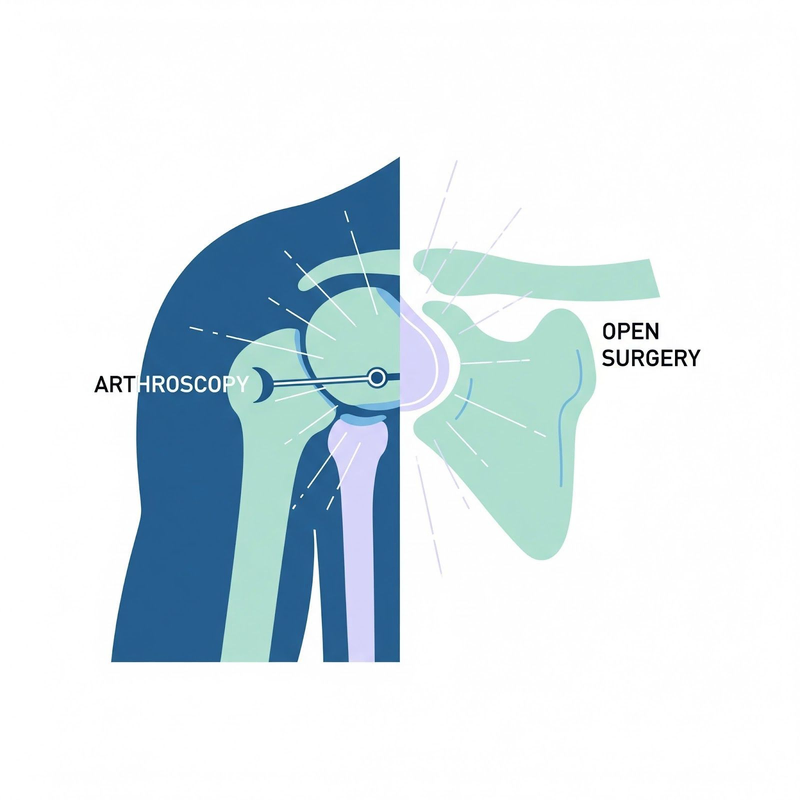
Arthroscopic vs. Open Surgery for Shoulder Instability: A Comparative Analysis
Shoulder instability, often caused by traumatic dislocations or overuse, can significantly impair a person's quality of life 1. Surgical intervention is frequently necessary to restore stability and function to the shoulder joint. Two primary surgical approaches are commonly employed: arthroscopic and open surgery. This article provides a comprehensive comparison of these techniques, examining their outcomes, advantages, and disadvantages.
Outcomes of Arthroscopic and Open Surgical Techniques
While both arthroscopic and open surgical techniques aim to stabilize the shoulder joint, their outcomes can vary based on factors such as the severity of the instability, patient characteristics, and surgeon experience 2. Arthroscopic surgery is often recommended for younger, active individuals, while open surgery may be more suitable for older patients or those with complex tears 3.
In general, studies suggest that both arthroscopic and open surgery can effectively improve pain and function in patients with shoulder instability. For example, one study comparing arthroscopic and open rotator cuff repair found that both techniques led to significant improvements in pain, active forward flexion, active abduction, and function at the time of follow-up 4. However, there are some key differences in outcomes reported in the literature:
- Function: One study found that open surgery may lead to superior functional outcomes compared to arthroscopic repair 4.
- Pain Resolution: Some studies indicate that open surgery may provide better postoperative pain resolution, potentially due to reduced acromioplasty needs 2.
- Retear Rates: A prospective cohort study found that retear rates were higher after open rotator cuff repair compared to both knotted and knotless arthroscopic repairs 5. This study also found that the arthroscopic groups had better American Shoulder and Elbow Surgeons (ASES) scores at 6 months and 2 years 5.
It is important to note that the research on the outcomes of arthroscopic and open surgery for shoulder instability is ongoing, and there is no clear consensus on which technique is definitively superior. The choice of surgical approach should be individualized based on the specific needs and circumstances of each patient 2.
Advantages and Disadvantages of Arthroscopic Surgery
Arthroscopic surgery, a minimally invasive procedure, offers several advantages over open surgery for treating shoulder instability:
- Smaller Incisions: Arthroscopic surgery involves inserting a small camera and miniature surgical instruments through tiny incisions. This results in less trauma to the surrounding tissues, leading to benefits such as reduced scarring and a quicker recovery 6.
- Reduced Pain: The smaller incisions and minimal tissue disruption associated with arthroscopic surgery typically lead to less postoperative pain and discomfort 7. Additionally, nerve blocks are often used during and after arthroscopic surgery to further manage pain 9.
- Faster Recovery: Patients undergoing arthroscopic surgery generally experience a faster return to normal activities compared to those who undergo open surgery 7.
- Lower Risk of Infection: The smaller incisions in arthroscopic surgery reduce the risk of infection compared to open surgery 7.
- Improved Cosmesis: The minimal scarring associated with arthroscopic surgery can be an important consideration for patients concerned about the cosmetic outcome 11.
- Diagnostic Advantage: Arthroscopic surgery allows surgeons to directly inspect the shoulder joint for damage that may go unseen in an open procedure or an MRI scan, aiding in accurate diagnosis and treatment 3.
- Efficiency: Arthroscopic surgery can often be used for both diagnosis and treatment in a single procedure, potentially saving time and resources 12.
- Double-Row Repair: For rotator cuff tears, double-row arthroscopic repair may offer better biomechanical strength and healing rates compared to single-row repair 13.
However, arthroscopic surgery also has some disadvantages:
- Limited Access: Arthroscopic surgery may not provide adequate access to all areas of the shoulder joint, potentially limiting its use in certain complex cases 14.
- Technical Challenges: Arthroscopic surgery requires specialized skills and equipment, and the surgeon's expertise can significantly influence the outcome 14.
- Potential for Complications: Although rare, complications such as nerve damage, blood clots, chondrolysis (damage to the shoulder cartilage), and recurrent instability can occur after arthroscopic shoulder surgery 15.
Advantages and Disadvantages of Open Surgery
Open surgery, the traditional approach to shoulder instability repair, involves a larger incision to directly access the shoulder joint. This technique offers some advantages over arthroscopic surgery:
- Direct Visualization: Open surgery provides the surgeon with a direct, unobstructed view of the joint, allowing for more precise and comprehensive repairs 6.
- Greater Access: Open surgery allows for a broader range of procedures and may be more suitable for addressing severe joint injuries and complex cases 6. This includes cases where arthroscopic surgery has failed, particularly if pain or weakness persists or if imaging shows bone changes 17.
- Potentially Lower Retear Rates: Some studies suggest that open surgery may have lower retear rates compared to arthroscopic surgery, particularly for larger tears 5.
- Faster Procedure: In some cases, open surgery may be quicker than arthroscopic surgery 18.
The Latarjet Procedure
The Latarjet procedure is a specific type of open shoulder surgery used to treat recurrent shoulder instability. It involves transferring a bone graft from the coracoid process to the front of the glenoid (shoulder socket). While generally effective, the Latarjet procedure carries specific risks, including:
- Recurrence: Instability can recur due to factors such as incorrect patient selection, technical errors, or complications like fracture of the coracoid graft or malpositioning 19.
- Neurological Complications: Nerve injury can occur, although the risk can be minimized with careful surgical technique 19.
- Hematoma Formation: A hematoma (collection of blood) can form at the surgical site, but this can often be prevented with proper hemostasis (stopping bleeding) during the procedure 19.
However, open surgery also has some disadvantages:
- Larger Incision: The larger incision in open surgery results in more scarring and a longer recovery time 20.
- Increased Pain: Open surgery is associated with more postoperative pain and discomfort due to the greater tissue disruption 21.
- Higher Risk of Infection: The larger incision in open surgery increases the risk of infection compared to arthroscopic surgery 10.
- Longer Hospital Stay: Patients undergoing open surgery may require a longer hospital stay for recovery 10.
- Post-operative Frozen Shoulder: Stiffness and limited range of motion can occur after open surgery, sometimes requiring further treatment 22.
- Low-Grade Infections: A specific type of low-grade infection can occur, characterized by a post-op frozen shoulder that doesn't improve with usual treatments 22.
- Revision Surgeries: A second surgery may be needed after rotator cuff repair if the initial repair fails to heal or re-tears. These revision surgeries can be more challenging and have lower success rates than the original repair 23. Similarly, revision surgery may be needed after shoulder replacement, with a lifetime risk of approximately 1 in 4 cases 21.
- Blood Clots: To minimize the risk of blood clots, calf compression pumps are often used during open surgery, and anticoagulants may be used in high-risk patients 22.
Recovery Time
Recovery time after shoulder surgery varies depending on the type of procedure, the extent of the injury, and individual factors such as age and overall health 24.
Arthroscopic surgery generally has a shorter recovery time compared to open surgery. Patients undergoing arthroscopic shoulder surgery may be able to return to work or school within a few days, and full recovery may take several weeks to months 9. For arthroscopic rotator cuff repair, the typical recovery timeline is:
- 6-8 weeks: Return to most forms of normal activity.
- 12-16 weeks: Limited athletics.
- 4-6 months: Full activity, including contact athletics 25.
Open surgery typically requires a longer recovery period. Patients may need to wear a sling for several weeks, and full recovery may take several months to a year 26. The recovery process after open shoulder surgery often involves distinct phases:
- Phase 1 (first 6 weeks): Focus on pain reduction and tissue healing with passive exercises.
- Phase 2 (weeks 7-14): Gradual return to active movements and functional range of motion exercises.
- Phase 3 (weeks 15-22): Strength-building exercises and return to daily activities 27.
It's important to note that pain levels after arthroscopic surgery can vary based on the type of procedure, individual pain tolerance, and rehabilitation compliance 28.
Cost
The cost of shoulder surgery can vary significantly depending on factors such as the type of procedure, the surgeon's fees, and the geographic location.
Arthroscopic shoulder surgery generally costs between $2,611 and $18,590 29. In California, the cost ranges from $4,775 to $7,777 30. Medicare estimates the total cost to range from $1,800 to $7,500, with patients paying approximately $370 to $1,500 out-of-pocket 16.
Open shoulder surgery costs can range from $6,000 to $50,000, with anesthesia costs starting around $600 31.
Availability in Calgary, Alberta
Both arthroscopic and open shoulder surgery are available in Calgary, Alberta. Several orthopedic surgeons specializing in shoulder surgery practice in the city, including Dr. Ian Lo and Dr. Richard Boorman 32.
The Shoulder Care Access Project (SCAP) Clinic at the University of Calgary Sport Medicine Centre provides assessments for patients with shoulder problems and can provide surgical referrals if needed 34.
Surgical Solutions Network offers private shoulder arthroscopy and rotator cuff repair surgery at various locations in Calgary, including Canadian Surgery Solutions and Rockyview Surgical Centre 35.
Patient Perspectives
Understanding patient experiences with different surgical approaches can provide valuable insights into the impact of these procedures on daily life and overall well-being. Here are a few testimonials from patients who have undergone shoulder surgery:
- "I had major shoulder surgery... Dr. Press did a fantastic job. Three months out this week and I am done with PT and moving forward." 37
- "Prior to my operation I had many years of pain, discomfort and the inability to undertake many tasks with my right arm/hand. Now eight months later I have a completely functioning arm. I am pain free and my arm has a full range of motion..." 38
- "I had a right shoulder replacement. The surgery was at 7:30 am and I was discharged that same morning at 10:30 am... I am now 6 months post surgery and I am stronger and have better mobility than before the surgery without the pain..." 39
- "I was injured in a auto accident and my Rotator cuff was very painful... I am so happy I did as my left shoulder is stronger now than my right. I am free of pain in my left shoulder after two years to recovery." 39
These testimonials highlight the potential for successful outcomes and improved quality of life after shoulder surgery. However, it's important to remember that individual experiences can vary, and not all patients achieve the same results.
Conclusion
Arthroscopic and open surgical techniques are both viable options for treating shoulder instability. Arthroscopic surgery offers the advantages of smaller incisions, reduced pain, faster recovery, and improved cosmesis. Open surgery provides direct visualization, greater access, and potentially lower retear rates. The choice of surgical approach should be made on a case-by-case basis, considering the specific needs and circumstances of each patient. Factors such as the severity of the instability, patient preferences, surgeon experience, and cost should all be taken into account.
In general, arthroscopic surgery may be preferred for younger, active patients with less complex tears, while open surgery may be more suitable for older patients or those with massive tears requiring more extensive repair. However, the final decision should be made in consultation with a qualified surgeon who can thoroughly evaluate the patient's condition and discuss the risks and benefits of each surgical option. Shared decision-making between the patient and surgeon is crucial to ensure the best possible outcome and patient satisfaction.
Works cited
1. Open and Arthroscopic Shoulder Surgery - Dr John Conway, accessed February 17, 2025, https://www.johnconwaymd.com/open-arthroscopic-shoulder-surgery-orthopedic-surgeon-houston-tx.html
2. Comparison of Outcomes between Open and Arthroscopic Rotator ..., accessed February 17, 2025, https://pmc.ncbi.nlm.nih.gov/articles/PMC10796185/
3. Shoulder Decompression: Arthroscopy vs Open Surgery - Sports-health, accessed February 17, 2025, https://www.sports-health.com/treatment/shoulder-injury-treatment/shoulder-decompression-arthroscopy-vs-open-surgery
4. www.achot.cz, accessed February 17, 2025, https://www.achot.cz/pdfs/ach/2022/01/03.pdf
5. Open versus Two Forms of Arthroscopic Rotator Cuff Repair - PMC, accessed February 17, 2025, https://pmc.ncbi.nlm.nih.gov/articles/PMC2650068/
6. Difference Between Arthroscopic & Open Surgery - Mid-America Orthopedics, accessed February 17, 2025, https://midamortho.com/arthroscopic-surgery-vs-open-surgery-how-do-they-compare/
7. Benefits of Arthroscopic Surgery | Shoulder Arthroscopy Los Angeles, Pasadena CA, accessed February 17, 2025, https://www.lashouldersurgery.com/benefits-of-arthroscopic-surgery-shoulder-elbow-surgeon-los-angeles-ca.html
8. Shoulder Arthroscopy – Indications, Procedure, and Benefits - Dr. Berkman, accessed February 17, 2025, https://berkmanmd.com/shoulder-arthroscopy/
9. Shoulder Arthroscopy: Procedure, What to Expect, and Recovery - Cleveland Clinic, accessed February 17, 2025, https://my.clevelandclinic.org/health/treatments/21785-shoulder-arthroscopy
10. When Is Shoulder Arthroscopy A Better Option Than Open Surgery? - Sumit Dewanjee, MD, accessed February 17, 2025, https://www.fxrxinc.com/blog/when-is-shoulder-arthroscopy-a-better-option-than-open-surgery
11. Common Conditions Treated with Arthroscopic Shoulder Surgery, accessed February 17, 2025, https://www.eliteorthopaedic.com/blog/common-conditions-treated-with-arthroscopic-shoulder-surgery/
12. The Amazing Benefits of Shoulder Arthroscopy for Treating Shoulder Pain - The Woodlands Sports Medicine Centre, accessed February 17, 2025, https://www.woodlandssportsmedicine.com/blog/the-amazing-benefits-of-shoulder-arthroscopy-for-treating-shoulder-pain
13. Expectations Following Rotator Cuff Surgery - PMC, accessed February 17, 2025, https://pmc.ncbi.nlm.nih.gov/articles/PMC5825351/
14. Is Shoulder Arthroscopy a Major Surgery? 7 Pros and Cons Explained - Neelam Hospital, accessed February 17, 2025, https://neelamhospital.com/is-shoulder-arthroscopy-a-major-surgery/
15. Shoulder arthroscopy Information | Mount Sinai - New York, accessed February 17, 2025, https://www.mountsinai.org/health-library/surgery/shoulder-arthroscopy
16. Arthroscopic Shoulder Surgery: Purpose, Risks, and Procedure - Healthline, accessed February 17, 2025, https://www.healthline.com/health/arthroscopic-shoulder-surgery
17. Surgery for Shoulder Dislocation - NYU Langone Health, accessed February 17, 2025, https://nyulangone.org/conditions/shoulder-dislocation/treatments/surgery-for-shoulder-dislocation
18. The Relevance of Open Rotator Cuff Repair in 2021 - PMC, accessed February 17, 2025, https://pmc.ncbi.nlm.nih.gov/articles/PMC8046857/
19. Contraindications and complications of the Latarjet procedure - PMC, accessed February 17, 2025, https://pmc.ncbi.nlm.nih.gov/articles/PMC5734530/
20. Arthroscopy - Mayo Clinic, accessed February 17, 2025, https://www.mayoclinic.org/tests-procedures/arthroscopy/about/pac-20392974
21. Symptoms of failed shoulder surgery: What is typical? - MedicalNewsToday, accessed February 17, 2025, https://www.medicalnewstoday.com/articles/symptoms-of-failed-shoulder-surgery
22. Risks & Complications - Your Surgery - ShoulderDoc, accessed February 17, 2025, https://www.shoulderdoc.co.uk/article/1473
23. Rotator Cuff Surgery Risks and Complications - Sports-health, accessed February 17, 2025, https://www.sports-health.com/treatment/shoulder-injury-treatment/rotator-cuff-surgery-risks-and-complications
24. What is the Average Shoulder Surgery Recovery Time? - Full Circle Orthopedics, accessed February 17, 2025, https://fla-ortho.com/what-is-the-shoulder-surgery-recovery-time/
25. Arthroscopic shoulder surgery for the treatment of rotator cuff tears, accessed February 17, 2025, https://orthop.washington.edu/patient-care/articles/sports/arthroscopic-shoulder-surgery-for-the-treatment-of-rotator-cuff-tears
26. Shoulder Surgery Recovery - Orthopedic Specialists of North County, accessed February 17, 2025, https://www.orthonorthcounty.com/blog/shoulder-surgery-recovery-20407.html
27. Rotator Cuff Surgery Recovery: When Can You Return to Work? - Ventura Orthopedics, accessed February 17, 2025, https://venturaortho.com/rotator-cuff-surgery-recovery-time-off-work/
28. Is Arthroscopic Shoulder Surgery Worth It? - Alexander Orthopaedic Associates, accessed February 17, 2025, https://alexanderorthopaedics.com/blog/is-arthroscopic-shoulder-surgery-worth-it/
29. How Much Does a Shoulder Arthroscopy Cost Near Me? - MDsave, accessed February 17, 2025, https://www.mdsave.com/procedures/shoulder-arthroscopy/d787fbc8
30. Shoulder Arthroscopy Cost in California - MDsave, accessed February 17, 2025, https://www.mdsave.com/procedures/shoulder-arthroscopy/d787fbc8/california
31. How Much Does Shoulder Surgery Cost? - Dr. Chris Jones Colorado Springs, CO, accessed February 17, 2025, https://coloradosportsdoctor.com/how-much-does-shoulder-surgery-cost/
32. Orthopaedic Care | Gateway Surgery Team, accessed February 17, 2025, https://gatewaysurgery.ca/team/
33. Dr. Richard Boorman Orthopedic Surgeon in Calgary, AB | Surgical Solutions Network, accessed February 17, 2025, https://surgicalsolutionsnetwork.ca/about/our-physicians/dr-richard-boorman/
34. Shoulder Care Access Project Clinic | Sport Medicine Centre | University of Calgary, accessed February 17, 2025, https://sport-med.ucalgary.ca/clinics/shoulder-care-access-project-clinic
35. Private Shoulder Arthroscopy in Canada | Surgical Solutions Network, accessed February 17, 2025, https://surgicalsolutionsnetwork.ca/services/orthopedic/shoulder/shoulder-arthroscopy/
36. Private Rotator Cuff (Shoulder) Surgery in Canada | Surgical Solutions Network, accessed February 17, 2025, https://surgicalsolutionsnetwork.ca/services/orthopedic/shoulder/shoulder-rotator-cuff-repair-surgery/
37. Patient Testimonials | Dr Cyrus Press | Total Shoulder Replacement Springfield, VA, accessed February 17, 2025, https://www.cyruspressmd.com/patient-testimonials-orthopaedic-surgeon-woodbridge-fairfax-stafford-springfield-va.html
38. Patient Testimonials | Shoulder Surgery Specialist St Albans, Stevenage - Mr Adam Rumian, accessed February 17, 2025, https://www.shoulderandelbowspecialist.co.uk/testimonials-consultant-orthopaedic-surgeon-hertfordshire.html
39. Patient Testimonials - Oregon Shoulder Institute, accessed February 17, 2025, https://www.oregonshoulder.com/patient-testimonials
