
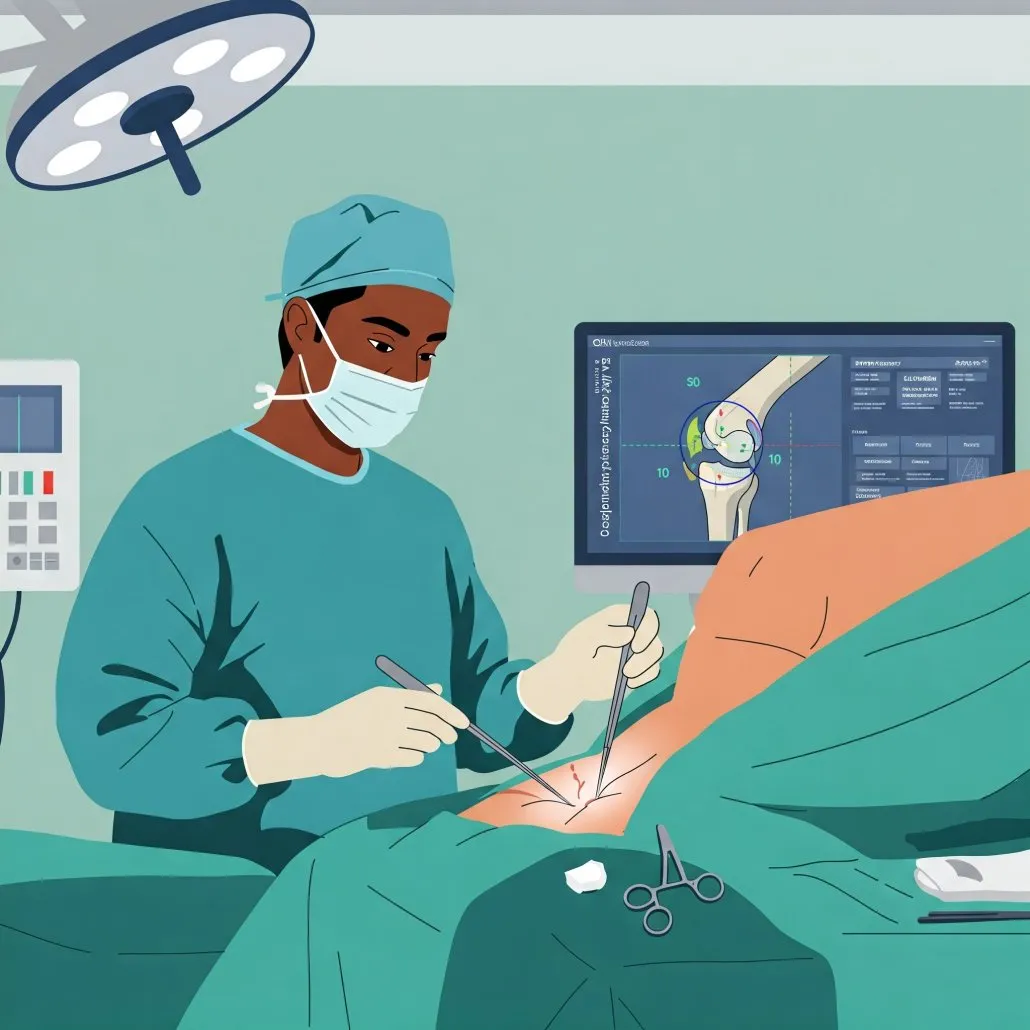
Computer-Assisted Navigation in Total Knee Arthroplasty
Total knee arthroplasty (TKA) is a widely performed surgical procedure for end-stage knee osteoarthritis. While generally successful, improper positioning or alignment of the implants during surgery can lead to complications such as restricted range of motion, instability, and early failure 1. Computer-assisted navigation (CAN) has emerged as a technology to improve the accuracy of implant placement in TKA. This article evaluates the impact of CAN on implant alignment, limb alignment, and clinical outcomes, while also discussing the learning curve and cost-effectiveness of this technology.
Types of CAN Systems
Computer-assisted navigation (CAN) systems in total knee arthroplasty (TKA) can be broadly categorized into image-based and imageless systems 2. Image-based systems utilize preoperative imaging, such as computed tomography (CT) scans, to create a three-dimensional model of the patient's anatomy. This model is then used during surgery to guide implant placement. Imageless systems, on the other hand, do not rely on preoperative imaging. Instead, they use anatomical landmarks and kinematic data acquired during surgery to create a virtual representation of the knee joint.
| System Type | Data Acquisition | Key Components |
|---|---|---|
| Image-based | CT scan, Fluoroscopy | Computer platform, Tracking system with infrared cameras, Fiduciary markers |
| Imageless | Anatomical landmarks, Kinematic data | Computer platform, Tracking system with infrared probes, Reflective markers |
Components of a CAN System
A typical CAN system consists of three main components: the computer platform, the tracking system, and the markers 5. The computer platform processes data from the tracking system and displays it on a monitor, providing the surgeon with real-time information on implant positioning and alignment. The tracking system uses infrared cameras or probes to track the position of markers attached to the patient's bones and surgical instruments. These markers allow the system to create a three-dimensional representation of the knee joint and track the movement of instruments in relation to the patient's anatomy.
Classifications of CAN Systems
CAN systems can be further classified as "closed" or "open" systems 5. Closed systems are designed to work with specific implants or surgical techniques from a particular manufacturer. Open systems, on the other hand, are more versatile and can be used with a variety of implants and techniques from different manufacturers. The choice between a closed or open system depends on the surgeon's preferences and the specific needs of the patient.
Impact of CAN on Implant and Limb Alignment
Coronal Alignment
Studies have consistently shown that CAN improves the accuracy of implant and limb alignment in TKA, particularly in the coronal plane. A meta-analysis of randomized controlled trials found that CAN significantly improved the accuracy of the mechanical axis of the lower extremity compared to conventional TKA 6. Another meta-analysis reported similar findings, with CAN leading to a lower risk of implant malalignment 8. Specifically, CAN has been shown to reduce outliers in coronal alignment, which is crucial for long-term success and implant survival 9.
Sagittal Alignment
CAN also improves the accuracy of sagittal alignment of the femoral component 6. This is important for achieving proper knee kinematics and preventing complications such as patellar maltracking.
Soft Tissue Balance
In addition to improving implant and limb alignment, CAN can also enhance soft tissue balance and patellar tracking 2. By providing real-time feedback on ligament tension and joint kinematics, CAN allows surgeons to make more precise adjustments during surgery, leading to a more balanced knee joint.
Addressing Anatomical Challenges
In cases with extra-articular deformities, where traditional instrumentation may be challenging, CAN has been shown to be a valuable tool for achieving accurate implant placement 11. The technology allows surgeons to navigate complex anatomical variations and ensure proper implant positioning even in the presence of deformities.
Specific Techniques and Systems
The Exactech GPS® navigation system is an example of a CAN system that utilizes intraoperative data collection about joint kinematics and anatomy to guide implant positioning 12. This system provides real-time feedback on joint stability, valgus-varus angle, and tibial slope values, allowing surgeons to make informed decisions during surgery.
Another example is the Brainlab Knee3 computer navigation-assisted TKA system, which utilizes AMA alignment 13. This technique involves minimal adjustment of femoral and tibial osteotomy angles based on soft tissue conditions, aiming to reduce the need for soft tissue release.
Impact of CAN on Clinical Outcomes
While CAN has demonstrated clear benefits in terms of implant and limb alignment, its impact on clinical outcomes is more nuanced. Some studies have reported improved functional outcomes, such as better Knee Society Scores, in patients who underwent CAN-assisted TKA 14. However, other studies have found no significant differences in clinical outcomes, including pain and function, between CAN and conventional TKA 7.
A systematic review of navigated TKA found limited evidence of improvements in clinical outcomes, with no long-term studies demonstrating improved function or lower revision rates 9. However, it is important to note that the impact of CAN on clinical outcomes may vary depending on patient factors, such as age. Studies suggest that younger patients may experience better knee function and improved longevity of the implant with CAN-assisted TKA 15.
Despite the mixed findings on overall clinical outcomes, CAN has shown potential benefits in specific areas. For example, studies have reported reduced blood loss and decreased incidence of fat embolism with CAN-assisted TKA 16. Additionally, CAN has been shown to improve soft tissue balance and joint alignment, potentially leading to a more natural-feeling prosthetic knee 1.
Learning Curve for Surgeons Using CAN
Surgeons adopting CAN technology typically experience a learning curve 17. One study found that the learning curve for CAN in TKA may be as few as 10 cases 18. Another study suggested a learning curve of approximately 20 cases, after which a beginner can reproduce the results of an expert 17.
During the learning curve, surgeons may experience increased operative times 18. However, this increase appears to be transient and non-significant, with some studies even reporting a decrease in operative time with increased experience 19. Interestingly, research on robotic-assisted TKA, which shares similarities with CAN, suggests that there is no learning curve observed for implant placement and lower limb alignment, as the implants are correctly placed from the first procedures 20. This highlights the potential of technology to enhance accuracy even for novice users.
Cost-Effectiveness of CAN in TKA
The cost-effectiveness of CAN in TKA is a complex issue. While CAN systems can be expensive, they may offer potential long-term savings due to improved outcomes and reduced revision rates 21. However, studies have shown that the cost-effectiveness of CAN is sensitive to various factors, including the cost of the navigation system, the accuracy of alignment achieved, and the probability of revision surgery 21.
One study found that CAN can be cost-effective if it leads to a significant reduction in revision rates 23. Another study reported that CAN resulted in marginal increased quality-adjusted life years at an additional cost, with the cost-effectiveness remaining uncertain 24.
A comparative cost analysis of different computer-assisted technologies found that all technologies increased the total cost of TKA compared to conventional techniques 25. The most important cost-related variables were technical support and additional disposables. The longer surgical times and additional surgical trays required for the techniques had a marginal effect on overall costs.
Accelerometer-based navigation (ABN) systems have emerged as a potential solution to balance accuracy and cost-effectiveness 26. These systems offer comparable accuracy to traditional CN systems but at a lower cost, making them a potentially attractive option for surgeons and hospitals.
Limitations and Drawbacks of CAN Technology
Despite its potential benefits, CAN technology has some limitations and drawbacks. These include:
- Increased operative time, especially during the learning curve 5. This can be a concern for hospitals and surgeons, as it may impact operating room efficiency and scheduling.
- Potential for increased risk of deep infection due to longer exposure time 5. Although studies have shown comparable complication rates between CAN and conventional TKA, including neurological deficits and joint infections 27, the potential for increased infection risk remains a consideration.
- Cumbersome procedures compared to conventional techniques 5. The use of CAN systems can add complexity to the surgical workflow, requiring additional equipment and setup time.
- High cost of navigation systems5. The initial investment in CAN technology can be substantial, which may be a barrier for some hospitals and surgeons.
- Potential complications related to the insertion of Schanz screws, such as periprosthetic fractures and nerve injuries 27. While these complications are relatively rare, they can be serious and require further intervention.
Guidelines and Recommendations
While there are no specific guidelines or recommendations from professional organizations regarding the use of CAN in TKA, several studies have provided important tips for surgeons using this technology 3. These include:
- Use two 3-mm drill pins for fixation of the optical array to the tibia and femur. This ensures secure attachment of the tracking arrays and minimizes the risk of displacement during surgery.
- Plan the positioning of pins relative to the implant to avoid obstruction of the trials. Careful planning of pin placement is essential to prevent interference with the implant trials and ensure accurate navigation.
- Use bicortical fixation in severely osteoporotic patients. Bicortical fixation provides greater stability in patients with weakened bones, reducing the risk of pin loosening or fracture.
- Ensure the reflective beads on the optical array are clean at all times. Clean reflective beads are crucial for accurate tracking by the infrared cameras or probes.
- Train an assistant to press the screen buttons in the correct order. A trained assistant can help streamline the surgical workflow and ensure that the navigation system is used efficiently.
- Understand the infra-red technology used in computer-assisted navigation. This technology uses infra-red waves to create a 'mini GPS system' for the knee joint, allowing the surgeon to identify the correct alignment for the components and execute a surgical plan that minimizes tissue disruption and bone removal 28.
Synthesis and Conclusion
CAN technology has shown promise in improving the accuracy of implant and limb alignment in TKA. However, its impact on clinical outcomes remains uncertain, and further research is needed to establish its long-term benefits. Surgeons adopting CAN should be aware of the learning curve and potential drawbacks associated with this technology. The cost-effectiveness of CAN is also a complex issue that requires careful consideration.
Overall, CAN appears to be a valuable tool in specific situations, such as those involving extra-articular deformities or complex anatomical variations. Surgeons considering adopting CAN technology should carefully evaluate the potential benefits and limitations in the context of their patient population and practice setting. Patient selection criteria and training considerations are crucial for successful implementation of CAN.
As technology continues to evolve, it is likely that CAN will play an increasingly important role in improving the outcomes of TKA. Future research should focus on evaluating the long-term clinical benefits of CAN, optimizing surgical techniques, and developing more cost-effective systems.
Works cited
1. Computer-Assisted Navigation in Total Knee Arthroplasty (TKA), accessed February 17, 2025, https://www.bumrungrad.com/en/health-blog/march-2015/computer-assisted-navigation-tka
2. Computer-Assisted Navigation for Orthopedic Procedure, accessed February 17, 2025, https://www.myhealthplanner.com/web/public/brands/medicalpolicy/external-policies/computer-assisted-navigation-for-orthopedic-procedure/
3. Computerized Navigation: A Useful Tool in Total Knee Replacement - PMC, accessed February 17, 2025, https://pmc.ncbi.nlm.nih.gov/articles/PMC7478328/
4. Computer Assisted Navigation for Musculoskeletal Procedures - Medical Policy, accessed February 17, 2025, https://www.providencehealthplan.com/-/media/providence/website/pdfs/providers/medical-policy-and-provider-information/medical-policies/mp375.pdf
5. Computer Assisted Navigation in Knee Arthroplasty - PMC, accessed February 17, 2025, https://pmc.ncbi.nlm.nih.gov/articles/PMC3232352/
6. journals.plos.org, accessed February 17, 2025, https://journals.plos.org/plosone/article?id=10.1371/journal.pone.0239341#:~:text=The%20meta%2Danalysis%20showed%20that,in%20traditional%20total%20knee%20arthroplasty.
7. Comparison of the clinical effects of computer-assisted and traditional techniques in bilateral total knee arthroplasty: A meta-analysis of randomized controlled trials | PLOS ONE, accessed February 17, 2025, https://journals.plos.org/plosone/article?id=10.1371/journal.pone.0239341
8. Meta-analysis of navigation vs conventional total knee arthroplasty - PubMed, accessed February 17, 2025, https://pubmed.ncbi.nlm.nih.gov/22333865/
9. Computer-assisted Total Knee Arthroplasty Is Currently of No ..., accessed February 17, 2025, https://pmc.ncbi.nlm.nih.gov/articles/PMC3528921/
10. Comparison of computer-assisted navigation and conventional instrumentation for bilateral total knee arthroplasty: The outcomes at mid-term follow-up, accessed February 17, 2025, https://pmc.ncbi.nlm.nih.gov/articles/PMC6882567/
11. Computer-Assisted Navigation of Total Knee Arthroplasty for Osteoarthritis in a Patient with Severe Posttraumatic Femoral Deform - Joint Preservation Institute, accessed February 17, 2025, https://www.jointpreservationinstitute.com/pdf/computer-assisted-navigation-of-total-knee-arthroplasty-for-osteoarthritis-in-a-patient-with-severe-posttraumatic-femoral-deformity.pdf
12. Outcomes of Computer-Assisted Total Knee Arthroplasty Compared to Conventional TKA: A Bicentric Controlled Retrospective Clinical Study - MDPI, accessed February 17, 2025, https://www.mdpi.com/2077-0383/10/15/3352
13. Alignment analysis of Brainlab knee 3 navigation-guided total knee arthroplasty using the adjusted mechanical method - Frontiers, accessed February 17, 2025, https://www.frontiersin.org/journals/surgery/articles/10.3389/fsurg.2022.1040025/full
14. Computer Assisted Total Knee Arthroplasty: Does it Make a Difference? - PMC, accessed February 17, 2025, https://pmc.ncbi.nlm.nih.gov/articles/PMC3865127/
15. Computer assisted navigation in total knee and hip arthroplasty - SICOT-J, accessed February 17, 2025, https://www.sicot-j.org/articles/sicotj/full_html/2017/01/sicotj170015/sicotj170015.html
16. Critical review of the current practice for computer-assisted navigation in total knee replacement surgery: cost-effectiveness and clinical outcome - PMC, accessed February 17, 2025, https://pmc.ncbi.nlm.nih.gov/articles/PMC3070008/
17. Full article: Computer navigated total knee arthroplasty: The learning curve, accessed February 17, 2025, https://www.tandfonline.com/doi/full/10.3109/10929088.2010.486559
18. The learning curve associated with imageless navigation in total knee arthroplasty - PubMed, accessed February 17, 2025, https://pubmed.ncbi.nlm.nih.gov/35226121/
19. The learning curve associated with imageless navigation in total knee arthroplasty - PMC, accessed February 17, 2025, https://pmc.ncbi.nlm.nih.gov/articles/PMC8883460/
20. Learning Curve in Robotic-Assisted Total Knee Arthroplasty: A Systematic Review of the Literature - MDPI, accessed February 17, 2025, https://www.mdpi.com/2076-3417/12/21/11085
21. The cost-effectiveness of computer-assisted navigation in total knee arthroplasty - PubMed, accessed February 17, 2025, https://pubmed.ncbi.nlm.nih.gov/17974880/
22. The cost-effectiveness of computer-assisted navigation in total knee arthroplasty - eScholarship, accessed February 17, 2025, https://escholarship.org/content/qt7032n5g0/qt7032n5g0_noSplash_2be39b3cc8d0224bb8e617c997ba44a8.pdf?t=lshhje
23. Technology and Cost-Effectiveness in Knee Arthroplasty: Computer Navigation and Robotics, accessed February 17, 2025, https://cdn.mdedge.com/files/s3fs-public/Document/September-2017/038020032s.pdf
24. The cost-effectiveness of computer navigation in primary total knee replacement: a scoping review in, accessed February 17, 2025, https://eor.bioscientifica.com/view/journals/eor/6/3/2058-5241.6.200073.xml
25. Comparative Cost Analysis of Four Different Computer-Assisted Technologies to Implant a Total Knee Arthroplasty over Conventional Instrumentation - MDPI, accessed February 17, 2025, https://www.mdpi.com/2075-4426/12/2/184
26. Comparison of navigation systems for total knee ... - Frontiers, accessed February 17, 2025, https://www.frontiersin.org/journals/surgery/articles/10.3389/fsurg.2023.1112147/full
27. Pros and cons of navigated versus conventional total knee arthroplasty—a retrospective analysis of over 2400 patients, accessed February 17, 2025, https://pmc.ncbi.nlm.nih.gov/articles/PMC8497299/
28. Private Computer-Assisted Knee Replacement Surgery - Circle Health Group, accessed February 17, 2025, https://www.circlehealthgroup.co.uk/treatments/computer-assisted-navigation-total-knee-replacement
