

Skeletal muscle is the single largest tissue mass in the body, constituting 40% to 45% of the dry body weight. Muscles attach to the bones and produce movements or exert static forces. They can be connected directly to bone or insert on a bone by means of a tendon, which is a specialized type of connective tissue. The area of interface between a skeletal muscle and its tendon is called the musculotendinous junction.
Skeletal muscles may take a variety of forms, from the slender sartorius to the broad, fan-shaped pectoralis major. However, their histologic architecture remains the same. Each muscle is composed of muscle fibers called myofibers (Fig. 1).
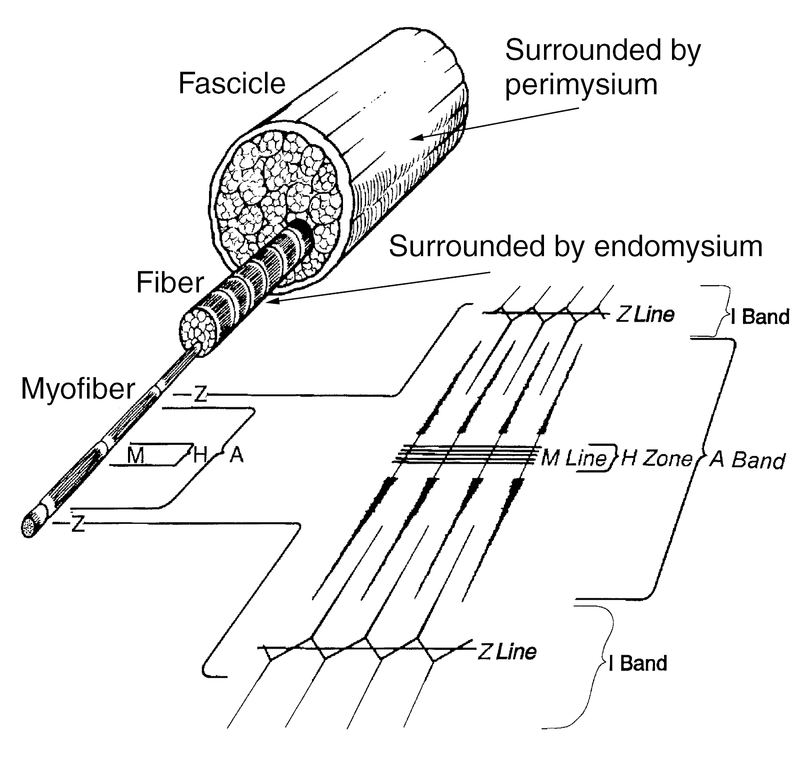
Figure 1 Schematic representation of the structural design of human muscle. The structure of the bands within a myofiber is shown in Figure 2.
(Reproduced from Garrett WE Jr, Best TM: Anatomy, physiology, and mechanics of the skeletal muscle, in Buckwalter JA, Einhorn TA, Simon SR (eds): Orthopaedic Basic Science: Biology and Biomechanics of the Musculoskeletal System, ed 2. Rosemont, IL, American Academy of Orthopaedic Surgeons, 2000, pp 683-716.)
Each of these fibers is essentially one large multinucleated cell created from the fusion of many other cells. An individual muscle fiber typically spans part of the muscle, though it may run its entire length.
A framework of connective tissue supports muscle. Each fiber is surrounded by an endomysium. Groups of fibers are surrounded by a perimysium, resulting in fascicles that are often large enough to be visible to the naked eye. The entire muscle is enveloped by an epimysium. This architectural arrangement supports integrated motion among the fibers.
Tendons allow the force generated by the muscle to be transferred into motion by connecting the skeletal muscle to the bony skeleton.
Physiologic Function
Mechanics
Muscle contractions can be described as isotonic, isometric, or isokinetic. Isotonic contraction occurs, for example, when a biceps curl is performed with a free weight. The tension in the muscle is constant, but its length changes throughout the range of motion. The magnitude of isotonic contraction is a measure of dynamic strength. Isometric contraction occurs when a person pushes against a wall with his or her arms. Tension is generated, but muscle length remains unchanged. The magnitude of isometric contraction is a measure of static strength. Finally, isokinetic contraction signifies muscle tension generated by muscle contraction at a constant velocity over a full range of motion. The magnitude of isokinetic contraction is also a measure of dynamic strength. Muscle contraction can also be described as concentric or eccentric. Concentric contraction occurs when the muscle is shortened as it contracts. Eccentric contraction occurs when tension is generated even though the muscle is elongated; the muscle power is used to decelerate the joint. Injuries occur more commonly with eccentric contractions.
Contraction of a muscle occurs as a result of the coordinated shortening of its component myofibers. For the contraction to occur, a highly organized intracellular apparatus consisting of long, slender myofibrilsmust function properly. Myofibrils are composed of repeating units called sarcomeres, which are the fundamental components of the contractile apparatus. Sarcomeres are made up of thick (myosin) and thin (actin) filaments in an intricate arrangement of bands and lines that allows these structures to slide past each other (Fig. 2).
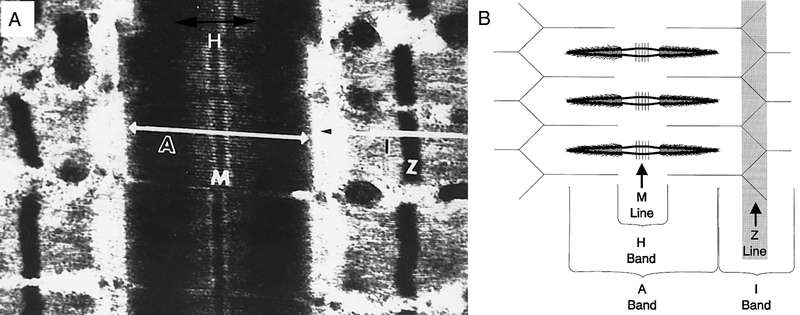
Figure 2A, Electron micrograph of skeletal muscle illustrating the striated, banded appearance. A = A-band, M = M-line, H = H-band, I = I-band, and Z = Z-line. B, The basic functional unit of skeletal muscle, the sarcomere.
(Reproduced from Garrett WE Jr, Best TM: Anatomy, physiology, and mechanics of the skeletal muscle, in Buckwalter JA, Einhorn TA, Simon SR (eds): Orthopaedic Basic Science: Biology and Biomechanics of the Musculoskeletal System, ed 2. Rosemont, IL, American Academy of Orthopaedic Surgeons, 2000, pp 683-716.)
Activation of the muscle fiber causes the myosin heads (globular regions of the myosin molecules) to bind to actin. This results in a change in the shape of the proteins, drawing the thin filament a short distance (approximately 10 nm) past the thick filament. Then the linkages between actin and myosin break and reform (requiring adenosine triphosphate [ATP], pulling the filaments past each other with a ratchet-like action.
Muscle contraction is stimulated by the motor nerve endings. A motor neuron in the spinal cord generates an electrical impulse, or action potential, that travels down its axon. The nerve enters the muscle and contacts an individual myofiber. This specialized communication point is called the motor end plate, or neuromuscular junction (Fig. 3).
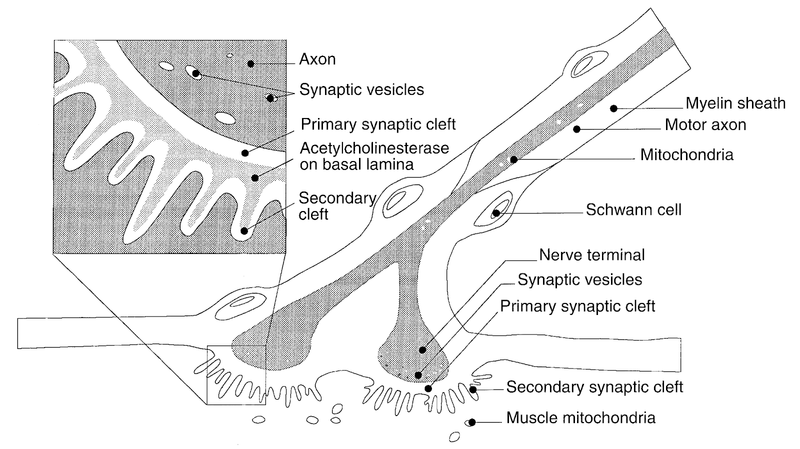
Figure 3 Schematic representation of the motor end plate.
(Reproduced from Garrett WE Jr, Best TM: Anatomy, physiology, and mechanics of the skeletal muscle, in Buckwalter JA, Einhorn TA, Simon SR (eds): Orthopaedic Basic Science: Biology and Biomechanics of the Musculoskeletal System, ed 2. Rosemont, IL, American Academy of Orthopaedic Surgeons, 2000, pp 683-716.)
Here, the nerve forms a synapse with the muscle, a specialized site at which an electrical signal is transmitted chemically across a cleft to produce a similar electrical impulse on the other side of the gap.1 The presence of such gaps allows for the pharmacologic modification of what is essentially an electrical process.
As the axon approaches the muscle at the synapse, it loses its myelin sheath, and the entire terminal axon is covered by a Schwann cell, a specialized support cell that encases nerve fibers. The nerve terminal covers a region of the muscle where the membrane systems of the nerve and the muscle weave to maximize the area of contact between them. These folds are called synaptic folds, and the space between them, called the synaptic cleft, is 50 nm across.
The chemical mediator involved in neuromuscular synaptic transmission is acetylcholine, which is stored in the presynaptic axon in membrane-bound sacs called synaptic vesicles. The electrical impulse (action potential) produces an influx of extracellular calcium into the presynaptic terminal, which leads to fusion of the vesicle with the adjacent membrane and then the release of acetylcholine. The acetylcholine diffuses across the synaptic cleft and then binds to postsynaptic acetylcholine receptors, changing the membrane potential and generating an action potential in the muscle. Acetylcholine is deactivated by the enzyme acetylcholinesterase, which is also located in the synaptic cleft. The action potential reaches the interior of the muscle fiber through a membrane system that includes transverse tubules, directed perpendicularly to the axis of the fiber, and cisternae of the sarcoplasmic reticulum (SR), directed parallel to the axis of the fiber (Fig. 4).
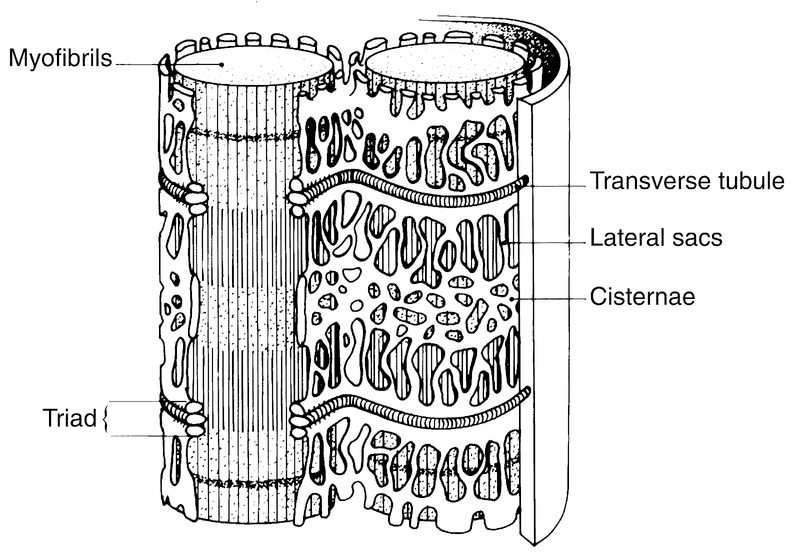
Figure 4 Schematic representation of the sarcoplasmic reticulum.
(Reproduced from Garrett WE Jr, Best TM: Anatomy, physiology, and mechanics of the skeletal muscle, in Buckwalter JA, Einhorn TA, Simon SR (eds): Orthopaedic Basic Science: Biology and Biomechanics of the Musculoskeletal System, ed 2. Rosemont, IL, American Academy of Orthopaedic Surgeons, 2000, pp 683-716.)
The SR is the system of membranes responsible for transmission of the electrical signal from one muscle cell to the next. An action potential moving over the surface of the fiber passes down the transverse tubules and causes Ca+2 release from the outer vesicles of the SR.
Each muscle fiber is contacted by a single nerve terminal. Collectively, a single motor axon and all the myofibers it contacts constitute a motor unit. The number of muscle fibers within a motor unit and the number of motor units within a given muscle vary considerably. The number of myofibers within a motor unit determines the precision with which the muscle can be used. A muscle under fine motor control may contain only 10 fibers per unit, whereas muscle under gross motor control may contain more than 1,000 fibers.2,3
The types of fibers within motor units also differ, providing an additional level of physiologic flexibility. At least three types of fibers have been identified in human muscle and are classified according to the different isoforms of myosin adenosinetriphosphatase (ATPase) they contain (Table 1).
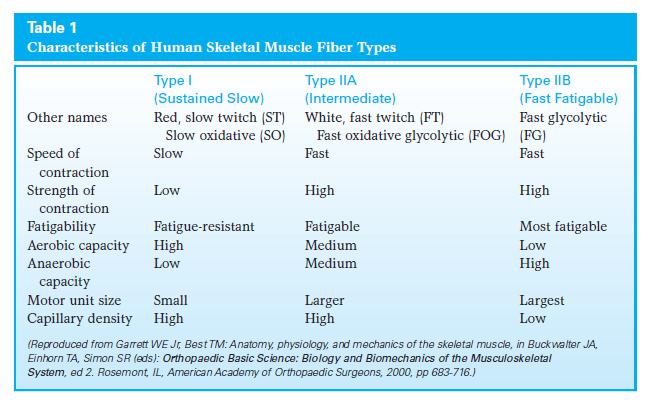
ATPase hydrolyzes ATP during muscle contraction, as myosin and actin slide over one another. The various types of ATPase work at different speeds, and thus the type of ATPase correlates closely with the intrinsic speed of muscle shortening. Essentially, these may be described as sustained slow fibers (type I), intermediate fibers (type IIA), and fast fatigable fibers (type IIB).4 Slow fibers use aerobic metabolism and thus depend on adequate perfusion and oxygenation.
Proprioception
Proprioception is the ability of the body to sense its position in space. Muscles contribute to proprioception. Sensory nerve endings include those on muscle spindles, which are sensitive to length, and in the Golgi tendon organs, which are sensitive to tension. There is also a variety of free endings in the muscle, some of which are involved in sensations of pain. These nerve endings transmit information to the central nervous system, including the motor neurons that innervate the muscle. Through reflexes and higher order processing, postural adjustments are made and the body “senses” the positions of the limbs in space.
Normal Histology and Composition
Each muscle fiber contains multiple nuclei that lie immediately beneath the sarcolemma, which is its plasma membrane. A small proportion of the nuclei at the periphery of the myofiber are stem cells, also called satellite cells, which can repopulate damaged fibers after injury.5
The cytoplasm, called sarcoplasm, is similar to that of other cells. It contains a cellular matrix, organelles, and a variety of other molecules. Among the organelles, the Golgi apparatus and mitochondria are abundant and lie close to the nuclei. The sarcoplasmic reticulum is a continuous branching network of membrane, which is a specialized form of endoplasmic reticulum that is unique to muscle. Glycogen, lipid droplets, and myoglobin are among other cytoplasmic components.
Other cell types within muscle include fibroblasts, endothelial and smooth muscle cells constituting blood vessels, and Schwann cells around the sheath of nerve axons.
The cells in tendons are called tenocytes. These cells are typical fibroblasts with long cytoplasmic extensions. The cell density of tendons is similar to that of ligaments but lower than that of other tissues such as bone marrow or liver, conferring mechanical strength to these structures.
External to the sarcolemma is a basement membrane that merges with the extracellular matrix (ECM) to form the endomysium. The basement membrane is rich in protein and carbohydrate components, including collagen, laminin, fibronectin, and a variety of glycoproteins.
The ECM of tendons is composed of dense, parallel bundles of collagen fibers. These bundles are oriented along the line of tension between muscle and bone insertion for maximal transmission of load, and they have less crimp than the collagen bundles in ligaments. The collagen is almost 95% type I, with the remainder primarily type III collagen and proteoglycans. Tendons generally attach to bone via a specialized direct insertion site that has four zones: tendon, fibrocartilage, mineralized fibrocartilage, and bone. Sharpey’s fibers are collagen bundles that extend from the tendon or periosteum into the bone.
Blood vessels run parallel to the axis of myofiber in the connective tissue, often with several capillaries around each myofiber. They are arranged with enough redundancy to permit changes in length during the contraction-extension cycle of a muscle.
Development and Aging
Skeletal muscle cells develop from a mesodermal cell population called myoblasts. These spindle-shaped cells divide and fuse to form long, multinucleated tubes, called myotubes, that differentiate into muscle fibers. During this period, many contractile proteins appear, some of which exist in embryonic isoforms. By the seventh week of gestation, distinct muscle and tendinous structures can be identified. Further steps in muscle differentiation include the production of structural and metabolic proteins, organization of the ECM, and innervation.
Classic developmental studies demonstrate that the formation of neuromuscular junctions is a mutually inductive event; neurons induce postsynaptic differentiation in myofibers, and myofibers induce presynaptic differentiation in motor axon terminals. More recent experiments indicate that Schwann cells, which also surround axon terminals, play an active role in the formation and maintenance of the neuromuscular junction.
In childhood, both muscle fibers and tendons increase in length. The region of the myotendinous junction appears to be the site at which these fibers lengthen, rather than near the muscle belly.6 Sarcomeres remain constant in size; additional units are added to the fiber during growth. In adulthood, the primary mechanism by which the musculotendinous unit lengthens is elongation of the muscle belly.
During aging, there is loss of muscle mass and strength, termed sarcopenia. It is perhaps, unfortunately, a universal process. The mechanisms are complex, with both myogenic and neural components.7 It appears that regeneration of muscle fibers in older individuals proceeds more slowly, a result of biochemical, hormonal, and cytokine-related changes. Aging may also express its effects via the relative loss of testosterone, which occurs with advancing age. Testosterone increases protein synthesis in muscle and decreases its breakdown.
Pathophysiology
Muscular Dystrophy
Muscular dystrophies (also called myopathies) are noninflammatory inherited disorders of progressive muscle weakness. There are several types, distinguished by their inheritance patterns. Duchenne’s muscular dystrophy is an X-linked recessive disorder of young boys that is characterized by clumsy walking, decreasing motor skills, lumbar lordosis, and muscle weakness. The hip extensors are usually affected first. Muscle biopsy demonstrates foci of necrosis and connective tissue infiltration, with absence of the dystrophin protein and elevated creatine phosphokinase (CPK) on DNA testing. These individuals typically lose independent ambulation by age 10 and become wheelchair dependent by age 15 years. They usually die of cardiorespiratory complications before age 20 years. Becker’s muscular dystrophy has a similar but less severe pathophysiology. Affected individuals also have an abnormal absence of dystrophin and histologic evidence of necrosis with connective tissue infiltration. However, they can often live beyond age 20 years without respiratory support. Other rare types of muscular dystrophy are seen in older individuals. Facioscapulohumeral muscular dystrophy is an autosomal dominant disorder seen in individuals between 6 and 20 years of age. They have facial muscle abnormalities, normal CPK, and winging of the scapula. Limb-girdle muscular dystrophy is an autosomal recessive disorder diagnosed in individuals between 10 and 30 years of age and is characterized by pelvic or shoulder girdle involvement and elevated CPK.
Muscle Injuries
Muscle injury can occur by a variety of mechanisms ranging from ischemia to direct injury by crush, laceration, or excessive force. Injured muscle undergoes processes of degeneration and regeneration.8 When muscle fibers are damaged, an inflammatory process ensues, followed by removal of debris by macrophages.9 New fibers appear within the connective tissue framework and are believed to be generated from a population of satellite cells that exist in a quiescent state within the original muscle syncytium. Synchronous processes that affect the functional recovery of muscle are connective tissue formation (fibrosis) and revascularization. Fibrosis can be extensive enough to interfere with muscle regeneration, preventing fibers from shortening or lengthening fully.
Forms of muscle injury include lacerations, contusions, and strains. Lacerations typically result from direct trauma from a sharp object. Recovery of function requires reorganization of devitalized tissue, muscle regeneration across the injury site, and reinnervation of denervated myofibers; it is usually partial rather than total.
Contusions usually result from blunt injury, occurring frequently in motor vehicle accidents and sports injuries. A contusion leads to an inflammatory process and hematoma, with subsequent muscle regeneration and scar formation. Severe blunt injury to muscle may result in heterotopic bone formation (synthesis of bone where it is not normally present) within the muscle, referred to as myositis ossificans.10
Muscle strains are indirect injuries caused by excessive tension on a muscle rather than by direct trauma. A strain may result in either a complete or an incomplete muscle tear. The muscle fibers can avulse from the tendon at the myotendinous junction. However, failure usually occurs in the muscle fiber within several millimeters of the junction. The terminal sarcomeres near the myotendinous junction are stiffer than the middle sarcomeres of a muscle fiber. The injury to muscle occurs within this region of relative stiffness.11 Among the most frequently injured muscles are the hamstrings, the rectus femoris, and the gastrocnemius; these muscles cross at least two joints and as such may be subject to more stretch. In addition, the architecture in these muscles demonstrates an extensive length of the myotendinous junction.
Tendon Injuries
Tendon injuries can result from a sudden tensile force or laceration. Injuries that result in large gaps in the tendon, such as occurs after laceration of the finger flexor tendons, require surgical repair and suturing to hold the ends together during healing. Tendons respond to injury in a way that is similar to that of skin and other connective tissues. An initial phase of inflammation is followed by a reparative phase in which surrounding cells enter the site and produce a collagen scar, after which remodeling occurs over time. Controversy still exists as to whether the invading cells come from within the tendon (intrinsic cells) or from the surrounding tissues (extrinsic cells). The strength of the healing tendon is significantly lower than the uninjured tendon in the initial phase of healing, and strength does not increase until 3 weeks after injury. With improved techniques of tendon suture repair, early motion is now possible after tendon lacerations. This movement is thought to improve the functional outcome by minimizing adhesion formation.
Research and New Directions
Repair of Skeletal Muscle
While there is some understanding of how skeletal muscle regenerates, it is incomplete. Topics under investigation include the molecular and cellular biology of satellite cells and the roles of blood vessel formation and innervation. This information provides a basis for developing strategies to augment muscle regeneration.12
Activity and Functional Recovery of Muscle
The influences of activity on functional recovery of muscle after injury are only beginning to be identified. These include the effects of immobilization and passive and active stimulation of myofibers. These insights are relevant to age-associated changes in skeletal muscle as well as the changes seen in muscle during space flight.
Gene Therapy and Tissue Engineering
The ability to retrieve and genetically alter stem cells (satellite cells) in individuals of all ages makes muscle an ideal tissue for both gene therapy and tissue engineering. A number of investigations have already focused on the possibility of using dystrophin-expressing stem cells to restore muscle function in individuals with muscular dystrophy. Tissue engineering research has focused on the use of satellite cells in both myocardial and striated muscle reanimation and the development of three-dimensional engineered replacement muscle tissues.
Key Terms
Acetylcholine A key chemical mediator involved in neuromuscular synaptic transmission
Action potential An electrical impulse generated by neurons
Concentric contraction The shortening of a muscle during activation
Dynamic strength The magnitude of isotonic or isokinetic contraction
Eccentric contraction The lengthening of a muscle during activation
Endomysium The connective tissue surrounding a muscle cell
Epimysium The connective tissue surrounding the entire muscle
Isokinetic Literally “same speed”; when applied to muscle action, it implies constant velocity of shortening
Isometric Literally “same length”;when applied to muscle action, it implies that the muscle length is held constant
Isotonic When applied to muscle action, it implies that the load is constant
Motor end plate (neuromuscular junction) The synapse between a motor neuron and a muscle fiber
Motor unit The motor nerve axon and the myofibers with which it contacts
Musculotendinous junction The area of interface between a skeletal muscle and its tendon
Myoblasts The embryonic cells that develop into skeletal muscle cells
Myofibers The fibers that constitute a muscle
Perimysium The connective tissue surrounding a fascicle
Sarcolemma Muscle-cell membrane and its associated basement membrane
Sarcomeres The fundamental components of the contracting unit of the myofibril
Sarcopenia The loss of muscle mass and strength as a result of aging
Sarcoplasmic reticulum A continuous branching network of membrane, which is a specialized form of endoplasmic reticulum unique to muscle
Schwann cell A specialized support cell that encases nerve fibers
Static strength The magnitude of isometric contraction
Stem cells Cells with the unlimited ability of self-renewal and regeneration; serve to regenerate tissue
Synapse A specialized site at which an electrical signal is transmitted chemically across a junction to produce a similar electrical impulse on the opposite side
Tenocytes The cells in tendons
References
1. Huxley AF: Muscular contraction. J Physiol 1974;243:1-43.
2. Burke RE: Motor unit properties and selective involvement in movement. Exerc Sport Sci Rev 1975;3:31-81.
3. Buchthal F, Schmalbruch H: Motor unit of mammalian muscle. Physiol Rev 1980;60:90-142.
4. Close RI: Dynamic properties of mammalian skeletal muscles. Physiol Rev 1972;52:129-197.
5. Garrett WE Jr., Seaber AV, Boswick J, et al: Recovery of skeletal muscle after laceration and repair. J Hand Surg Am 1984;9:683-692.
6. Griffin GE, Williams PE, Goldspink G: Region of longitudinal growth in striated muscle fibres. Nat New Biol 1971;232:28-29.
7. Roubenoff R: Origins and clinical relevance of sarcopenia. Can J Appl Physiol 2001;26:78-89.
8. Nikolaou PK, Macdonald BL, Glisson RR, et al: Biomechanical and histological evaluation of muscle after controlled strain injury. Am J Sports Med 1987;15:9-14.
9. Tidball JG: Inflammatory cell response to acute muscle injury. Med Sci Sports Exerc 1995;27:1022-1032.
10. King JB: Post-traumatic ectopic calcification in the muscles of athletes: A review.Br J Sports Med 1998;32:287-290.
11. Tidball JG: Myotendinous junction: Morphological changes and mechanical failure associated with muscle cell atrophy. Exp Mol Pathol 1984;40:1-12.
12. Marler JJ: Skeletal muscle, in Atala A, Lanza RP (eds): Methods of Tissue Engineering. San Diego, CA, Academic Press, 2001.
